Inlaying Marble in a Bubinga Top

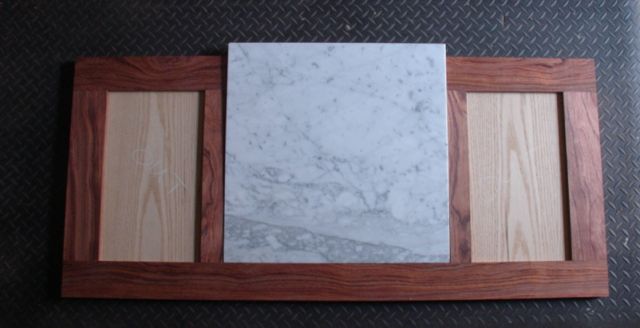
It has been an involved process getting to this point but here’s the first look at the Italian Marble placed into the top:

First Look at Marble and Top

First Look at Marble and Top

The over-all measurement of the top is 20″ wide by 44″ long.  The piece of marble is an 18″ square piece of Bianco Gioia Marble.  The two pieces that currently have some Oak plywood in them is where the marble will be inlaid.  These are approximately 8″ x 14″.  The center section is where the mechanical cellarette will be housed.  Since it measures approximately 12″ x 18″ there will be a 2″ wide inlaid section of marble at the front  as well.  The marble was purchased from Emser Tile here in Las Vegas at the recommendation of my tile guy.  I was pleasantly surprised at the service I got from them, sometimes buying small quantities of material doesn’t bode will with retailers/wholesalers.  He also suggested having a 1/2″ base for the marble due to their weight.  That was the next problem that needed solving.

These pieces of 8/4 Bubinga have been particularly difficult to work.  As I mentioned earlier, when a piece of lumber has beautiful and showy grain patterns, it usually means it’s going to be a tough one to work — oh so true for these! You may recall the reluctance it had to being planed smoothly and the joinery has been “hard fought”.  The top measures 1 1/8″ in thickness so applying the rule of thumb, the tenons are 3/8; one third the thickness of the piece.  A combination of machine work with a hollow chisel mortiser and a tenon jig on the tablesaw followed by hand work gave me an acceptable fit.

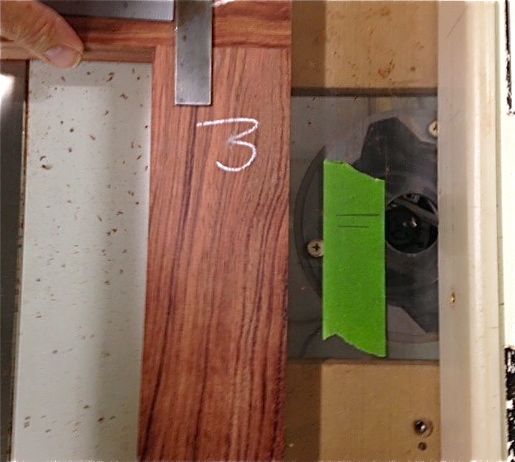
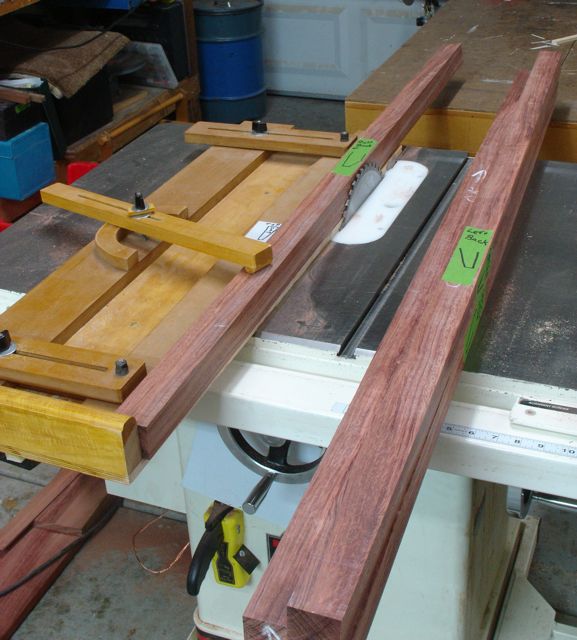
Router table to cut groove

Router table to cut groove

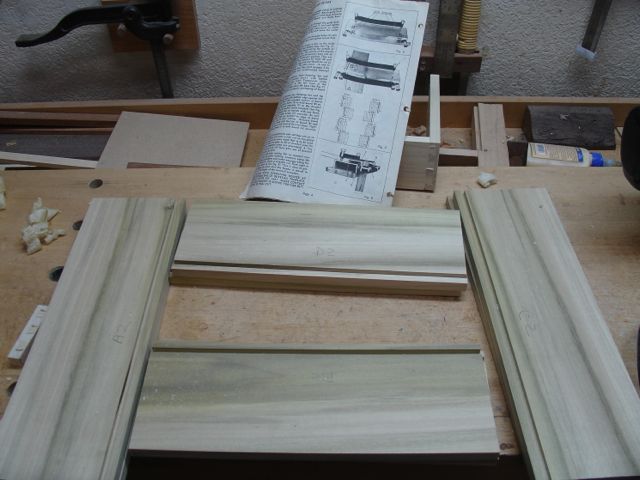
The next step to creating the top was to cut a groove that would house and support the plywood.  The tricky thing here was keeping all of the pieces organized and make sure the proper face of each board was held against the fence.  Let me explain what you’re looking at, the marks on the green tape indicate the beginning and starting point of the router bit.  The groove doesn’t run the full length of the pieces so they will have to be dropped down and picked up from the cutter depending on the location.  Since the groove depth is 3/8″  the edge of the board needs marking to tell me where to start and stop each cut.  Due to the hardness of this wood the cut had to be made in two passes.  The face of the board needs to go against the fence so the backside was marked with chalk — every time I picked up a board my mantra was: “see the chalk before you cut” and it worked!

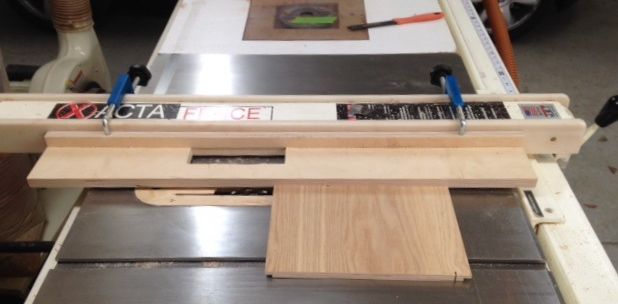
L-Fence on Tablesaw

L-Fence on Tablesaw

Now that the grooves were properly located it was time to size the plywood.  I had some quality, 1/2″ Oak ply in stock so that was the obvious choice, it’s a 7 ply material so plenty strong.  After cutting them oversize to allow for the groove depth, they were rabbeted to slip into it.  That was achieved using an L-shaped fence and a dado head in the tablesaw.  Now it’s finally time to dry fit and glue this piece up!

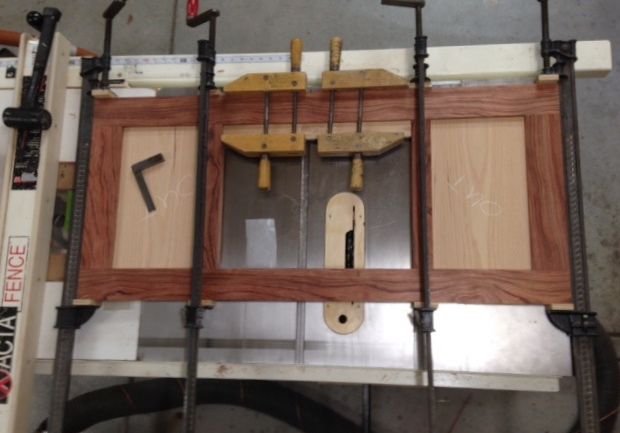
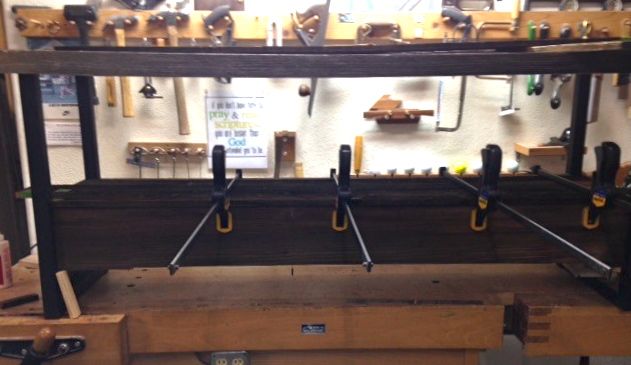
Glue ups are always stressful and this one was no exception.  The flattest surface I have in the shop is the tablesaw so that became my assembly table.  A combination of Gorilla glue and cabinetmakers glue from Lee Valley was used for this process.  Because of the oily nature of Bubinga the Gorilla glue was used for the mortise and tenon joints while the cabinetmakers glue secures the plywood.

Glued up and curing

Glued up and curing

Just a side note on the glue from Lee Valley.  I ordered a bottle to replenish my supply recently and when I opened it the consistency coming out was more like a tootsie roll than glue!  I sent a picture to their customer service and they replaced the bottle for me, no questions asked.  We were trying to figure out what could have happened to the glue and they suspect that it must have frozen and thawed several times in its journey from eastern Canada to here which ruined it!  Moral of that story is to only order it during warmer temperatures!

Posted in Mechanical Cellarette, Mortise and Tenon Joint | Tagged , , , , , | 1 Comment

Fitting Lee Valley Brass Leg Tip #01A4535

Tablesaw Taper Jig

Tablesaw Taper Jig

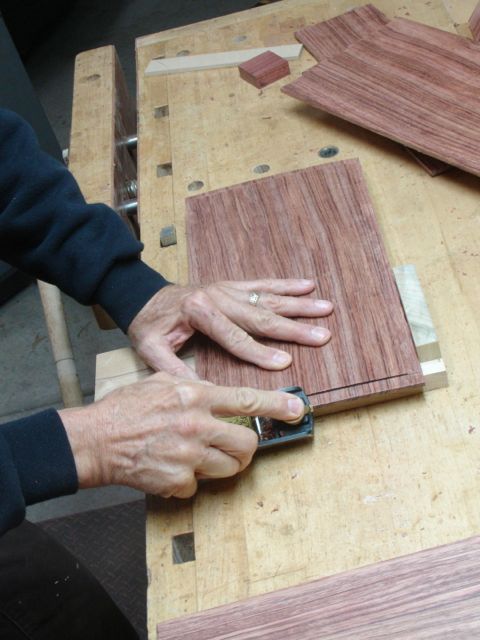
The wood used for the Mechanical Cellarette is Bubinga which I’m learning is a pretty challenging material to work with.  The legs are approximately 1 3/4″ square and the initial plan was to taper the insides of them with the bandsaw then plane smooth.  On my sample piece, planing that band sawn surface to an acceptable finish proved to be rather difficult due to the inter-locked grain.  Even a freshly sharpened Jack Plane with a very tight mouth couldn’t achieve the finish I was after;  time for Plan B which was to use the tablesaw and a tapering jig.  This left a much smoother finish, one that I was able to smooth by taking the thinnest shavings possible with a smooth plane.  Once they surfaces were acceptable, I used the traditional marking system to identify which leg goes where.  I also use machinists letter stamps for a backup.  The grain pattern of Bubinga is quite vivid so I chose the best faces for the show surface.

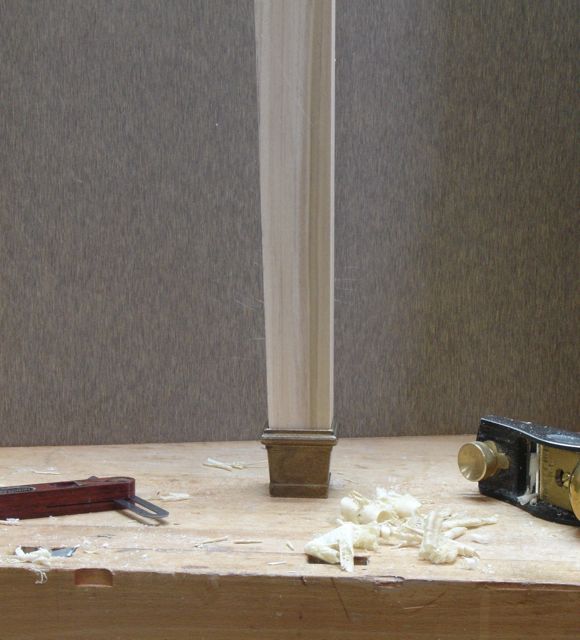
Now that the legs have the taper complete the next step was to fit them for the brass leg tips from Lee Valley.  These will add a traditional look to the piece.  My client liked the appearance of them in the plans so they were chosen for the project.  These are an old brass finish and the only instructions given is that they attach with a single brad into a friction fit.  That’s the extent of the information given so it’s up to the craftsman (me in this case) to figure out the process.  They measure 1 5/8″ tall and the width at the top is 1 3/8″.  When I laid out the taper it was done so that the leg would measure 1 3/8″ square at 1 5/8″ from the bottom.  That was step one.

Determining Tip Angle

Determining Tip Angle

Now I needed to determine the degree of angle inside of the tips.  I first tried to hold the sliding bevel square inside the cap and set the angle from there — not acceptable!  I’m currently teaching a hand dovetail class so chose to use this system to set the bevel, it’s the same way you’d set one for laying out the tails.  It begins with a vertical line drawn up 1 5/8″ which is the length of the tip.  The difference between the top and bottom of the tip is 1/4″ (1 5/8 vs. 1 3/8) so I marked 1/8″ to the side of that vertical line.  Now the bevel is set by lining it up at the bottom of the line and the mark 1/8″ to the side.  You can be sure I made a practice piece on some Poplar to make sure this worked before I began work on the actual legs.  You may notice a couple of aids I used to accomplish this in the slide show.  First of all, I absolutely love my Black Diamond ReVolt headlamp I got from REI with gift certificates for my recent birthday!  I can see the lines not only for hand cutting joinery but also on the bandsaw.  Another aid I used was to put green painters tape on the boards and pencil the cuts on it.  The wood is pretty dark and I find that green tape shows pencil lines better than the traditional blue painters tape.  Last of all, to keep the small cut off pieces from being sucked into the dust collector I added a temporary  zero clearance fence to the bandsaw.
This slideshow requires JavaScript.

Now that the legs are complete the next step is to make the top.  I’m building the casework after the top is sized to make sure of the dimensions.  I picked up two pieces of Italian Marble that measure 18″ square that will be inlaid into the top after it’s completely finished and installed.

Posted in Mechanical Cellarette, Uncategorized | Tagged , , , , , , , , , | 1 Comment

Work Begins on Latest Commission

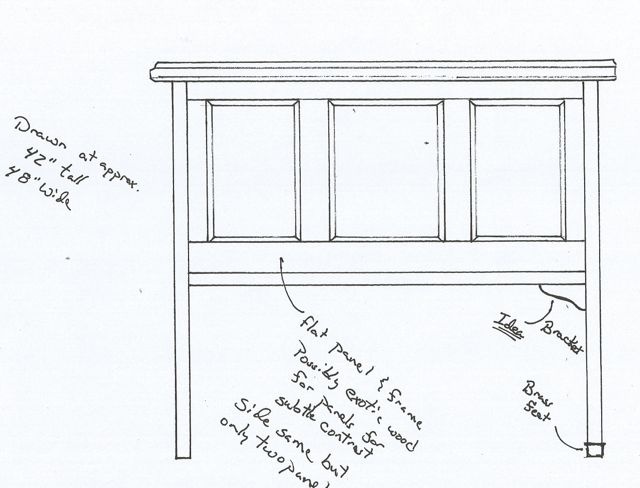
Mechanical Cellarette-WoodworksbyJohn-OriginalDesignTowards the end of last year I was contacted about making a Mechanical Cellarette.  Now, this was something I’d never heard of before and my research turned up very little information.  Essentially, it is a cabinet used to store liquor and there are some references to it on auction sites.  I met with the client, he showed me the intended location and shared his vision of what he had in mind.  I submitted this basic plan to him which he approved and the work began.  It’s taken a while to get all of the parts and pieces together but the timing worked perfectly as I just completed Nick’s Media Stand when the mechanical part of this project was delivered.

The project will be in my clients office which is a brand new space.  Fantastic finishes on the walls and the flooring is Brazilian Rosewood.  Images I had found of the Mechanical Cellarette were mostly in the Victorian style with lots of carvings and applied moldings and my design and style is more Shaker inspired.  I prefer letting the wood itself be the star of the show.  To that end, he suggested using Bubinga which is a beautiful wood from the western jungles of Africa.  This will be teamed up with a top of inlaid Italian Marble.  I knew going into this project that Bubinga is a difficult wood to work with, extremely dense and heavy but that’s the correlation: beautiful wood = challenging work!
Brass Leg Cup on Poplar

Brass Leg Cup on Poplar

The first parts to arrive were these brass leg cups from Lee Valley.  We decided they would add a nice style element to the cabinet.  This was the first of many challenges to come for this project.  The legs will be approximately 1 3/4″ square and taper towards the inside bottom. The leg cups also taper from 1 3/8″ at the top to 1 1/8″ (inside dimensions) at the bottom.  This requires a combination of machine and hand tool work to get the fit just right.  A trial piece was done on Poplar and I took notes so to be able to do the same thing on the Bubinga.  I know that it won’t cut as easily as the Poplar will but at least now I have the process down.

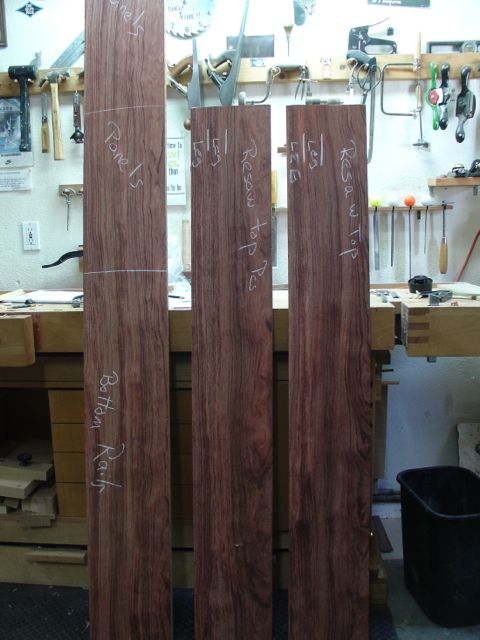
8/4 Bubinga ready to cut

8/4 Bubinga ready to cut

I ordered the 8/4 Bubinga from Woodworkers Source in Arizona.  You’re looking at just under $500.00 worth of material which is enough for the top and framework for the Cellarette.  Rod Stewart’s classic “The First Cut is the Deepest” always plays in my head as I begin to cut apart the materials.  I substitute hardest for deepest because you just can’t afford to make a mistake here! Careful planning is called for when using expensive woods, especially since the supply is limited and hard to obtain.  I’ll be purchasing the 4/4 Bubinga from Peterman Lumber here locally — they don’t stock 8/4.  Once things were laid out it was time to begin the actual cutting.

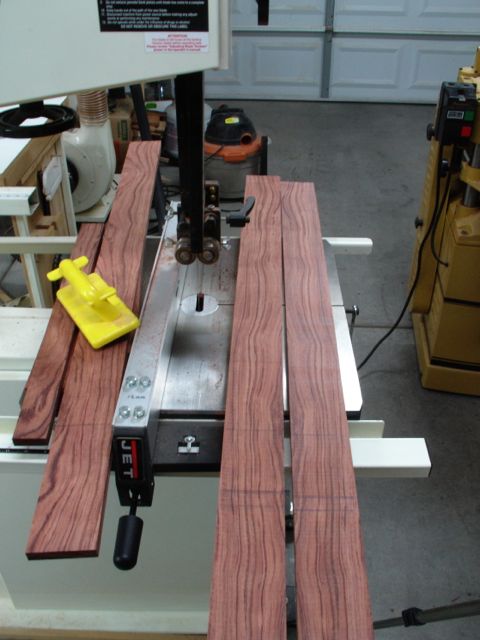
Re-sawing top material

Re-sawing top material


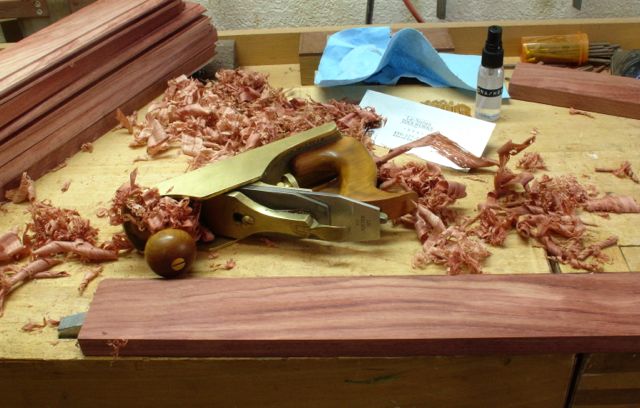
Even after carefully honing the blade on my old Stanley #7 jointer plane it had a difficult time with this interlocked grain of this wood.  By taking the thinnest of cuts with the tightest mouth possible the jack plane gave me an acceptable surface.  I can tell that there will be a lot of hand scraping to achieve the finish I want on this Bubinga!  I was pleasantly surprised to see that the resaw process went better than I feared.  The bandsaw is fitted with a Wood Slicer resaw blade from Highland Woodworking.  This is a time that proves buying the Powermatic planer with the upgrade, Byrd Shelix cutter was a good investment.  It was able to surface the resawn pieces and achieve a good finish.  As always, it will require a smooth plane and card scraper for the final surface preparation but that’s to be expected.

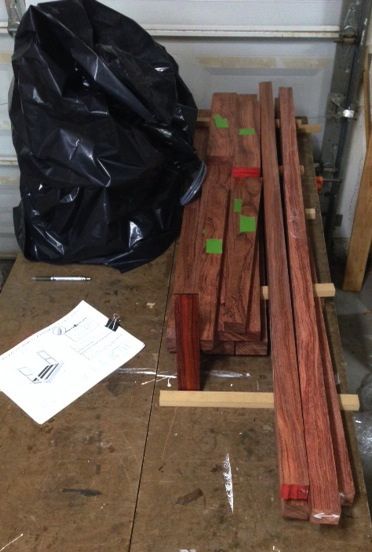
Days end result

Days end result

At the end of this work day I reduced the stack of 8/4 Bubinga to these pieces.   They will sit for a few days to stabilize before the joinery work begins.  The small piece at the lower left is a cut-off that I’ve applied the first coat of finish to.  This really brings out the richness and beauty of the wood.  I’ll take it with me to select the Italian marble for the top.  The mechanism for the unit is under the bag to keep it as dust free as possible in a shop environment.  I wanted to see how smoothly this unit from Auton worked so made this little video as a demonstration.  I’ve used television lifts before and they usually have a single lift mechanism located at the rear of the unit and can exhibit some instability as the raise and lower.  This unit features four gears on either side of a rack that the unit essentially “crawls up”, well worth the money as this unit seems to be of very high quality.  Here’s my video:

So there’s the first step of many to come on the creation of the Mechanical Cellarette.  Time to order the marble and pick up the remaining Bubinga here from Peterman.

Posted in Mechanical Cellarette | Tagged , , , , , , , , | Leave a comment

Nick’s Media Stand Delivered

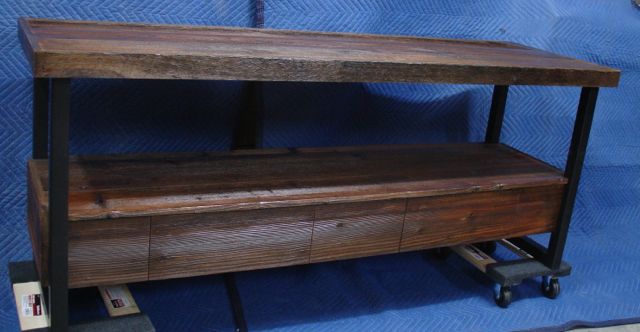
Yesterday a friend helped me to deliver this unit to the client — good deal for the delivery charges; a cup of Starbucks and a treat!  This is a picture of it in the house and, as you can see my client is still in the early stages of moving in.  The TV that will be on the unit is sitting behind it.

Nick's Media Stand in place

Nicks’ Media Stand in place

The unit went upstairs and luckily, they were wide and my friend was strong!  All of the pictures show a bit of distortion, sorry; it was difficult to get enough distance to eliminate that both in my shop and their house.  The pictures in my shop show it on dollies with furniture pads used for backdrops.

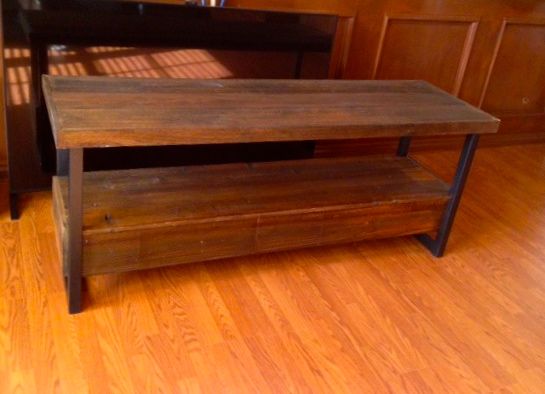
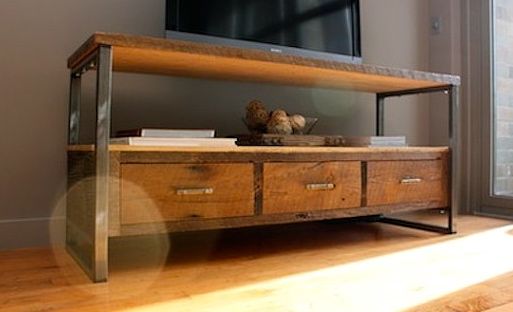
Inspiration Photo

Inspiration Photo

During our early planning stages for this unit I was given this image as an example of what they were looking for.  Over-all their piece measures 65″ long by 20″ wide and stands 26″ high.  As you can see, there is a resemblance between my work and the inspiration piece with some notable differences.  The material in mine is recycled  material that started life as dog-eared, 1″ x 8″ Redwood fence boards.  They came from somewhere in California and are probably about 50 years old!  I mentioned in one of the blogs that who knows,  I could have cut these as a teenager.   I worked for a Silvera Lumber in Antioch then and that was a job I would do at times!  In any case, the bottoms had quite a bit of the expected rot and the top, dog-eared sections were beat up as well.

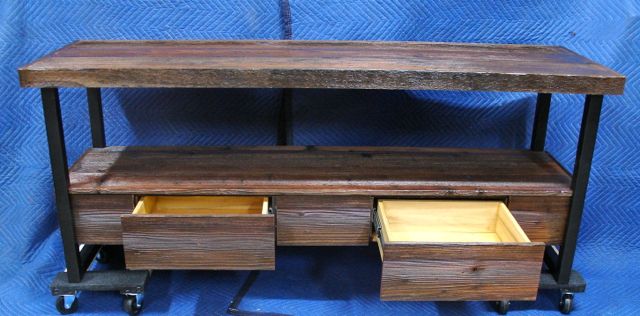
Drawer Unit

Drawer Unit

The first step to prepare them was to run one face through the planer to establish a fresh, smooth surface.  This was for the glue to adhere when they were attached with brads.  Due to the rough nature of the boards, those brads barely show at all.   The show side of these boards were wire brushed by hand to remove the accumulation of 50 years of dirt, grime, and who knows what else!

Drawer Detail

Drawer Detail

Being able to find a suitable board that would span the drawer was of importance to me.  After all, in fine furniture construction you select a single board for your drawer fronts for a continuos flow of the grain and even though this is constructed of recycled materials it had to be done right.  The drawer box and top are made of shop grade, Maple plywood.  The drawers are 1/2″ Poplar and feature full extension, ball bearing slides rated for 100 pounds.  The drawer pulls haven’t arrived yet but the mounting holes are drilled and ready.

The metal legs came from an Etsy store, Blue Ridge Metalworks.  The finish chosen for this project is multiple coats of General Finishes Enduro-Var which is a water based, Polyurethane.  This was sprayed on as brushing on the rough surface of the recycled boards wouldn’t have good results.  There’s talk of a companion unit to go into their living room — that’s would be a good indication that my client was pleased with my work!

Posted in Recycled Wood Furniture | Tagged , | 3 Comments

Hand Tool Class Session #3

This week marks the half way point in the class I’m teaching at WoodItIs here in Las Vegas.  WoodItIs is a wonderful school located in North Las Vegas and founded by Jamie Yocono.  She has expanded the physical size of the school and offers a full complement of classes through our local colleges and university. She also has a series of classes where students start with the basics and advance to becoming proficient furniture makers.  Besides the school, Jamie takes on a variety of custom woodworking projects.  Anyone wanting to learn the basics of woodwork and furniture construction can find a starting place at her school.  I’ve been fortunate enough to be invited as a guest instructor teaching the hand tool aspects of our craft.

HandToolClass-Wooditis-LasVegas-JohnEugster-2

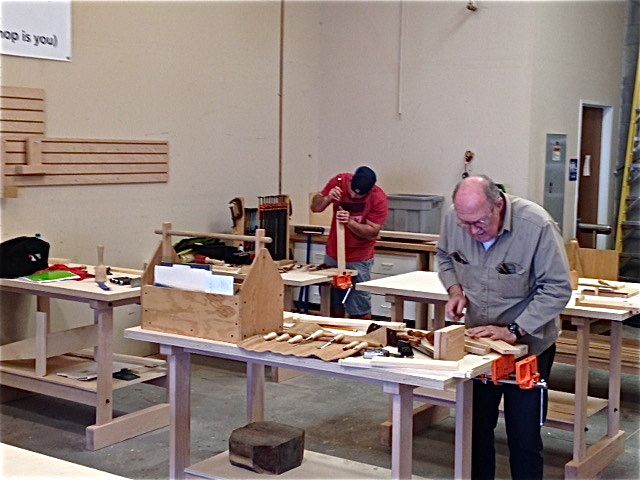
The class runs from 11:00 – 2:00 for six Saturdays.  We began with learning how to properly sharpen plane and chisel blades.  Not having a properly sharpened tool only causes a lot of frustration to anyone learning how to use hand tools.  Although not a requirement, students were encouraged to bring in their own tools to begin the learning process.  These first two weeks had lots of lecture/demonstration and I’m afraid I was too busy to take any photos!  We’re using a bench hook as the initial learning project.  Although this could simply be three pieces of wood, some screws, and glue I’ve developed this into what I call “Project Overkill”!  The main board for the bench hook is used to develop our hand plane skills.  Starting with a working edge (Jack plane), then a working end (block plane), and finally planing the board to width.  After that, the students cut a dovetail to secure the two pieces together and the hook part of it is housed in a hand cut dado.  I bring in my two, old Stanley router planes so they can experience that tool. One of the students has a new Lie-Nielsen version of the router plane!  You can see in the pictures above and below that they are hard at work on this project.  Time seems to just fly by when you’re engaged in the quietness of hand tool work.  We generally end up going past the two o’clock hour but that’s okay!

HandToolClass-Wooditis-LasVegas-JohnEugster-3

HandToolClass-Wooditis-LasVegas-JohnEugster-1


One student completed all three pieces at the end of the class today so first thing up for the next session will be an assembly demonstration.  The remaining 3 sessions are a time for them to put this work into practice on a project of their choice.  The class description suggested a box with lid.  I’ve been asking (bugging?) them to come up with the size and purpose for the box but for some reason haven’t had any responses.  My guess is that they are so intent on learning the skill, making a box hasn’t sunk in yet!

Tool Tote

Tool Tote

Today I brought in a tool tote that I had used in another class and the response from them tells me that it may be a winner.  The inspiration for this project came from Jim Tolpin’s book: The New Traditional Woodworker.  Those of you with sharp eyes may notice that the one pictured has dovetails on one end and pegged lap joint at the other — this was done as a learning exercise but for this class it’ll be dovetailed all around.  This seems like a logical choice for a project seeing how they will need a way to carry their tools anyway.  We’ll use Pine for this with a Baltic Birch plywood bottom.  Due to time and equipment restraints I’ll probably rough cut their materials for them.  Looking forward to seeing how they apply what they struggled to learn on the bench hook to this project.


Posted in Hand Cut Dovetails, Hand Tool Woodworking, Tool Sharpening | Tagged , , , , | Leave a comment

Nick’s Media Center Coming to Completion

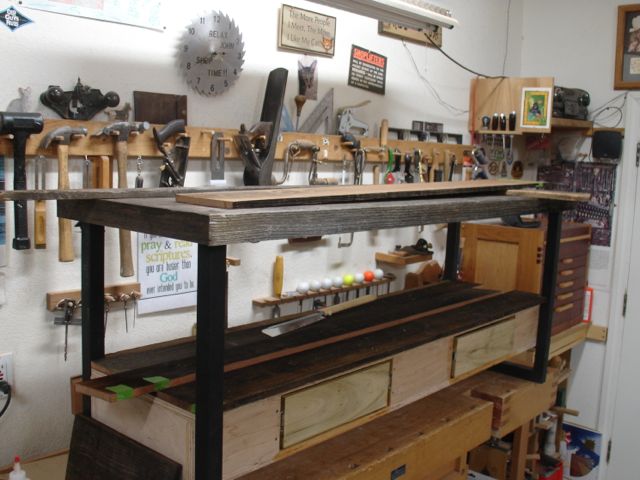
Making progress as you can see!

Making progress as you can see!

The past couple of days have been productive on this project.  Before my neighbor helped put it up on my workbench I had cut and sized the pieces of reclaimed fence boards used on the top and for the banding around it.  These have been planed on the underside to create a smooth glue surface.  Glues and #18 brads secure them to the plywood substrate.  I needed my neighbors help to slide the drawer unit between the legs to begin cutting the reclaimed material for that.  In the first blog about this project I explained the process of making the drawer unit.  The top was left off of it to make fitting the drawers easier.

These drawers are machine dovetailed, something my students are probably aghast over!

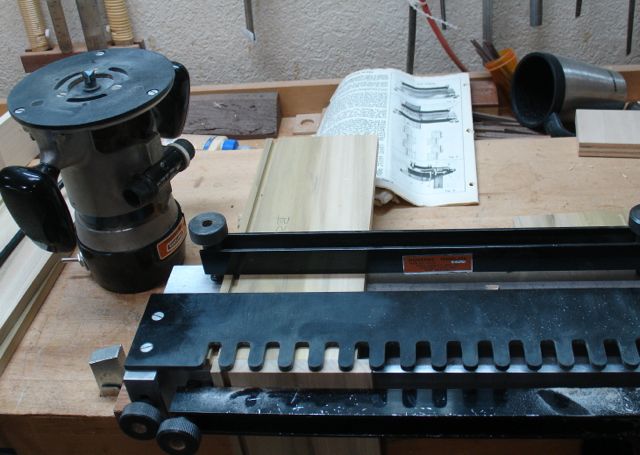
TVStand-ReclaimedWood-WoodworksbyJohn-DrawerFitting-3Not all work calls for hand cut dovetails but I will tell you that I don’t use this very often. Matter of fact, the jig I use I bought in the early 1970’s, it’s a Craftsman and old enough to be found on eBay, check out this LINK.  Same goes for the router, it’s also an oldie from Sears listed as a commercial grade with a 3/4″ h.p. motor.  When you think of all the choices you have these days for woodworking tools it’s hard to believe that Craftsman was one of the major players in those days.  I remember buying this router in 1972 or so.

How's that go?

How’s that go?

Now days I keep it set up with a dovetail bit and as you can see, have the original instructions that came with it.  Good thing too because I use it so seldom I couldn’t recall how to lay out the parts.  I begins with cutting your groove for the drawer bottom to keep from getting confused.  The pieces are placed in the jig “inside out” so labeling the parts as the directions say to do is essential.  Oldie but a goodie and still serviceable.  Pretty darn noisy though — ear protection required!

After they were glued up and dry, a coat of shellac was applied to them as well as the inside of the drawer space.  That will provide an odor free layer of protection for the drawer, I usually wax these as well.  When ever I use metal slides I use a full extension, ball bearing unit made by Dynoslide.  I get them from Woodworkers Emporium and they are rated for 100 pounds.  Here’s my process:

This slideshow requires JavaScript.

Once I was happy with the drawer action the top of the drawer unit was glued and screwed into place.  Now it’s time to begin attaching the reclaimed fence boards.  I decided to rip a clean, smooth edge on them to make a cleaner joint.  As I mentioned, these are glued and nailed to the Maple plywood substrate.  The banding was then mitered and applied around the top.

Notching bottom boards to fit around legs

Notching bottom boards to fit around legs

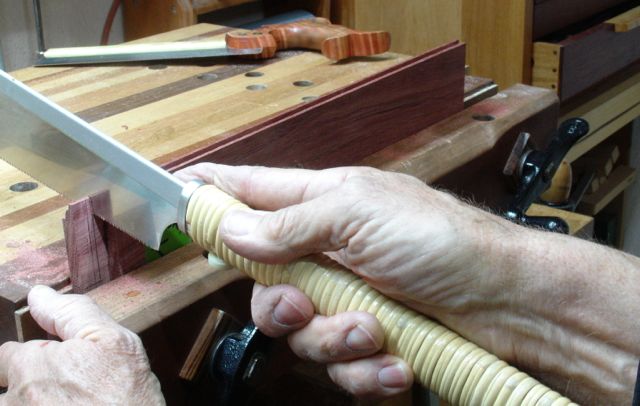
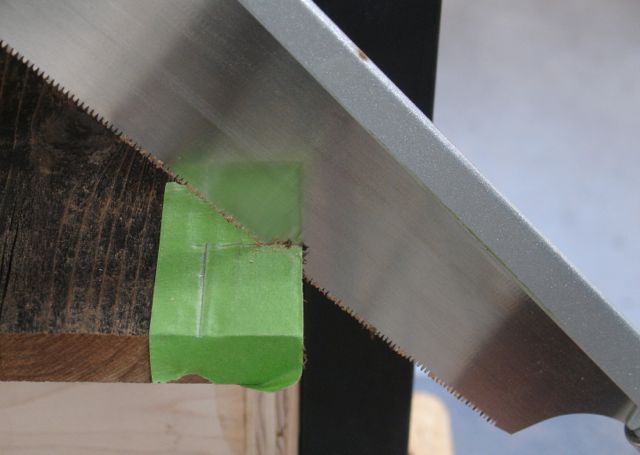
The drawer unit will need to have the boards nailed on after it is in place between the legs.  The plan is to pre-finish those boards and glue/nail them on once it’s screwed in position.  To cut the notches for the leg I used a Japanese style razor saw.  Markings don’t show on these boards so a piece of tape is put on so I can see what I’m supposed to cut.  I was able to select one board with some interesting grain pattern for the front of the drawer unit.  I know it’s a rustic piece but I still want that continous grain pattern flowing across the front from drawer to drawer.  It’s really hard to see in this picture, the first step of the finish procedure was using a wire brush to remove all of the dirt (and who knows what else!) from the board.  Next it will receive multiple coats of clear, satin varnish.

Drawer Unit

Drawer Unit

We just had a rain storm move in, not too good for shooting the finish tomorrow so there may be a slight delay.  Hope not because I received the Bubinga for the next project — a Mechanical Cellarette.

Posted in Recycled Wood Furniture | Tagged , , , | 2 Comments

All the Parts Have Arrived!

Finally, it’s time to begin work on the TV stand that it seems like I’ve been planning for a very long time!  When I accepted this commission there was a source for recycled fence boards here in Las Vegas.  I purchased a few of them, made a mock up, and then presented this to my client.  He approved the design and gave me the customary 50% down deposit.  However, when I went to pick up the required fence boards they were completely out!  They come from somewhere in California and it was several weeks before their supply was replenished.  Finally got them and they were different sizes and soaking wet.  After stacking them with stickers to dry out in the shop they are now workable.

Leg Bracket Error

Leg Bracket Error

The other hold up was getting the legs fabricated.  I sent my client some sources from Etsy and he picked out a style he liked from Blue Ridge Metalworks.  Since they were located in North Carolina I expected the shipping costs to be huge but was pleasantly surprised as they were considerably less expensive than the few local sources I contacted.  We did have a few problems with tracking numbers and forgetting to add a brace for the drawer unit but the owner, Jon, was quick to actually call me when asked.  He explained some growing pains due to expansion of the business and corrected the problems quickly.  Only slight concern I had was with a bracket being welded on that was proud of the leg by about 1/4″.  Luckily I was able to take away some of the wooden rim to make it fit as it should — much easier to chisel wood than it is to grind metal!

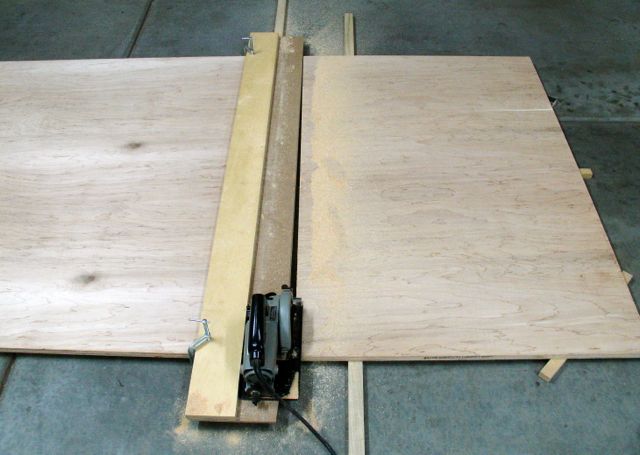
Finally, the actual construction of this piece can begin and started with creating one relatively smooth surface on the underside of the fence boards.  Since these are recycled I suppose you could call them old growth Redwood — just like the fence boards I used to cut working at Silvera Lumber in the 60’s!  Next up was sizing the plywood to fit the legs. Mass produced furniture uses MDF which is heavy, doesn’t hold screws very well, and also doesn’t have much structural strength to it. TelevisionStand-ReclaimedWood-WoodworksbyJohn-TrackSawI use domestic, 3/4″, shop grade Maple plywood.  To me the extra expense is justified by giving my clients a quality piece of furniture.  Breaking down those 4′ x 8′ sheets began with my old school track saw.  Although you can find many hi-tech versions on Amazon, this simple shop made guide combined with a Porter-Cable trim saw gets the job done.

Mock up and first visual

Mock up and first visual

The top of this piece is pretty straight forward as you can see in this first mock up of it.  It measures 20″ x 65″, there’s an edging glued/nailed to thicken and reinforce the edge.  Yes, any of my students reading this I used glue and a brad gun for this!  There will be two drawers in the unit below which I decided to make as a torsion box for stability and strength.  Since there is a span of five feet, this unit needs to be stable in order for the drawers to work properly.  Although I’m known for hand tool woodwork and joinery, when working with sheet goods glue and screws are in order.  I imagine this torsion box assembly could have been simply glued and nailed.  I’ve been accused of over-building but I’d rather have that reputation than one of cutting corners!

Since there are drawers here it’s critical that the assembly is square.  All holes were first pre-drilled and countersunk on the drill press.  These were then assembled into U-shaped pieces that will define the drawer spaces:

This slideshow requires JavaScript.

After these 3 assemblies dried it was time to attach them squarely to the bottom of the drawer unit.  This began by using the same setup on the drill press to pre-drill the holes.  They are glued/screwed on the outside edge only, the drawer sides are left loose to allow for any adjustments for squareness.  As you can see, all went according to plan.  Before attaching the top I’ll install the drawers and full extension slides, it’ll be much easier that way then working in a closed up area.  The drawer space is approximately 5″ high by 16″ wide and 12″ deep.

This slideshow requires JavaScript.

The next phase will be making the drawers.  These will be made of 1/2″ Poplar with Baltic Birch plywood for the bottoms.  I know I’ve probably shocked some of my students in the construction process for this piece but I’ll also be machine cutting the dovetails for the drawer —- there are times and projects that call for modern processes rather than traditional hand work.  I promise, the other project I’ve accepted will feature more traditional work!

Posted in Recycled Wood Furniture | Tagged , , , , , , , , , , | 2 Comments

So Many Projects — Thank Goodness, Plenty of Time!

No doubt you’ve heard that adage that warns us to be careful what we wish for?  Well my work had hit a low spot, probably due to the holidays, so I decided it was time to begin work on the John’s Armoire project I’ve had a few blogs about.

John's Armoire Plan

John’s Armoire Plan

After drawing the plans up and driving to Woodworkers Source in Arizona work began on this project.  Work that is designed to stretch my abilities which is something I always want.  If you’ve been following the blog you know the progress that I’ve made.  Towards the end of December I accepted two other commissions, both of which are fairly large so the shop would be pretty crowded if I attempted to work on all of them at the same time.  Luckily, they need parts that are outsourced so I should be able to space the work out — self discipline will be required.

One of these projects is a media stand that will feature a top and drawer section made of reclaimed fence boards. I just received the metal legs for them this evening so now it’s time to start work on this project.  I will blog it as work progresses.  The other project is for sideboard with a hidden liquor compartment. It will be made of Bubinga which I ordered from Woodworkers Source in Arizona.  The shipping shows it should arrive by the end of the week but the heart of this project is an appliance lift manufactured by Auton.  It’s been ordered and should be here in about 2 more weeks.  So that leaves me with a day to finish up what I can on the Armoire until it needs to be put aside for my paying customers.

I chose to make this a final day to work on the Armoire.  You may recall that it is made of Genuine Mahogany and I purchased all 8/4 material so I could resaw and build up the panels.  These panels are about 3/8″ thick and since they’re 16+ inches wide will require flattening with the use of hand planes only.  That’s okay with me because incorporating  hand planed surfaces is a feature of my furniture.  You know too, that I’ve recently experimented with adding video’s to this blog.  Thought this might be a good time to see how that works out so please, let me know your thoughts.

After setting up the camera on a tripod, the first panel I’ll attempt is the one that goes on the middle section.  It only measures 9 7/16″ x 16 1/4″ so is a good candidate for my first attempt at working this Genuine Mahogany.  These are only 3/8″ in thickness so flattening may be the wrong word to use, they’ll probably always have a bit of curvature to them but since they fit into a 1/4″ wide by 5/16″ deep dado they should be fine.

My glue of choice for laminating up panels is Gorilla Glue, I’ve never had a failure and I like the fact that it will not show a glue line when the panel is finished.  Also, the squeeze out from the polyurethane glue scraps right off without any problem.  After surfacing the boards to a uniform thickness they were glued up and the process began.  Here I’m using my Lie-Nielsen #5 Jack Plane to begin the process.  The corners are radiused slightly to reduce any tendency for the corners of the blade to dig into the wood.  Something I enjoy as a woodworker is the sound of the plane as it takes whisper thin shavings off of the wood:

For some reason, the center of the panel where the glue line is was a bit lower.  I placed a thin shim below the center of the panel to raise and support it.  Then, took a deeper cut with the plane, became a bit aggressive which got the job done as you can see here:

After smoothing out the aggressive cut, slightly deeper cut to level the glue line the final smoothing was done with a #5 Bronze smoother, again from Lie-Nielsen.  I’ll make no apologies, I’m a huge fan of theirs and shamefully promote their tools to my students. That being said though I encourage them to work their way up to a quality tool, I think you can learn a lot of technique honing your skills with lesser quality tools.  Then when your skill level and love for the craft warrant it it’s time to buy the very best.  This is the final video:

Dry Fit, Loving the Wood!

Dry Fit, Loving the Wood!

Of course, now I had to do a trial fit to see how the panel looks after rabbeting the back of it to fit into the groove.  As I suspected, there is a “wave” to the panel but it’s easy enough to fit into the groove.  I’ll cut a slight chamfer on the tongue part of the panel to make glue up as stress free as possible.  Refer to the plan at the beginning of this blog, this is the center section of the Armoire.  You may notice the mortises at the bottom of this picture for the drawer stretchers.  The top of the small drawers fits into the bottom of the stretcher in this photo.  Can’t hardly wait to begin assembly and oiling of this piece but paying customers always come first!


Posted in Hand Planes, Hand Tool Woodworking, Johns Armoire | Tagged , , , , , , , | 2 Comments

Of Tools and Wood

As I was thinking about this blog my initial plan was to make it a scathing one dealing with the lack of quality found in woodworking tools today.  These thoughts came about as I was working with my hand tool class, trying to teach them how to properly sharpen and then set up a woodworking plane.  The frustrations many of them had were due to the poor quality of the machining of those tools!  Incredible, I wouldn’t allow anything like those to leave my shop, even when I taught junior high school wood shop I demanded that my students work had a certain level of quality to them.  It really saddens me to see that the quality of a tool is trumped by the profit margin.  I’m well aware of the adage “time is money” and utilize it in my own commissions but, that being said; my bottom line is the quality of my work.  I suppose that being a one man shop makes that easier than being a large company with the “bean counters” cutting corners wherever possible to boost the bottom line.  After the students had left, I was talking with Jamie, the owner of Wood It Is where I’m teaching the class.  It does seem that the quality of so-called entry level hand tools is lacking.  It’s very hard for someone to spend upwards of $100.00 plus for a tool when they don’t know whether or not they’ll even enjoy woodworking.  On the other hand though, if they purchase a poor quality tool chances are they’ll be so frustrated trying to use it that they’ll give up.  It’s a conundrum for sure!


1970's era chisel

1970’s era chisel

I just sold my Stanley Jack Plane that I bought in the late 60’s and have built many pieces with for $60.00.  Probably more than what I paid for it back then but it has a relatively high degree of quality.  I sold it to one of my students and am sure it will serve him well.  I was looking at my first set of chisels that I used to knock out 2″x4″‘s for let in braces when I was a carpenter.  You can see the top of the handle is all chewed up from the framing hammer but it can still be sharpened, hold a pretty decent edge, and mortise out for a door hinge.


This really is a pretty pointless rant, I just wish that those who want to get into hand tool woodworking were able to buy some decent quality tools to get them started without having to take out a second on their home.  If any of you have tool recommendations I’d love to hear them and share them with the class.  We’ll be meeting for the next 5 Saturdays so give it some thought — thanks!


Posted in Uncategorized | Tagged , , , , | 8 Comments

Things I’ve Read Now Put to the Test

I doubt that I’m the only woodworker out there that subscribes to a number of woodworking sites that send out information and, of course; lots of invitations to either buy or subscribe to something.  Even though the commercial part of it is annoying it does expose you to a number of ideas and processes you would otherwise not know about.  That’s why I’ve titled this blog “Things I’ve Read Now Put to the Test“.  For the most part  the advice I give students when asked about how to do something is to investigate all the resources they can, then come up with their own method and perfect that.  I suggest too, to put on a pair of blinders because that information we get via the internet always claims  to have the best, easiest, way to do anything!

In my opinion, Fine Woodworking Magazine is the most reputable source of information out there.  I bought my first issue when I was in the Industrial Arts department at San Francisco State and about 8 years ago sold my complete collection to a collector!  I now have an on-line membership and check out the latest issues from the library for reading.  In any case, I’d like to talk about some articles that came to mind as I was preparing for the upcoming Hand Tool Class.  The first was one by Michael Peckovich and had to do with a method he came up with to help his students as they cut dovetails.

Clear Pine; Radiata

Clear Pine; Radiata

It came to mind as I was making the project for the class, a dovetailed box made of Radiata Pine. This is a species I hadn’t heard of before and if you click the link you’ll find that it is a fast growing species of Pine which explains its’ very soft characteristic.  My guess is that it is fed copious amounts of fertilizer to yield a fast growing but not very stable wood.  See the picture at the right, I was dismayed to see how the end grain “chunked out” rather than cut cleanly like a harder wood tends to do.  There’s a belief that softwoods are easier to work with than hardwoods which I believe and this experience proves that!  With sharp chisels the edge grain can be cut cleanly and since that’s where the glue strength comes in I can’t be concerned with the appearance of the cut between the pins and tails.  I tend to worry about how the students will work with this and that’s when I remembered the masking tape trick.  Getting a clean scribe into this Radiata Pine is difficult due to its softness.  The technique Michael Peckovich described used painters tape, he found that the tape not only gave the students a better visual it also seemed to act as a stop for the dovetail saw as the joint was cut, you know what; it seems to work!

Pin board taped, ready to scribe

Pin board taped, ready to scribe

Cuts made, ready to chisel out waste

HandcutDovetails-Maskingtape-WoodworksbyJohn-Experiment-3


The process begins by putting a layer of painters tape on the end of the pin board.  I needed to re-scribe the shoulder line.  The tails are then transferred to the pin board and the tape is removed from the area that will be cut away.


As I began cutting to the line it was a bit easier to hold the saw onto the waste side of it.  Due to the soft nature of this wood, scribing a clean, crisp line was difficult so the tape actually acted like a barrier of sorts to help begin the cut.


This is the initial fit after chopping out the waste between the pins.  Really not too bad if I do say so myself!  It’ll be very interesting to see if my experience with the class is similar to the one discussed in the article — certainly hope so!


MDF Caul

MDF Caul

Another method I wanted to try prior to the class was to use soft pine as cauls for the glue up.  This is another “Things I’ve Read Now Put to the Test“. The usual way I go about this is to make cauls from some scrap material that has sections removed so that there is only pressure on the tails and the pins, which are slightly proud, have somewhere to go, here’s an example of one.  I’ll take a piece of MDF or scrap, mark the tail locations, remove them with a series of cuts on the tablesaw, and finally cut them into strips as shown.  This way clamping pressure is placed on the tails and the pins, which are usually slightly proud, have somewhere to go as the clamp applies pressure.

I recall reading an article in Fine Woodworking that mentioned using soft pine for the cauls because it’s soft enough for the pins to “dent” into when clamping the box together. Thought to give that a try as well, much easier to put packaging tape on a piece of soft pine than it is cutting grooves.  The other thing to try during the glue up came from yet another “Things I’ve Read Now Put to the Test” and that was just start the box assembly and apply glue to the sides of the tails only.  After seeing how the end grain “chunked out” from the Radiata Pine there certainly wouldn’t be any glue strength there!

Glue up

Glue up


For this project bar clamps were supported on some blocks.  After partially assembling the box my glue of choice; Old Brown Glue, is applied to the long grain sides of the pins and the box is clamped together being sure to check for square.


Clamped up with soft Pine cauls

Clamped up with soft Pine cauls

The soft Pine cauls that I’m experimenting with are covered with packaging tape to prevent the any glue from sticking to it.


Soft Pine caul with pin impressions

Soft Pine caul with pin impressions

After drying over night I wanted to see if the theory went into practice and if you look closely at this photo you’ll notice the impression of the pins in the Pine, it worked!

That’s all for this blog but these are things I can share with my class that starts tomorrow (1/17) at 11:00 am.  The class is more skill based than project based, looking forward to meeting with them and sharing my woodworking passion with them.

Posted in Hand Cut Dovetails, Hand Tool Woodworking | Tagged , , , , , , | 1 Comment