Back in Teacher Mode

Well, I received an email from Jamie, the owner of Wooditis here in Las Vegas yesterday that the Hand Tool Class I’m scheduled to teach is a go, there is a full class sign ups so this will be fun!  Here is a LINK to the class announcement, the picture she put in there of me is from a show and tell session we had at one of our monthly, Sin City Woodworkers meetings.  The school is located in the general vicinity of the North Las Vegas Airport and I’ve taught a few other classes there over the years.  It’s a great venue to share my love of woodworking with others.  Funny thing about teaching — many times being the teacher I learn new things too!  The focus will be sharpening and setting up your tools, planing wood square/smooth, and cutting joinery by hand.  The initial project is a bench hook which is over built but will teach those things.  We’ll also be making a dovetailed box.

Last Saturday I also had a full class at a seminar on setting up, sharpening, and usage of hand planes.  This was part of Woodworkers Emporiums, Second Saturday events.  Had 11 attendees and felt it went quite well.  There does seem to be a resurgence of people interested in the hand tool aspect of woodworking.  With all of this it means the Armoire has to take a back seat but there are my two commissions in progress too.  Both of those are on hold until the parts that are being “out-sourced” arrive.  For the media table I’m waiting on the metal legs and the mechanical cellarette is waiting for the lift mechanism.  Good to be busy, keeps a man out of trouble!

Posted in Hand Planes, Hand Tool Woodworking | Leave a comment

Dowel Making Video: My First Hi-Tech Attempt

Never stop learning, experimenting, and pushing yourself that’s my mantra!  Probably what lead me from running 10K’s, to marathons, and then trail ultras of 50-100 miles but isn’t that what life is for?  The next step on the Armoire will be to begin the complicated assembly process and the first step are the draw bored mortise and tenon sections that make up the drawer frame.  I thought I had some Walnut laying around but was wrong!  Luckily, I had a meeting with Jamie of WoodItIs to discuss my upcoming Hand Tool Class and asked her if by chance, she had a scrap piece of Walnut I could have.  Lucky for me she did, I needed to make the pegs/dowels for the joints.

Thinking that this would make a good tutorial entry for the blog I was somewhat stymied as to how to present it.  Lupe has made videos of demonstrations at our Sin City Woodworkers meetings and even opened a YouTube account to post them.  The members of the club enjoy those so I thought let’s give it a try.  I’d be interested in any feedback from you blog readers giving me any opinions or critique — didn’t realize that the sound would come through too, hope you like classic rock!

Step 1:  The process begins by cutting square material for the dowels.  In the past I’ve used the tablesaw but that’s a bit dicey so chose the bandsaw which is much safer for this step.  If you check out this previous post on dowel making where I used the tablesaw  ‘m sure you’ll agree!  The size needed is 3/16″ and you need to experiment a little to get the fence set correctly.  Too large and it’s hard to get the piece through the dowel plate, too small and you end up with facets on the dowel.  It ended up that the stock is about 13/64″ square, heres the first step:

Step 2:  The next step is one that really helps the process.  I’ve made what I call a “dowel sled” which is nothing more than a piece of MDF fashioned into a bench hook with a V-groove in it.  The square piece that comes off of the bandsaw is placed in it so a block plane can take off the corners turning it into an octagon — this makes putting it through the dowel plate much easier.  The hand motion of holding the piece in the sled while planing is the key.  This step ends with the use of a pencil sharpener at the end of the octagon:

Step 3:  Next up is making the actual dowel.  I’m using a dowel plate from Lie-Nielsen which is inset into a pretty fancy yet substantial holder.  To me, this is nicer than just having the plate float around on top of your bench.  A dead blow mallet works well here as well as supporting the stock while you gently “beat it” through the hole.

Step 4:  Here is a close up of the final step to this process.  You can see that the top split off so it’s best to make your pieces longer than the dowel you’ll eventually need.

Now that this is all said and done I must admit it was a huge learning experience figuring out how to first take the video but then upload to YouTube and insert into this post.  Appreciate any of your comments; good, bad, or indifferent so I can improve where needed, hope you enjoyed it!


Posted in Hand Tool Woodworking, Johns Armoire, Tool Sharpening, YouTubeVideo | Tagged , , , , , , | 3 Comments

Difference between a good woodworker and one not so good!

That may strike you as a strange blog title but many times during my teaching career a student would ask me: “what’s the difference between a good woodworker and one that’s not so good?”  Keep in mind, these were sixth to eighth graders so not the time to get into huge philosophical replies.  My simple answer was this:  “a good woodworker has learned how to hide his or her mistakes”!  Simple as it may sound; I think that all woodworkers or artists in most fields will make mistakes.  Sometimes it’s due to your own fault in handling tools or measurement and related math.  Other times it may just be due to the materials we work with.  You may recall that the bottom stretchers of the armoire are assembled with dovetails.  These are about 3/4″ thick.  One one, my layout line was off slightly less than 1/16″ (don’t know how that happened) so it needed to be moved up that amount.  What I chose to do in that instance is glue a piece on the lower side of the tail and then chop out the socket to raise that member.  The other mistake was due to the wood, see the before and after:

My guess is that the piece split out while fitting the joint. Redoing the entire stretcher was out of the question so I knew it needed to be repaired.  Basically the damaged area was cut out and another piece of Genuine Mahogany was glued to it.  This was then cut, planed, chiseled, etc. until it fit as it should.  Here’s a slide show of the process I went throughout to accomplish the fix:

This slideshow requires JavaScript.

The other area I wish I would have taken a before picture of was the shop in general.  The shop takes up the single side of our 3 car garage.  Luckily, Diane’s car is small (Mini-Cooper) so besides that on the double side of the garage there is room for all my machines on wheels plus storage.  I have an assembly table that doubles as the out feed for the tablesaw but it got to where every horizontal surface was completely covered with wood, tools, pencils, sawdust, etc. — I just couldn’t stand it any longer!

Organized Chaos

Organized Chaos

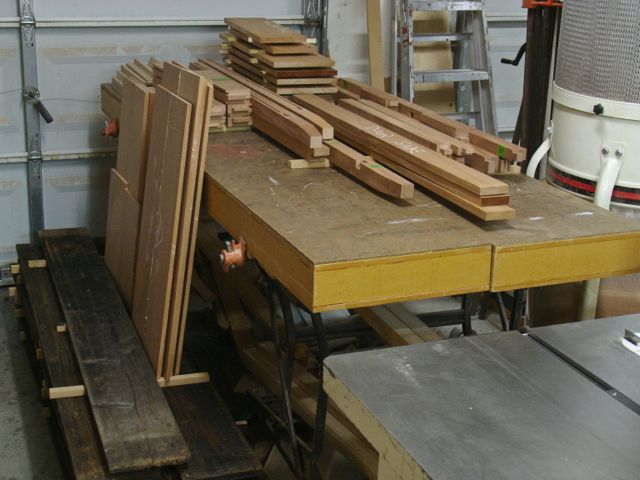
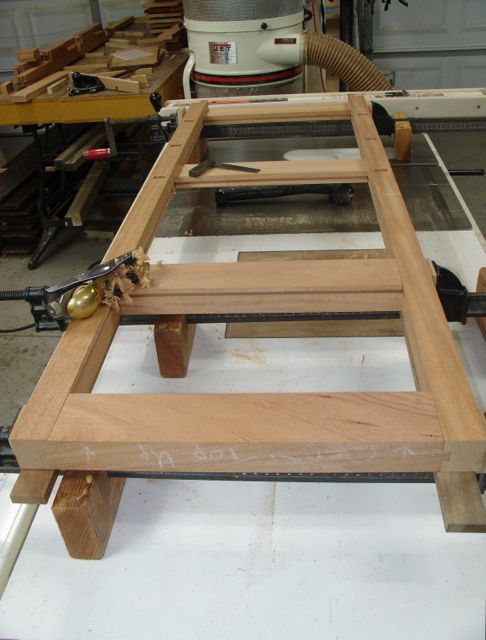
Seems I wasted more time trying to find what I needed and it became a safety hazard.  All of the pieces that had been fitted and dry clamped together were disassembled and marked.  As far as the sequence of assembly goes I will first assemble the front and rear frames.  Those will then be joined together with the appropriate panels between them.  What you see here are all of the panels joined but needing to be surfaced — all hand plane work that I’m actually looking forward to.  The dark pile of lumber they are sitting on is for a paid commission that I’ll start this weekend — more on that later.  The pile of boards on the back of the assembly table are the drawer fronts that have been resawn and surfaced and are now stickered to stabilize.  All the other pieces are for the frames and drawer web.

Clean Workbench!

Clean Workbench!

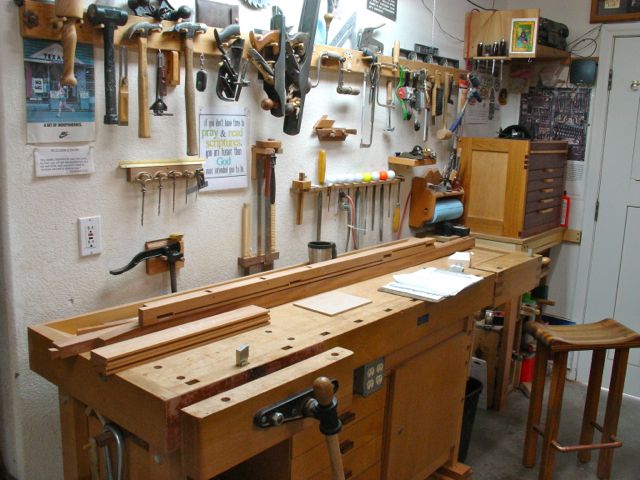
My work bench can now also be found!  The last bit of mortise and tenon joinery needs to be made for the back of the door unit.  That’s what I have planned for tomorrow.  If all goes according to plan, Walnut dowels/pegs will be next followed by surface planing all of the frame pieces prior to assembly.  I currently have two paying jobs (yeah!) that are waiting for items ordered from 3rd. party vendors.  One of those is a media table with metal legs, those are scheduled to arrive Friday.  I need to build the top and drawer section for that project to fit the legs so really need to physically have them before cutting the wood.  The other project is an extreme challenge and the crucial part for that won’t be here for another 3 weeks.  I’ll leave you with a teaser though, here’s a google search for mechanical cellarette to pique your interest.

Posted in Hand Cut Dovetails, Hand Tool Woodworking, Johns Armoire, Tutorial | Tagged , , , | Leave a comment

Drawer Web Frame: My Approach for the Armoire

John'sArmoire-WoodworksbyJohn-Mortise&Tenon-Fitting

Dry fit to level joints

In my latest post, the end of the year one; I was working on the mortise and tenons for the armoire.  This unit has three, main frames; the left, right, and one in the middle.  The tricky part of the assembly will be putting it all together!  Now, that kind of sounds like a “no duh” statement doesn’t it?  What needs to happen is for all of the stretchers, panels, bottom, and drawer web frame members to go together at one time — which becomes a greater, more  monumental challenge every time I think about it!  Keeping all of that in mind I decided that now was the right time to level the joinery of those frames.  This was accomplished with a block plane.  Prior to the final assembly, every surface will be finished with a smooth plane except for the ones that will have a peg driven through the tenons.  Those will be surfaced after the pegs are inserted, cut, and planed flush.

Mortises in back of drawer stretchers.

Mortises in back of drawer stretchers.

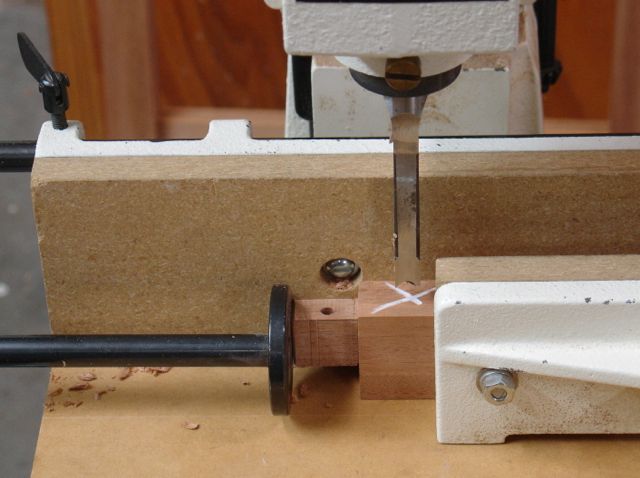
The next is making the drawer web frame.  These runners are made of Alder and are mortised into the drawer stretchers.  This time I’m using the tenoning jig rather than the dado head which I discussed in the last post.  The first step was making a 3/8″ wide, 5/8″ deep, and 1″ long mortise in the back of each drawer stretcher.  Using the hollow chisel mortiser allowed me to set stops to insure that each of the drawer web frame members are in the same location.

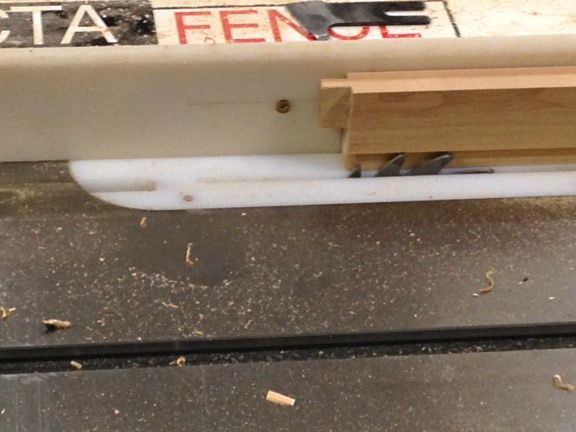
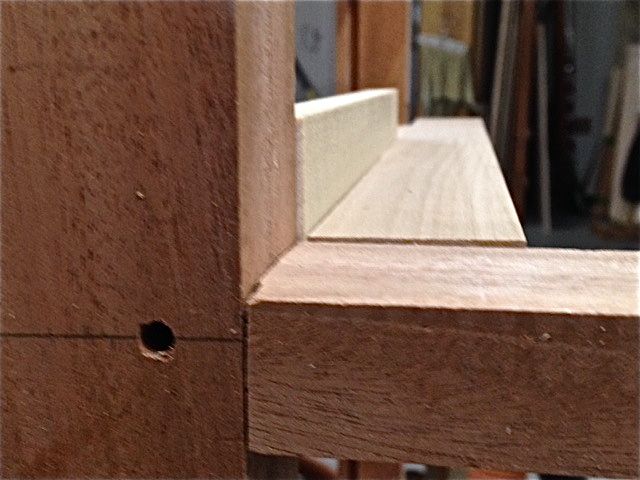
After double-checking the measurements the Alder pieces were cut to size and readied for the tenon.  I’ve used this technique for a single drawer and although I’ve never seen anything written about it found that it worked then so am up for trying it again!  The drawer stretchers and web frame are the same thickness (7/8″).  By offsetting the tenon in the drawer web frame so that it sits proud of the stretcher it will create an automatic reveal at the bottom of the drawer.  I used a small bench ruler to determine the width of the reveal.  Here’s how I went about it:

This slideshow requires JavaScript.

Once my practice pieces gave me the fit I was after every one of the drawer web frame pieces had the machine work done with the tablesaw and tenon jig.  I needed to be very careful with the orientation of these pieces so machinists stamps were used to punch a ‘B’ prominently on the bottom surface.  Now comes the quiet part of this operation, beloved hand work!

This slideshow requires JavaScript.

Side guide offset in web

Side guide offset in web

After fitting these together one step remains.  The drawer runners will support the drawer so that is is less than 1/16″ above the stretcher.  I want to maintain that distance from the sides as well.  The sides of the frame will need something to guide the drawer so here’s my solution.  Using the same bench ruler an offset was located on the drawer runner which will give me the same reveal on the sides as there is on the bottom.  Since there was a single dado blade installed in the saw already for cutting the tenons, I used it for creating the offset as well.

Offset drawer web frame

Offset drawer web frame

What happens next is to cut 1/2″ x 3/4″ pieces that will be glued to that offset.  The result will be a drawer web frame that will guide the drawer and create an even reveal all the way around.  Lots of engineering has gone into this and I’m pretty confident that it will work for the Armoire.  Here’s a mock up, what do you think — will this be a success?

Posted in Hand Tool Woodworking, Johns Armoire, Mortise and Tenon Joint, Tutorial | Tagged , , , , , , , | 1 Comment

Cutting Tenons & End of Year Thoughts

Around 8:00 am, Dec. 31st.

Around 8:00 am, Dec. 31st.

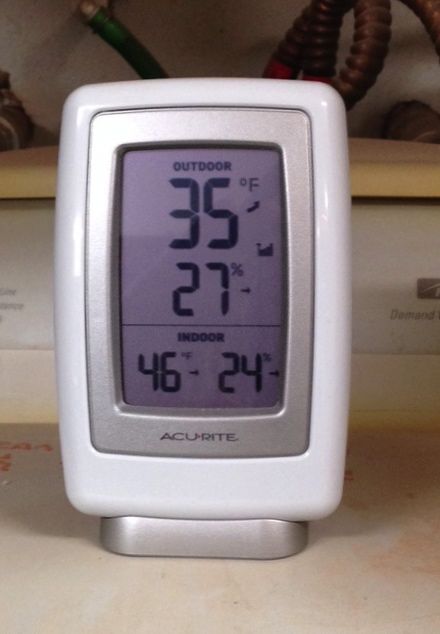
First off, we’re experiencing a cold spell here for the end of 2014 and earlier had predictions of up to 3″ of snow on the Las Vegas strip!  Snow isn’t completely unheard of here in the desert but is somewhat unusual, forecasts have been updated to less than an inch but since I’m at a higher elevation we could still see some accumulations tonight.  With the wind chill it’s pretty darn cold out there and not much better in my shop.  I have a single burner on a propane bottle that has brought the inside temp up to comfortable working level and I know those of you in colder climes are probably laughing and thinking I’m a pansy!

Beeswax vs. Cold Metal

Beeswax vs. Cold Metal

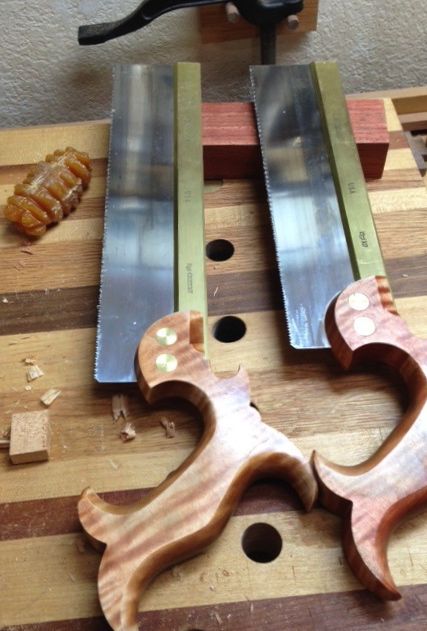
I did find though, that the dovetail saws needed a bit of beeswax to work the way they should, amazing how a quick application of that stuff makes saws and planes work so much easier.


The stage I’m at on the Armoire is cutting all of the tenons for the framework.  Previously all of the grooves were routed for the panels and mortises were cut with the hollow chisel mortiser where required.  So far there are about 20 of them for the casework and I realized that I forgot the stretchers for the top of the door section and the rear portion of the side where the door is.  Those will be 1/4″ tenons rather than the 3/8″ and 1/2″ used on the rest of the frame.  That’s the same size as what will be used on the door so they will all be cut at the same time.

I titled this blog “tenons & thoughts” because as I was working on fitting the tenons, I discovered some problems!  I always look at my work as an opportunity to learn and improve my woodworking skills.  Many years ago I had this revelation:

“My work will never meet my expectations”

 Now that may sound like a weird statement to you but I realize that the quality and perfection I think I should be able to achieve realistically isn’t possible.  What that does for me personally though, is to drive me to constantly improve and get closer to that  unattainable level of perfection.  I’m not content with the quality of my work and constantly try to make it better.  I find that artists and craftsman I admire are always striving to go that extra mile.  My wife and I used to refer to the opposite of this desire to go the extra mile as the Kincadean Syndrome.  You may be familiar with the artist Robert Kincade also known as the painter of light.  He was a hugely popular artist and a marketing genius.  He came up with his “schtick” as the painter of light and capitalized to the max on that premise.  My desire is to constantly push myself to learn new concepts and processes — I suppose that’s why I have a small, one man shop but honestly; I have no desire to go beyond that.

Okay, enough end of the year philosophy, let’s get to cutting tenons.  Other than doing them completely by hand, the methods I use are either a tenon jig or a dado head on the table saw.  For all of these piece I chose to use a dado head, here’s a slide show of that method:

This slideshow requires JavaScript.

Here’s what I discovered as I began to fit these tenons to their corresponding mortises, they weren’t always consistent even though the dado head I have is a pretty good quality Amana unit that usually cuts an even, flat bottom.  It took more work squaring up the cheeks than I thought it should.  Perhaps since I was holding the stock by hand there was enough play to allow some movement.  In any case, when using a tenoning jig I don’t seem to encounter this problem.  Well, from the beginning this project was designed to push my capabilities and give me lots of opportunity to hone my skills and it’s doing its intended job.  Here’s the procedure I’m using to fit the tenons:

This slideshow requires JavaScript.

The reason for using the dado head rather than the tenon jig was to save time, or so I thought.  Seems to me that making a single cut first for the shoulder then for the cheek using the tenon jig always gave me better results.  Usually all that’s needed is cleaning up the junction of the cheek and shoulder then planing the tenon to fit the mortise.  Generally I’ll cut them a strong 32nd oversize and plane to fit.  The glue strength for this joint comes from the face grain of the cheek inside the mortise and the dado head left some scoring even after fitting with the plane.

Well, there are more tenons to be cut!  The drawer web needs to be tenoned into the front and rear stretchers.  Those pieces are 7/8″ thick so will probably use a 3/8″ tenon, may even cut them all with two blades and spacers!  Also need a few 1/4″ mortise/tenon joints for the back of the right hand section that has the door — come to think of it there’s a stretcher that needs to go above the door too!

It’s New Years Eve and time to go to a small gathering of friends.  We plan to be home well before the fireworks start at midnight, Brandy the Dachshund and Ali the Cat need their people home to keep from freaking out!  Thanks for following my blog and have a wonderful 2015.

Posted in Hand Tool Woodworking, Johns Armoire, Mortise and Tenon Joint | Tagged , , , , , , , | 2 Comments

2014 in review

The WordPress.com stats helper monkeys prepared a 2014 annual report for this blog.

Here’s an excerpt:

The concert hall at the Sydney Opera House holds 2,700 people. This blog was viewed about 21,000 times in 2014. If it were a concert at Sydney Opera House, it would take about 8 sold-out performances for that many people to see it.

Click here to see the complete report.

Posted in Uncategorized | 2 Comments

DrawBored Mortise and Tenon; My Method

Work continues on my Armoire  and I’ve also received a deposit for one commission and a verbal approval of another — I won’t count on it until the check is in my hand which is scheduled for the 31st.  I’ve ordered the legs for the for sure commission and am waiting for my supplier to get more of the reclaimed fence boards that will be used for it, the holidays are great but it does change business hours for some of the suppliers I deal with but that’s okay, it allows me more time to work on my personal Armoire project.

John's Armoire Plan

John’s Armoire Plan

Speaking of which, the realization of how complicated and intense this project is strikes me most days.  Keeping track of all the parts and their relationship to one another is vital and I can see how easy it would be to make one error and throw a huge monkey wrench into the works!  If you check the drawing at the right it’ll help illustrate what phase of work is currently being done.  The lower drawer stretchers are complete; dovetailed into the legs.  Next up are the three drawer stretchers which are joined to the left leg and center section with a drawbored, mortise and tenon joint.  By adding that peg to an already strong joint the strength of it is increased dramatically.  Assembly of this Armoire will be quite a challenge and by draw boring this part of the frames I won’t have to worry about clamping all of it — it’ll be tricky and I’m keeping my fingers crossed that the sequence in my mind will match reality!

First up is cutting the mortises and making sure to cut them on the insides of the leg and center section.  For this part of the drawbored mortise and tenon joinery I’ll use a hollow chisel mortiser.  After all of those were cut out, they needed to be drilled with a 3/16″ bit for the peg.  To locate the center of the mortise a 1/4″ set up block was pressed against one wall so a pencil line could extend across the face.  To insure this hole is square, I set up a fence on the drill press, the hole goes completely through the legs.

MDF used to check set up

MDF used to check set up

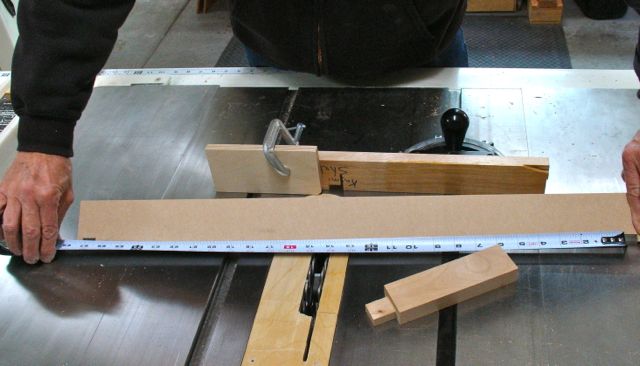
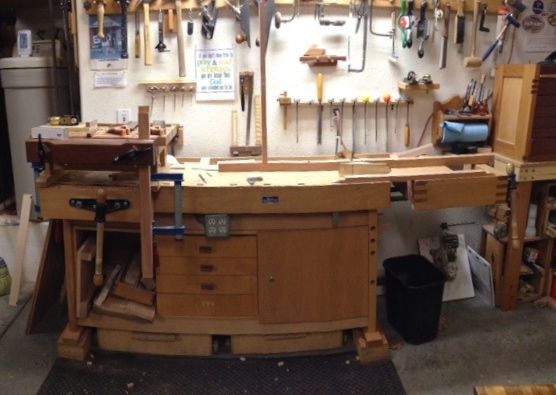
The top of the mortise is the top of the stretcher so only one side needs to have a shoulder cut.  There are a couple of ways to go about this and the method used here was to use a dado head on the tablesaw to remove the bulk of the material.  I needed 26 1/2″ for the length of the drawer so used a piece of MDF as a setup guide to insure that I got it.  The stop block on the miter gauge has been adjusted for the length of the tenon.  Once all of the pieces were roughed out with the saw it’s time to fine tune them individually to their corresponding mortise.  With twelve joints to fit my goal is to set up my work for efficiency, here’s the bench set up for this phase:

Panoramic  Bench Set-up

Panoramic Bench Set-up

The leg is clamped to the right side of the bench so I can lay out the width of the tenon.  At left I’ve clamped my portable workbench which brings the work to a good height for me.  Here’s where the shoulders and cheeks are cut and sized to fit the mortises.  Let me illustrate my method for this part of the drawbored mortise and tenon joint with this slide show:

This slideshow requires JavaScript.

I’m sure you can see where keeping track of which piece goes where is so critical, the first step in the assembly sequence will be gluing and draw boring these mortise and tenoned pieces together.  Marking all of the pieces as I explained in this previous blog really helps me stay on track with that.

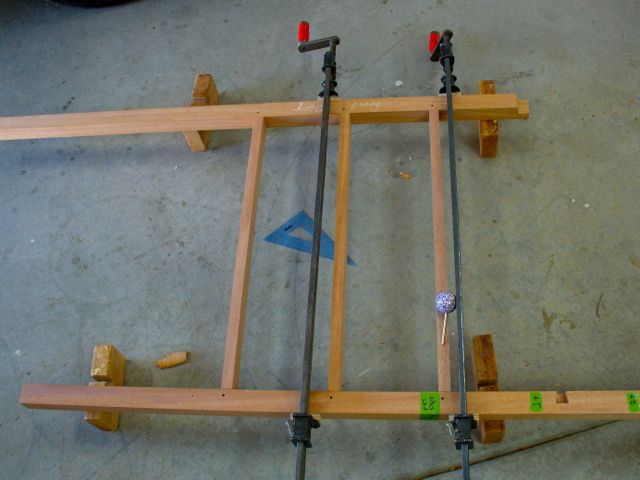
After all of the mortise and tenon joints fit it was time for locating the pegs for the draw boring portion of the joint.  The theory behind drawboring is that a peg is driven through the leg into an offset hole drilled into the tenon.  Since that hole is offset towards the shoulder it will pull tighter as the peg is pounded home.  Problem number one is locating the center of the hole.  You know I like to use golf balls for handles on files and rasps, they just give you a nice grip so here’s my center finder for this step made from a piece of 3/16″ rod.  I remembered reading somewhere that to put a centered point on a rod you need to rotate the rod while placing it against a rotating abrasive surface.  I made this because a scratch awl is too thin to stay centered in the 3/16″ hole.

To be on the safe side I did a few practice joints.  Getting the offset of the hole is critical, if you locate the hole too far towards the shoulder you’ll have a devil of a time getting the peg through the hole and it may even break!  The sequence is best shown with this slide show:

This slideshow requires JavaScript.

Locating drawbored hole locations

Locating drawbored hole locations

Now that the practice drawbored mortise and tenon joint is completed successfully it’s time to do the real thing.  This was accomplished by clamping the pieces together, marking the centers and then drilling the holes with the drill press.  As you can see, I’ll be needing to make a bunch of 3/16″ Walnut pegs but there’s a way to go before I’m ready for that step.  Next up are the mortise and tenons required for the stretchers between the front and back frames.  Same basic process will be followed doing what is sometimes referred to as “hybrid woodworking” where the power tools perform the grunt work and hand tools finish the process.  The grooves for the panels will also be routed — that should be all that’s left to do before the final smooth plane work on all of the pieces.

Posted in Hand Tool Woodworking, Johns Armoire, Mortise and Tenon Joint, Tutorial | 3 Comments

Sculpted Cargo Shorts: Work Diary

The Chopped Challenge contest is over so I can now post this blog!  The title of this project is Heavy Starch and I’m happy to say they tied for third place in the People’s Choice award which gave me a $25.00 prize.

Heavy Starch

Heavy Starch

And so it Begins!

And so it Begins!

Before I begin on this particular blog allow me to explain what it’s all about.  For the Sin City Woodworkers end of the year party we generally have a themed, anonymous show/contest.  This year we’re following the television show “Chopped” format and have a list of mystery ingredients that we need to utilize to make a project of our choice.  Project will be brought in, assigned a number, then displayed around the shop.  Members will select the project they feel is the best and that one will be awarded a gift certificate to Lee Valley.  I’ll get into the mystery ingredients later but first want to get my thoughts down as I attempt this project.  The main ingredient is wood of your choice limited to 1″ x 6″ x 8′ and I chose Basswood for my work.  I’m going to attempt to carve a set of cargo shorts from it.  At this point, this will be more of a diary where I’ll document my thoughts and decisions as I attempt this challenge!  Obviously,  since the contest is anonymous I can’t publish this until it’s over.  It started with soaking the model shorts and using the entire bottle of spray starch to have them maintain their shape.  Pretty straight forward what happened next, three pieces were glued together and then roughed out on the bandsaw:

Carved Basswood Shirt

Carved Basswood Shirt

That was the easy part!  My only other attempt at doing this type of work was when I sculpted/carved a portion of a ruined shirt I had.  The inspiration for that was a carved tank top at WoodItIs that I’ve always admired.  The tank top is a full, in the round carving whereas my shirt is one dimensional — these shorts will be (hopefully) in the round and to be honest, I’m not 100% sure of how to go about it — hence this diary to document my thoughts, successes, and failures!


Roughing out Design

Initial Pocket, creases are too hard!

Initial Pocket, creases are too hard!

Discovering a correct sequence to go about this is completely different from building a piece of furniture, box, or picture frame.  I find I need to “think differently” and first locate the main features of the item and go from there.  I think first the features need to be located.  These include the pockets, belt loops, and zipper.  You learn from your mistakes right?  The first was trying to create everything with straight lines.  Thankfully, Diane has a much better trained eye for this so pointed out that there really isn’t a straight line anywhere on the shorts.  Due to my technical nature I had gone so far as to make a cardboard template of the rear pockets and traced then onto the board!  After cutting out one side and having her critique I soon saw the error of  my ways!  The trick is to make a bit of variation without exaggerating what is really there.  Cloth has a natural flow to it and it’ll be my job as the artist to fool the viewer into thinking this piece of wood is actually a piece of cloth!  In this picture you can see the original hard lined pocket on the right side and then some slight waviness to the outline on the left side.  The cargo pocket begins at the back but will wrap around to the front side.  This is where I realized the main features need to be placed first, the creases and folds of the cloth should come later.  The ones I’ve put in are way to hard but I recall that when I did the shirt it’s best to refine them once the features are in place.  It’s virtually impossible to replicate the actual shorts in the wood sculpt.  What’s required is getting the general flow and then “letting the wood talk to me” with it’s grain direction and workability.

Going Around the Edge

My Basswood is a full inch thick.  My first thoughts were to leave the edges squared off to make it easier to clamp but, as my carving friend Randy pointed out; that’s not a good approach!  According to what he told me, you need to know what’s happening on one side to be able to have it flow over the edge to the other side.  I followed my plan of outlining things first around the edge to each side.  This is still in the rough stage but now that edge needs to be rounded over.  Chisels allowed the grain to splinter off (so to speak) and left a rough finish.  To overcome that my first thought was a block plane but the sole is too long so the obvious tool for this process was the spokeshave.  You can see here that it does work!

The outlining of the pocket needs to be re-carved as the edge becomes round but that’s easily done with a knife and appropriate gouge.

Work continued for a number of days………

Being a naturally detail oriented guy (my principal called me anal!) working on a free flowing project like this is good for me.  No real pressure, just a personal desire to conquer this challenge and see what I can accomplish in this artistic realm of woodworking.  Time doesn’t matter as I bend over the work bench creating what I hope will be some realistic cloth out of this chunk of Basswood.  CarvedShorts-9:2aOne thing I’d forgotten that works to smooth out the wood is spraying it with a mixture of denatured alcohol and water to soften the grain.  Check out how thin the shaving is at the end of the gouge!  As is my bad habit — I’m getting ahead of myself.  The first thing that needs to be done is getting the entire shape and main features in place then, and only then; should I be concerned about the final finish.

The area that’s really giving me fits is where the crotch flows into the legs.  There is so much going on there with folds and creases that Back seam-carvingcloth-8-29bI need to step back and do what I can to simplyify things.  I started by cutting too deep of a crease in that area so now — like Tim Gunn of Project Runway says: “make it work people”!   Well, no sense boring you with the work that’s going on currently with this project.  It’s now September the sixth and I have until December to get it complete.  Just received a custom order for a box on the Etsy store so will be working on that to pay the bills!  Since the holiday season is approaching it’s a good time to make more and build up the inventory.


They are Done!!

Well, as projects go this one was great and as usual — time just doesn’t seem to matter as it is now mid November!  Don’t know how many hours I have in these but I’m satisfied with how they turned out and what I’ve learned.  The Christmas Chopped Challenge is 11 days away and no matter what the results are, I’m pleased with what I’ve accomplished.  The rivets were added, they are brass and from Tandy Leather.  All of the stitching was completed with a tool I made by putting external lock washers on a metal rod with tubing as spacers.  The stitching varies with single, double, and triple rows depending on where it was located.  Here’s a slide show of the finished project.  I fulfilled the requirement of using dowels by having 1/2″ acrylic rods on the stand which is on a lazy susan bearing.  The stand itself is a piece of Poplar.  Here’s a slideshow of the final results:

This slideshow requires JavaScript.


Posted in Carving | Tagged , , , , , , | 6 Comments

Panels and Lap Joints

Preparing PanelDuring the time that the dovetail joinery is being cut and fit, I’m also trying to make up  the panels for this project.  There are two needed for the door, plus two more for each side, and a small one above the stepped drawers.   As the work continues I’m questioning re-sawing the 8/4 stock into three pieces for them.  There is some movement which makes it a challenge to square the edges in preparation for glue up.  At about 1/2″  thick, balancing the plane on the edge is tricky.  I’ve never thought of making a shooting board for long boards before but now I think it may be a valid idea!  Of course, a dedicated shooting board plane at $400-500.00 is out of the question!

John's Armoire Plan

John’s Armoire Plan

The dovetails for the framework are complete, next step is the lap joint for the center stile.  This will be glued and screwed from the inside of the case after the drawer stretchers are in glued and pinned in place.  This is one of many places things get complicated and careful layout is a must.  The pieces for the center stile are longer than needed so this is a good time to work on my hand skills to cut the lap joint at the ends that will be notched into the second drawer stretcher.  Maybe the sketch at left will help you visualize how this will all go together.


Tablesaw aka Clamping Table

Tablesaw aka Clamping Table

By the way, these steps could have been quickly and easily done on the tablesaw but, as mentioned; the panels are also being glued up and the tablesaw has now become a clamping table!  I do enjoy the hand work so this will be a great opportunity to cut the joinery by hand.  Speaking of which, these panels are over 17″ and my planer is 15″ so I’m looking forward to improve my skills at smoothing large panels like using all hand techniques.  Thankfully, there is only one show side so I can improve my skills on the inside of the panels before going to the one I’ll have to look at every day!

Lap Joint at end of Center Stile

Lap Joint at end of Center Stile

The first step is to mark out the area that needs to be removed with the marking gauge, square, and marking knife.  Both pieces were clamped together and the first cut is pretty straight forward.  Here’s where a sash saw would come in handy but my crosscut dovetail saw is up to the task.

Notch to aid starting the saw

Notch to aid starting the saw

Before making the cut, a chisel was used to cut a slight notch on the waste side of the scribed line.   This technique will help you get the saw started, similar to the technique used when cutting shoulders on dovetails.  The other cut for this joint was harder to make because of the length of the board.  It’s made with a rip cut saw but as you can see, even though I’m over six feet tall it was a stretch!

On my toes!

On my toes!

After squaring up the shoulders with a paring chisel my plan was to flatten out the bottom of the lap with an old #71 Stanley Router Plane — never too old to learn something though!  The depth needed is 7/8″ and, until now; I never knew that the #71 has a depth limit of 3/4″ — now what?  By turning the adjustment wheel upside down I was able to gain the travel needed for this cut.

After being satisfied with the lap at the ends of these pieces it was time to cut the corresponding  joint.  Since these are the sides that support the drawers it’s critical for them to be in exactly the same position on both the front and rear frames.  The drawer stretchers were clamped together for marking and initial cuts but then separated to fit individually.

It’s been very busy in the shop lately with work on this  personal project plus the “neighborly diversion” I mentioned in my last blog, and the commission for the media table made with the recycled materials.  I’m waiting for my supplier to get another load of them and for the legs to be delivered.  If that’s not enough to keep me stressed and happy my client sent an email stating: I am ready to financially commit and get going on constructions”; now if that isn’t music to my ears I don’t know what is!  He’s currently out of town so I’ll need to finalize the plans and get his deposit.  This promises to be a very challenging and interesting project but more on that as it happens.

Posted in Hand Tool Woodworking, Johns Armoire | Tagged , , , , | Leave a comment

A (much needed) Neighborly Diversion

As work continues on the Armoire the thought occasionally crosses my mind that this is a big undertaking!  Having discussed my procedure on the blog about how I intend to go about it and not hearing suggestions regarding other ways to construct this leads me to think my plan is a sound, albeit: complicated one.  One of my neighbors who I have done some work for in the past, asked me for a favor and I was glad to take a break from the Armoire to fulfill it.

Wine Bottle Storage

Wine Bottle Storage

Quite a number of years ago we had re-purposed a media niche in his home by my building a liquor cabinet for the lower part of it.  The upper part of it was mirrored with glass shelving to hold bottles and glasses.  All that was missing was a place for wine.  Oh yes, you may have heard me say that I very rarely stain — this project was one of my few exceptions.  Their kitchen cabinetry is adjacent to this wall and has a pickled, white wash Oak finish so this cabinet had to match.  I also added an end table with the same finish at a later date.  He had purchased a wine rack that had a dark, antiqued wooden top on it and wondered if I could replace the top to match the rest of the woodwork.  In this picture you see the finished project along with the original top.

This project gave me a nice break from the exacting work on the Armoire, started with smooth planing a piece of Home Depot Oak:

Smooth Plane

Smooth Plane

Not sure if I’ll ever have enough practice to really perfect this technique but if what they say is true …… “practice makes perfect” this can’t hurt!  Next I used a very technical drawing technique to radius the corners:

Washer & Pencil Radius

Washer & Pencil Radius

Which gave me a chance to use my new Auriou rasp from Lie-Nielsen which worked very nicely indeed!  Then a gimlet to do the holes:

Gimlet in Use

Gimlet in Use

Now, all that remained was to apply the finish.  I used a couple of coats of rattle-can spar varnish to protect it after the stain dried overnight.  I delivered it this afternoon and it’s exactly what he needed — back to the Armoire!

Posted in Uncategorized | Tagged , , , | 1 Comment