Measuring, Marking, & Keeping Organized

As I’m looking at the plans and pieces of material that will go into the making of my Armoire, I realize that this is a big undertaking!  This is on the scale of building my own house which, although I’ve done; didn’t seem as daunting.  Perhaps it’s because in house construction you can just scab a piece on if something went wrong or get a cat’s claw and wrecking bar and start all over.  In furniture construction one part is intricately joined to another, which is joined to yet another so things need to be spot on.  For example, the lower drawer stretchers will have three joints cut on them so if after cutting the first two successfully I mess up on the third it was all for naught!  Then those stretchers will need to be mortised in the back to accept the drawer web frame — make a mistake there and it’s back to square one.  The problem with that too though is that the pieces were selected from the same board so if I had to replace a stretcher it probably wouldn’t have the same coloration as the surrounding pieces and since I rarely stain that creates yet another probable disaster.  And that’s why furniture makers subscribe to this saying:

Measure twice and cut once!

Locating Bottom Stretcher

Locating Bottom Stretcher

So, after doing the rear of the frame for the Armoire it was time to tackle the front.  I figure that the rear frame is the one to practice on and hopefully the front will be flawless.  The tails are already cut on the stretchers and only need to be positioned correctly for scribing.  When transferring these locations I prefer using a marking knife made by Czeck Edge  The blade in it is extremely thin and sharp and it’s very easy to get into tight dovetails.  For general lay-out work I find this a little too flexible and use a heavier, stout bladed knife.  First up was locating the bottom of the stretcher to the bottom of the leg, this was accomplished with a combination gauge set from the back frame.

Second Stretcher

Second Stretcher

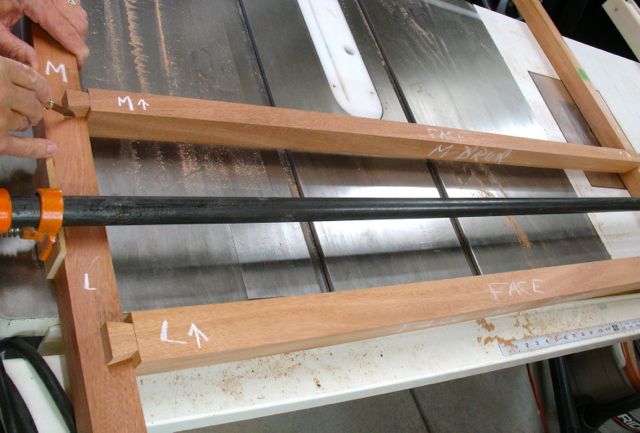
The next stretcher is located  8 1/4″ above the first.  Tape measure is read directly over the top for accuracy and then a pipe clamp is used to hold everything in its’ proper position prior to marking out.  I find that with the Czeck knife it’s best to make a few, light passes rather than one heavy pass to scribe the tails.

Temporary Markings

Temporary Markings

Along with all of the other things to keep track of is which board goes where and how!  Before unclamping this I used masking tape and a Sharpie to keep myself straight.  There are over a dozen pieces in each frame so it’s paramount to keep track of what goes where.  As the work progresses and the joints fit I’ll use machinists letter stamps to permanently mark the work.


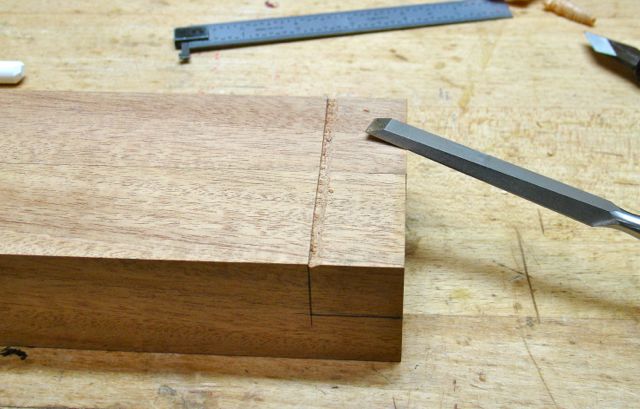
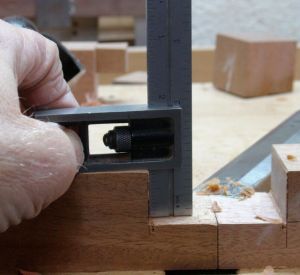
Before work begins on cutting the half blind dovetails on the carcass sides, their shoulders were checked for squareness and pared as needed.  Before I begin to cut the joint I’ll sharpen a pencil with a chisel and trace through the scribed lines.  Old eyes need all the help and light you can get at this point!

Darken Scribed Lines

Darken Scribed Lines

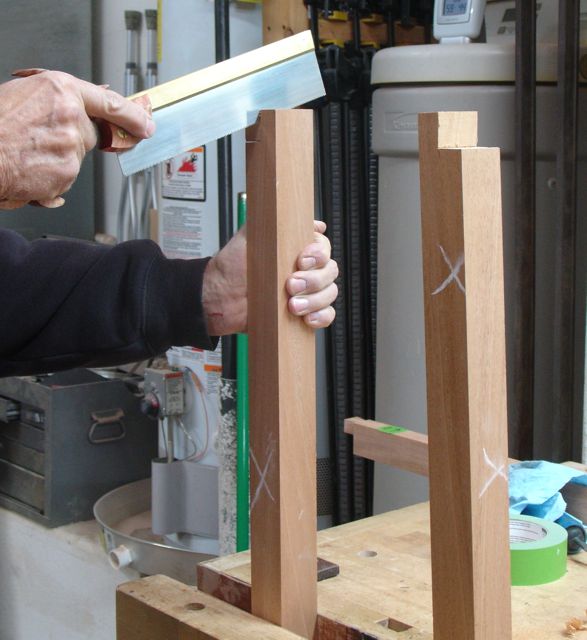
Whoops, notice that mark at the lower left?  Forgot to turn the dog around and it left its crisscross pattern — luckily this is the inside of the case and will probably plane off with a smooth plane.  For a tail this wide, I like making a few cuts in the waste area which I find helps clean it out.

Beginning The Process

Beginning The Process

Since the saw isn’t able to get into the inner corners of the joint your chisel will have to cut there.  When I remove the waste, especially in a deep (3/4″) and wide joint such as this the chisel technique I use is similar to one you’d use to groove or lap.  First angle towards the side from the middle one way:

Angle From Center to Edge

Angle From Center to Edge

Then the other direction:

Angled to Sides from Center

Angled to Sides from Center

And finally bring the bottom flat:

Flatten Bottom of Joint

Flatten Bottom of Joint

The difficulty with all of this is how snug do you leave your joint?  I’ve read many noted woodworkers describe their procedure for dovetails and often they say they never fit the joint completely home until it’s time for glue up.  That leaves a lot to chance because what if it is too tight and you can’t get it home — once you’re glued you’re screwed!  I suppose that’s where experience comes in.  I know that one of the joints on the back is a bit loose so I’m going to err on the side of snug now and check every surface for squareness the very best I can.  This is a labor of love, not a race.  Heck, if it were a race I could get a Kreg Jig and pocket screws and be done this weekend!

The last thing on this blog is how I mark the pieces once the joinery is complete.  You know that masking tape isn’t going to last forever.  I use Machinists Letter stamps and mark the joint so I can see it during glue up but it’ll be hidden afterwards.

Machinists Stamps

Machinists Stamps

As I mentioned, there are many parts for this Armoire and not everyone of the joints needs to be marked.  For example, the divider for the drawers only needs to be marked on one of its’ dovetails to locate it in the over-all construction sequence.  My set of stamps came in a wooden box so I’m beginning with the A and working through the alphabet.  To keep track of where I am I’ll simply return the stamp to the box upside down indicating it’s been used already somewhere on the project.  Time to put the camera aside, close up the lap top, and get out to the shop to make some chips!

Posted in Hand Cut Dovetails, Hand Tool Woodworking, Johns Armoire, Tutorial | Tagged , , , , , , , | 2 Comments

Armoire Work Begins — Outer Legs

Leg Marks

Leg Marks

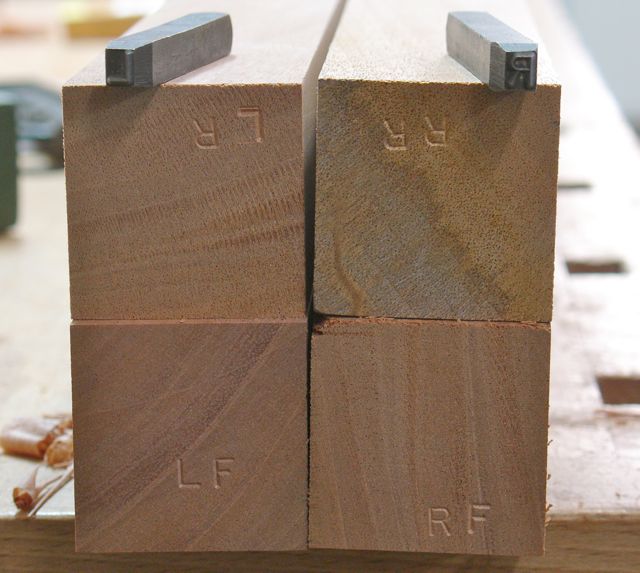
The Armoire project is quite challenging so I’m being very careful as the work progresses.  There are so many parts and pieces to the casework that labeling them properly is very important.  Starting with the legs shown here, a customary way of labeling them is to draw a  diamond shaped square across the insides of the legs were they intersect to show their relationship.  That works quite well but sometimes those markings will wear off.  I like using these machinists letter stamps to; hopefully, keep me from getting confused as the work progresses.

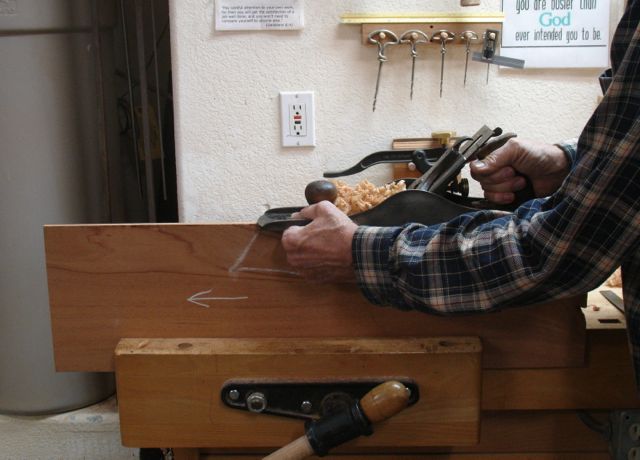
Leg Taper Before & After Planing

Leg Taper Before & After Planing


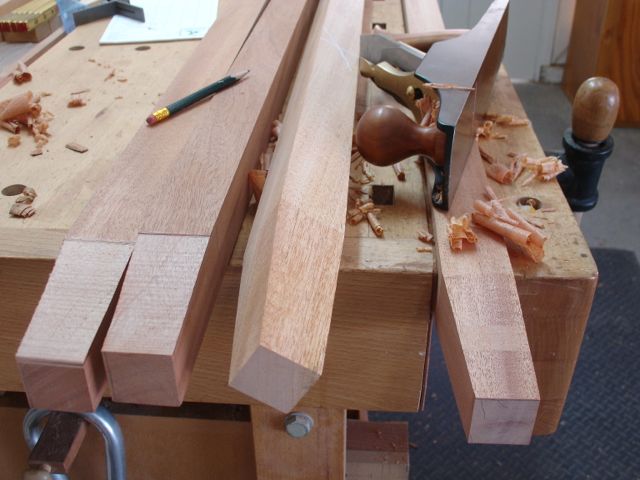
The legs have a tapered portion at the bottom of them that was laid out and cut on the bandsaw.  Once cut a jack plane was used to smooth and finalize their shapes.

Lay-Out of Drawer Stretchers

Lay-Out of Drawer Stretchers


Now that the bottom of the legs are complete, it’s time to lay out the position of the various drawer stretchers to begin that phase of the project.  The front and rear frames will be identical which gives me the opportunity to work on the rear one first and hone my work before going on to the front ones that will always be exposed to the world!  After clamping them together in the proper location a piece of painters tape was applied to one leg to help my old eyes focus on the lines!  Locations were then scribed across the inner faces of the legs.

After cutting the bottom stretchers to the required length, the tail of the dovetail is laid out and cut — here’s the process:

This slideshow requires JavaScript.

Transferring Dovetails

Transferring Dovetails

Of the eight tails cut only one needed to be squared up which was accomplished with a chisel on the shoulder and rabbet block plane for the back face.  This means that one tail is slightly thinner than the others so I marked it with a sharpie so I don’t cut its socket too deep.  Now the tails needed to be scribed in their perspective locations so everything was clamped together, checked for square, and transferred.

Like I mentioned before, I have the luxury of starting on the rear frame — you know you’re just one bad cut away from disaster on these projects but at the end of the day, one down and only seven to go.  After these joints are cut there will be a center divider that is joined with dovetails as well.

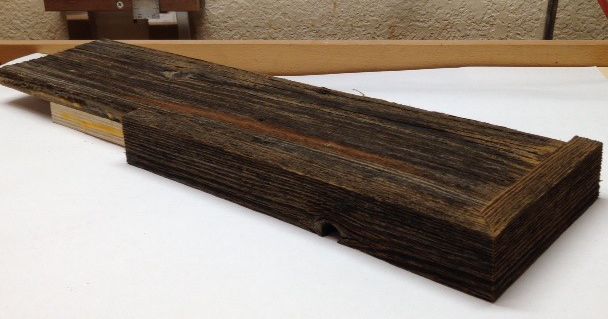
This furniture piece an example of old world joinery and a challenge to myself to see if I can replicate and accomplish it.  That’s one of the aspects of woodworking I enjoy the most — the challenge and the process.  I just collected a deposit for a new commission which is almost the direct opposite of the Armoire!  It’s a media stand made of recycled fence boards and square metal legs.  Here’s a photo of the mock up I made for their approval, instead of chisels and dovetail saws I’ll be using nail guns, glue, and screws!

Reclaimed Fence Boards  to pay the bills

Reclaimed Fence Boards to pay the bills

Posted in Hand Cut Dovetails, Hand Planes, Hand Tool Woodworking, Johns Armoire, Tutorial | Tagged , , , , , , , | 2 Comments

Preparing a Hock Blade for my #7

The plane I use for jointing my edges is a corrugated bottom, #7 Stanley that dates back to the mid 1920’s or so.  It has the original sweetheart blade that is laminated plus it has the low profile knob which is another indication of it’s age.  In any case, this tool was a trade for some work done for a client in the 1980’s and I love it!  Since work has started on the Armoire there are a lot of panels to glue up and 8/4 legs that need to be squared and trued.  The jointer plane with it’s 2 3/8″ wide blade is the perfect choice for that, however; some of this genuine Mahogany for the project was giving me problems.  When I planed the same edge with a Lie-Nielsen jack plane it planed much better.  Since that blade is a much thicker iron I figured it was time to update and improve my old #7.

A number of years ago the jointer planes performance was improved with the addition of Ron Hocks chip breaker.  It’s much heavier than the original and improved the cutting action considerably.  Rather than putting a Lie-Nielsen #7 Jointer on my Christmas list and really not expecting to get it I decided it would be more in keeping with my Dutch nature to invest in a better blade. Besides, I love this plane!  One of the best sources for plane blades is Hock Tools, I’ve dealt with them before.  What I really like about Ron Hock is that he takes the time to not only answer any questions or concerns via email, the same is true for phone communications. To my way of thinking, in this age of recorded messages and the endless phone options we’re faced with when trying to find information that’s gold!!  I asked him a question via email and then (since I pre-worry) called him too and he answered promptly.  I placed the order and had the replacement blade in 2 days.  Next up was to prepare it for use.

I use water stones and a Veritas MKII jig for sharpening. I don’t use a bench grinder but on occasion will use a modified 1″ belt sander to rough shape a blade.  The quality of Ron Hock’s blades is fine but I wanted that polished edge that only stones can give.  The initial work on the 4K stone showed me that it would take far too long to achieve the edge I was after so went to a 1K stone to work the entire surface.  You can see in the slide show that there was one corner that gave me problems, just couldn’t seem to raise that burr on the back of the blade that tells you the entire edge has been ground.  Checking it with a square showed that it was positioned correctly in the jig but you can see the sharpie mark in the right hand corner indicating the stone hadn’t touched that corner yet.  It took about 20+ minutes to hit the entire front edge and raise a burr on the back.  Here’s the slide show of the process:

This slideshow requires JavaScript.


The proof is in the Shavings!

The proof is in the Shavings!

After the 1K stone the followup work on the 4K and 8K went relatively quickly as you can see.  For the micro bevel I only take about 5 strokes working the blade backwards only.  That’s followed with a slight back bevel using David Charlesworth’s ruler trick and as you can see, it was well worth the time.  Sharpening is like sanding in a way.  My students used to complain about sanding and ask how long they needed to do it — of course the obvious answer was “until it’s smooth”.  In sharpening, just like in sanding; it pays to spend the majority of the time with the rougher grit (100 sandpaper or 1,000 stone) before going on to the finer ones.  It’s always tempting to me to tell myself it’s time to move to the finer stones even when I don’t have a burr all the way across the back of the iron.  Can’t figure out why that was happening but glad I persevered with the 1K stone to achieve the edge and cut I did.

Posted in Hand Planes, Tool Sharpening, Tutorial | Tagged , , , , | Leave a comment

John’s Armoire — First Cuts

John's Armoire Plan

John’s Armoire Plan

With apologies to Rod Stewart and Cat Stevens who wrote the song — The First Cut is the Deepest but in a woodworkers point of view, the first cuts are the hardest!  As you know, I just bought quite a lot of 8/4 Genuine Mahogany for this personal project.   If you read the previous post about this it is inspired by Dr. White’s Chest, a popular item in the Thos Moser line of furniture.  If you’re familiar with that piece you’ll notice I’ve thrown in my own design twists and am now faced with the challenge of bringing this from my mind and paper to a three dimensional, piece of furniture.  I haven’t come across anything like this in my research so either the techniques I’m thinking of using to create this  are revolutionary or have been tried before unsuccessfully!  The main area of concern is the small, three tiered drawer section in the middle of the piece.  The joinery there is tricky as is the area below the door separating the larger, bottom drawers from the rest of the piece.  On paper things are looking doable so I’m proceeding cautiously and really thinking through the entire project of this piece.

The first step was to double check the cutting list I used when I selected the lumber at Woodworkers Source in Phoenix.  Good thing too because an error was made in my thinking there when I found this beautiful piece that was more than 15″ wide.  Initially I thought this could be resawn into three 5/8″ thick pieces for the panels.  Driving home I realized that my bandsaw has a capacity of 12″ so there went that thought!  After much head scratching I finally came up with a process to use that piece to it’s best advantage.  Matching the grain pattern for the side panels will be a challenge since each 8/4 piece will be resawn into three pieces.  This makes the book match interesting and hopefully I’ll be able to come up with a good match.  The door panels will come from a single board and book matched the traditional way.  Can’t wait to see these since this particular piece of Mahogany has some birds eye figuration to it — haven’t seen that before!

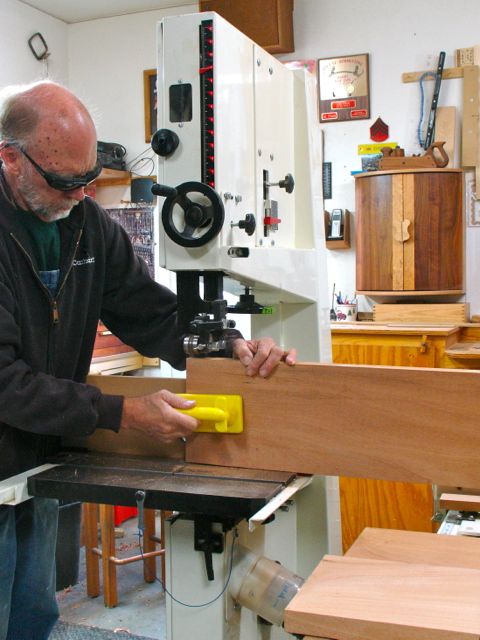
At The Bandsaw

At The Bandsaw

The work started with planing a square edge and then re-sawing the pieces as needed.  The blade used is a 1/2″ Wood Slicer from Highland Woodworking.  Although you can’t see it in this picture there is an auxiliary fence made out of a piece of MDF attached to the stock fence of the bandsaw.  I’ve found that once you adjust the stock fence for drift it works well, why pay a ton of money for an aftermarket one when this can be adjusted to suit your needs?  Here’s where working in a “hybrid” manner is an advantage.  After squaring an edge with a #7 Jointer Plane each of the 8/4 pieces were run through the bandsaw.

First slice for the end panels

First slice for the end panels

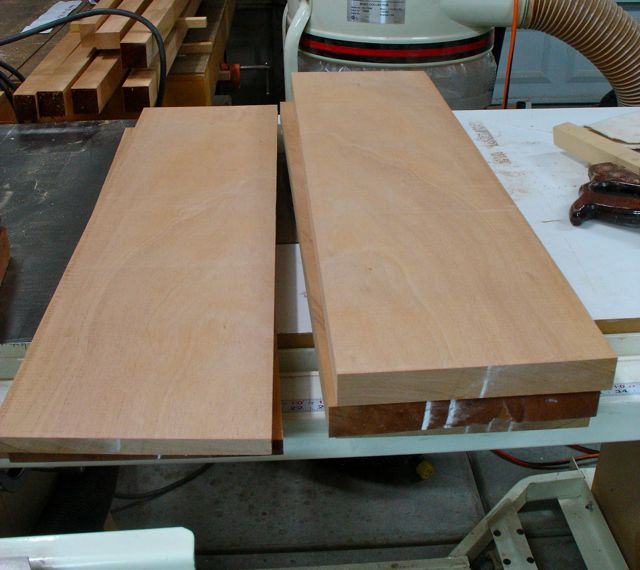
For the side panels this piece was about 5/8″ thick, the remaining piece was then run through the planer to smooth out that face.  Now that piece was once again resawn to yield the 3 pieces.  These will be stickered to stabilize the wood and (fingers crossed!) not too much warping, twisting, or other nasty changes will take place in them.  The plan is to see what type of changes do take place and then flatten them as needed with hand planes.  The panels will end up being about 17″ wide which is too wide for my planer so all leveling will be done by hand for the side panels of the armoire.  The door panels are about 13″ wide so these were resawn and book matched from one, 6 1/2″ wide piece.

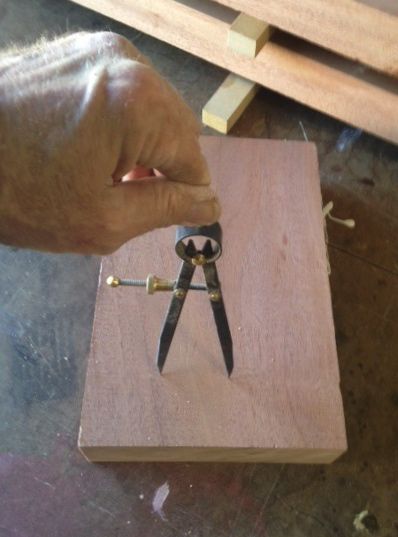
Stepping off the Width

Stepping off the Width

The thickness of the 8/4 stock is 1 13/16″ so I’d like to yield around 1 5/8″ for the posts.  The first part of this process was using dividers to step off the width of these parts.  After ripping these pieces down they too were stickered to let nature take it’s course.  The project will need 2 posts at 6’at the right side, 2 more at about 4′ for the center and then the other end needs 2 at about 5′.   The other materials that were cut to rough dimensions were the drawer dividers.  You may notice in the drawing that they increase in thickness as they go from top to bottom.  I’ve planned them out as 7/8″ for the upper drawers then 1 1/8″ for the middle and 1 5/8″ for the bottom.

As with any new work there will be challenges and no doubt some unforeseen problems as this piece takes place.  That’s what makes things interesting and challenging — why do the same thing all of the time; I prefer the risk and excitement of the unknown!  Diane was said that when she works on a painting she will work until she runs into a problem, overcome that one and then work to the next problem.  Of course, it’s much easier to remove and change paint then it is to stretch a board because you cut it too short but that’s okay, it’s her philosophy I like.  At the end of the day, this is what the shop looked like with all of the materials for the panels and frame resawn, stickered, and ready for the next steps.


Posted in Hand Tool Woodworking, Johns Armoire, Uncategorized | Tagged , , , , , , | 6 Comments

Art Nouveau Frame Update and Fixes!

ArtNueveu Frame

Here is the Art Nouveau frame in its’ final form with the designated painting by Diane in it.  There has been some “trials and tribulations” in the making of this frame which are mostly due to my own errors!!  I’ll blame some of that to being about 2 months away from signing up for Medicare, will you buy that excuse?

A Tale of Two Paints

In my last blog I explained how the usual technique of gilding portions of a frame and then spray painting it black prior to using wax to reveal the gild didn’t go as planned.  I thought that it was because the formula of the paint may have been changed.  Well, he says with his head hung low; Krylon and Rustoleum are two different brands of paint.  Even though both cans are the same size and say Satin Black doesn’t mean the formula is the same — that’s why the paint didn’t rub off of the gilded areas as it always had in the past.  The proper paint to use for this procedure is the Krylon.  That problem led me to remove all traces of the wax then re-size and gild the entire frame with silver leaf.  The result was a pretty cold looking frame so multiple coats of  Kusmi #2 button shellac from Shellac.net were applied with an air brush. Shellac.net is my recommended source of supply for shellac flakes of almost any variety.  It warmed the silver up considerably and meets Diane’s requirements.  Here is a side by side comparison of the frame it was in before and the new one.  With all of the reflected light it is somewhat difficult to get a true appreciation of the final result but I took both pictures in the same light and location.

The new frame picks up the warm tones in the painting which completes the mood Diane was after.

A Tale of Two Waxes

Completed Sample

Completed Sample

I’ll stick to this Tale of Two theme and elaborate how the Krylon paint over gilding process works.  At the left is the completed sample piece, please note that the carving was left pretty rough as it’s just a trial piece.  Also, there is an error in the design, it should go over and under rather than crossing over two strands!  The frame is correct.  After gilding the complete piece and realizing my mix up with the paint brands this piece was sprayed with Krylon and allowed to dry for 24 hours.  Now what I mentioned in my previous post applies; the longer you wait for the paint to cure the more difficulty you’ll encounter with removing it.

All waxes are not created equal, my preference is for Liberon Black Bison.  This is a great wax for the final step for most projects. Matter of fact, that was used on the frame for the final rub.  I like its mild odor and the finish it leaves.  The other wax I use sometimes is BriWax.  It has  more solvents which is apparent not only by the odor but also by how quickly it will remove the paint from the gilded areas.  In this slide show, the first work I did on this was on the sight edge using Liberon and a cotton ball.  It took quite a bit of rubbing to expose the gild.  I then went to the carve itself and began using the BriWax.  I should have used a Q-tip right away because the BriWax on a rag or cotton ball also removed the paint from the field surrounding the carve.

This slideshow requires JavaScript.

Corner Detail of Frame

Corner Detail of Frame

So, there you have it the completed tutorial on how to do a painted frame with gilded highlights.  As you can see with the sample piece I did it’s important to have the frame as smooth as possible.  Preparation is very important and after the problems I had with this frame very glad it turned out the way it did.  Over the years I’ve found that Krylon rattle can leaves a very nice finish on a frame.  I know some purists may cringe at the thought of using something like that on a piece of fine art but at a show Diane was in in San Antonio I saw them using it to repair a frame on a multi-thousand dollar painting so figure it must not be all that bad!

Posted in Carving, Gilding, Picture Frames, Tutorial | Tagged , , , , , , , , , | 3 Comments

Art Nouveau Frame — Tale of Woe!

Clayed and Gilded, Ready for Paint

Clayed and Gilded, Ready for Paint

Well, being an honest man means I have to admit to the failures in a project as well as the successes.  I know there were a few of my readers wanting to see how the Art Nouveau frame would turn out and have to report that it didn’t!  Not sure what happened because this technique has worked well for me in the past.  The technique was to spray the frame black after gilding the highlights with silver leaf.  After the paint dried I would use wax and a cotton ball to gently remove the paint from the gilded areas exposing them.  A reason for the failure may be that there was a different name on the can of Satin Black Rustoleum, it also had a different style of nozzle.  The paint wouldn’t dissolve with the wax as it had in the past, instead it became really gummy and then suddenly the red clay was exposed leaving very little of the silver gilding — not acceptable to say the least!  Lesson learned;  my test sample came out fine but that was with an older can of paint so it’s possible that the formulation changed and the new can of paint had one that set up quicker and harder.  Well, when you run into a problem you need to overcome and move onward.  I will use Naphtha or some type of solvent to remove all traces of the wax and then gild the entire face of the frame.  This time I’ll work in a more traditional fashion of sealing the leaf and then toning those areas of the frame I want to minimize — toning and antiquing of frames is a tricky area, one I need to work on so here’s my opportunity.

John’s Armoire — New Project

WoodworksbyJohn-CustomFurniture-LasVegas-Mahogany-DrwgAHere is the drawing I made for my new project — an Armoire.  It is my own design and I know it will be a very challenging piece.  Thos Moser has a very well known piece called Dr. Whites Chest which I’ve always admired but knew I would never be in position to buy.  Hey, I’m a woodworker so why not challenge myself to make my own plus add something to it to show my design sense.  Over-all this will be about 20″ deep by 4′ wide and the tallest section with the door will be 6′.  I want to use all traditional woodworking techniques and it is a post and panel construction.  I’ve done a lot of research and questioning to other woodworkers and there isn’t any easier way than to essentially make the front and rear frames which will have to be assembled at the same time while fitting the tenoned drawer runners/kickers into their mortises.  This will not be one of those weekend projects, more like a half year or so one!

The lumber I’m using is genuine Mahogany.  It just so happened that Woodworkers Source in Phoenix has it on sale this month prompting my 600 mile road trip yesterday.  After leaving Las Vegas at 4:00 am I arrived there a little over 5 hours later.  They have both 4/4 and 8/4 on sale and I had wrestled with which way to go.  I went with the 8/4 option even though it means more work as far as re-sawing and surfacing to make the project.  One big advantage to working this way is that the coloration of the wood will be more consistent through-out the piece.  I had my cutting list and chalk and spent close to 2 hours selecting the wood.  Unbelievable selection of wide boards, check out this one that is destined to become the panels for the sides and the doors; it’s almost 15″ wide and 8’+ long:

I was also able to select pieces to make the drawers out of single boards, they will be 7″-8″ wide.  Joining two boards together for the drawer front wasn’t the way I wanted to go so the final dimension was to be determined by the size of the boards I’m able to get from this wood.  Ended up with a bit more than 80 board feet of the 8/4 material and plenty of width to yield single board drawer fronts.  They also had a great selection of 4/4 material but the time and effort of going through and finding boards with similar grain pattern and coloration wasn’t worth it.  I suppose the unknown in all of this is how will the boards react after resawing — since there isn’t a time frame the plan is to sticker and allow them to settle down and dry after they have been cut.  This project will be a learning experience to say the least and I want to enjoy it rather than rush through it.  There are two potential clients for some custom work which would get priority over this personal project.  I tend to get obsessive so my mantra will be “Patience Grasshopper”!

Construction of the face frame (and back) will be a combination of draw bored mortise and tenons plus dovetails for the lower section.  That’s the best way to figure out the construction puzzle and is traditional.  Alder will be the secondary wood used for the interior web frames and the back.  The 3 drawer unit at the top will have the drawers suspended on runners and figuring out the exact construction details of that is one that I really haven’t finalized.  All other drawers will be traditional half blind dovetails with wooden runners.  The section with the door will have shelves for sweaters, shorts, etc.

The thought of under mount drawer runners to simplify the construction of this piece entered my mind but I want to stay traditional on this piece.  The Media Cabinet I built last year had a single bank of traditionally mounted drawers so this will just add to the complexity and challenge of the work!


Posted in Carving, Gilding, Hand Tool Woodworking, Johns Armoire | Tagged , , , , , , , | Leave a comment

Etsy Box Order — Almost Ready to Ship

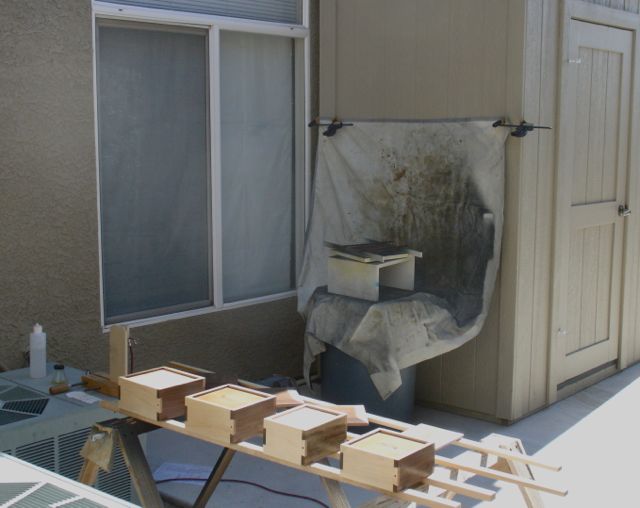
Nothing like the smell of Shellac in the morning!

Nothing like the smell of Shellac in the morning!

So — why talk about it when they’re not quite ready to ship?  Want to get this blog done and put this commission into the “complete” file to start on the next project.  All that remains is to rub out the shellac and I like to give the final coat at least 48 hours to cure fully.  The finish procedure on these boxes was to apply two coats of shellac, allow them to cure over-night before lightly sanding them with 400 grit paper.  After the final coats applied this morning are cured they will be rubbed out with Liberon Black Bison wax applied with a 4/0 white scotch pad.  Other than that the inside bottoms need to be lined with ultra suede and they’ll be ready to ship.  Two are for an order and the other two will be added to the store inventory.

Radius on the corner of the bottom piece

Radius on the corner of the bottom piece

Drilling holes for pins

Drilling holes for pegs

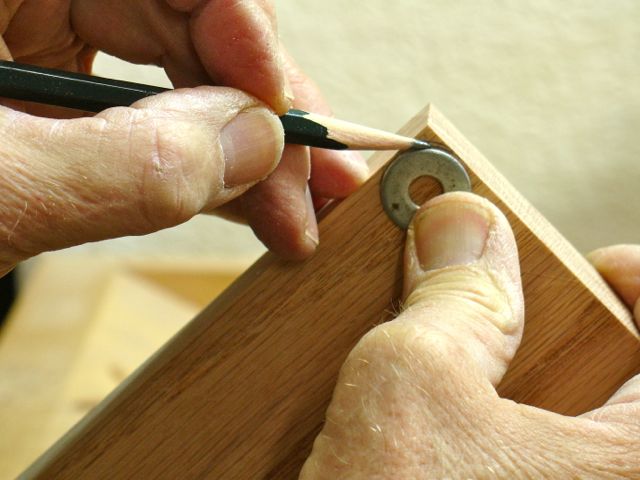
Once they were assembled the holes needed to be drilled out for the  3/16″ pegs centered in each tail.  This was accomplished at the drill press with a tall fence.  The last blog generated a number of comments about the box slotting bit that I used.  The bit is available from Lee Valley to cut either a 1/8″ or 1/4″ slot for box bottoms. For these boxes I used 1/4″ hardwood  plywood.  The only thing you need to fit these properly is to create a radius on the outer corners.  There are a number of ways to do this and my choice is to draw the radius on with a nickel and then remove it with a 1″ belt sander.

Beveling the lid at 15 degrees

Beveling the lid at 15 degrees

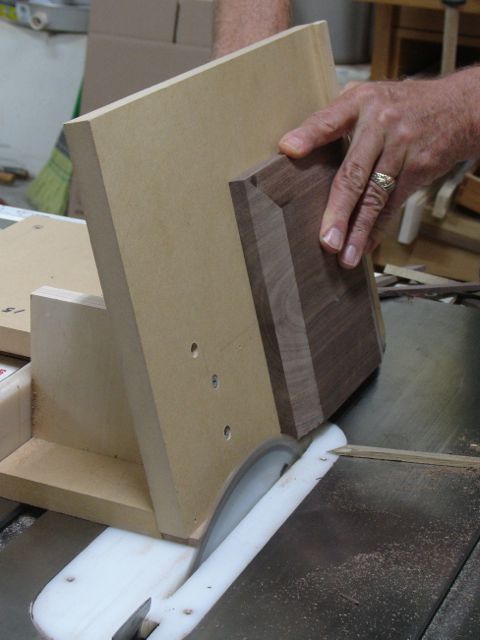
Glue up was next and since this is an unconventional way to utilize dovetails it’s a bit of a trick!  The glue of choice for me is Old Brown Glue due to its properties.  Only a small amount needs to be applied to the long grain of the joints and on the pegs.  Contrasting pegs were used which I believe adds to the puzzle like quality of these boxes.  After assembly I tackled the last step of making the lids.  They are a lift off affair that are rabbeted to fit the box.  They are bevel at 15 degrees, the process begins on the tablesaw with a fixture that slides on the rip fence and ends with block plane to remove saw marks and ensure the corners meet at a crisp 45 degrees.  I’ll have them packed up and ready to ship first thing Monday morning.

As always, I hope to achieve my personal goal of having the work exceed the expectations of my client.  I always appreciate they have enough faith in my abilities to commission a project from me via the internet.

Posted in Uncategorized | Tagged , , , , , , , , | Leave a comment

Break from the Routine — Road Trip !!

Diane and I took some time this weekend to do change up our usual routines.  Now that the bathroom remodel is complete we knew it was time to get out of town for a few days and do something different which we managed to do in Pasadena, California.  There is a huge (and I mean HUGE) flea market that is held at the Rose Bowl  which had always been on our list of things to do.  No way can you see every booth there in one day, we walked a lot, saw a lot, and; although we didn’t make any huge purchases we did have a wonderful experience.  The night before we went to the Norton Simon Museum and enjoyed the paintings, sculptures, and of course, picture frames there.  It’s always a treat to see paintings in person that you’ve only seen in books before.  Added to that is seeing other works from those famous artists that aren’t widely publicized.

FosterPlaningMill LogoAnother thing that has been on our list was to visit Foster Planing Mill located in Los Angeles.  I first learned of this place on-line when we were looking for moldings for Diane’s paintings.  They also exhibit at the annual West Coast Art & Frame show which is held every year here in Las Vegas.  Besides exhibiting they provide frame materials for the various educational workshops held in conjunction with the show.

Previously, we’d order a couple hundred feet of pre-finished molding and I’d make the frames from that.  As time went by, Diane wanted something to make her work stand out from everyone else’s.  We’d notice many paintings in shows and other galleries that had the same frame as hers!  Enter Foster Planing Mill and their excellent service.  Diane designed the profile she wanted and we worked with Bob to finalize it.  We’ve re-ordered that molding but when the economy tanked and Diane decided to put her painting on hold my framing days dwindled.  That’s changed now, and she has a new website and is also blogging about her work.   I’m happy happy making frames again for her work

80 Feet of Seconds Molding

80 Feet of Seconds Molding

Foster Planing Mill is located at 1258 West 58th. Street in Los Angeles and has been there since 1922.  In one of their newsletters they mentioned that they offered tours of the mill so I called last week and talked to Bob who said he’d be happy to show us around.  As you can see from this picture showing the moldings we bought, it is an old facility and I must admit — I loved it!  As a teenager I was hired at Silvera Lumber in Antioch, CA.  Started there in 1965 and worked until I enlisted in the Marine Corps in 1968.  When I was discharged in 1972 I went back to work for them.  The owner (Lou Silvera) and his son Dick were the best bosses I ever had.  Even though I quit them to begin my apprenticeship as a carpenter, they hired me back a few years later when the construction industry fell upon hard times telling me it was time to change occupational goals.  They worked around my schedule as I studied to become an Industrial Arts teacher.  That led to my 31 year teaching career.  Sorry about that long “back story” but taking the tour of Foster’s brought back many good memories about Silvera’s.

Foster’s is a company that still works the traditional way (no computerized equipment) and makes quality materials.  During the tour, Bob explained that much of the machinery dates to the 60’s and older!  To create custom moldings the first step is to cut the profile on a piece of steel plate.  Once that matches the design on paper, it will become the template for making the required number of cutters.  The machine that makes the cutters is similar to a lathe duplicator to ensure that each cutter is identical.  Depending on the complexity of the molding, two to six cutters may be required.  We started the tour with the gang rip saw that cuts materials to the required width before they go through the molding machine.  The molding machine cuts all 4 surfaces of the material.  From personal experience I can vouch for the quality and consistency of their materials.  No chatter marks and the wood is of excellent quality.

Sticks of molding that don’t meet their quality standards are destined to the seconds area.  This is where Diane and I spent some time picking out bundles of molding she thought were suitable for her work.  It’s also an area that reminded me of my work at Silvera’s — let’s just say I learned that pigeons and lumberyards seem to go hand in hand and learned how to eliminate them in my teens!  Diane prefers moldings that are at least 3″ wide and since she works primarily on canvas needs a deep rabbet.  That means they all start out from 8/4 stock.  You can’t break the bundles and pricing will vary with the profile.  Some of the pieces may have splits or knots I’ll need to work around.  Occasionally you can tell where the end of a piece was slightly narrower and the cutters made a pretty good snipe for a foot or so.  To make a long story short, we yielded about 75 feet of molding for $35.00.  Just to put that in perspective for you, I checked my price list from 2012 for the moldings we picked up and they ranged from $5.00 to $7.00 per foot!

The weekend was a great break from out normal routines but both of us missed our work spaces and being creative.  The Etsy order is almost complete, just down to the last of the finishing steps and I’ll blog them when they’re done.

So many projects — so little time!

Posted in Uncategorized | Tagged , , , , , , | 4 Comments

Etsy Custom Order — Two Boxes Continued

Work is progressing well on this project and it’s given me an excellent way to “hone” my dovetails.  Any time you read about certain skills the phrase muscle memory seems to come up.  I know during the many years I spent ultra-running my muscles responded to running without any hesitation.  Now, if I try chasing the dog around the house it feels like a completely foreign movement!  I now continue to pursue woodworking techniques and am rewarded when that muscle memory seems to be kicking in!  Here’s the progression so far:

This slideshow requires JavaScript.

There is so much information in magazines, on line, and from other woodworkers on how to cut dovetails it’ll make your head spin.  I always tell my students that the way  I teach is just one way and encourage them to explore other methods once they get the hang of it.  There are two woodworkers that have influenced me in this regard.  One is Tage Frid and the other is Christian Becksvoort.  I’ve linked them to information from Fine Woodworking if you’d like to learn more about them.  Like many others, Tage Frid influenced me when in the late 60’s and 70’s when woodworking and furniture making was a popular endeavor.  Christian Becksvoort started during that time period too and continues to make primarily Shaker style furniture.  In any case, my dovetail technique is influenced by both of them.  Both advocate cutting tails first, chopping out the waste with chisels rather than a coping saw, and stacking your work to aid your efficiency.  They also encourage you to learn how to saw to your lines so that you spend minimum paring with chisels to get the joints to fit.

You’ll recall I cut all of the tails first.  This morning they were scribed onto the pin board, cut and chiseled out.  Lay out begins with a marking knife but the line is darkened with a pencil whose point has been sharpened by a chisel.

This slideshow requires JavaScript.

Initial cuts on shoulder line

Initial cuts on shoulder line

This was done to each board until I had my “pile of pins” you saw earlier.  Both Frid and Becksvoort encourage stacking your pieces to save time it would take you to clamp them individually.  The first cuts are straight down into you shoulder line but not too deeply at first.  You only want to remove a thin sliver to begin with since going too deep will force the chisel away from your shoulder line.  Notice that in the Maple I cut a small wedge out of the waste area rather than a full piece as on the Walnut.  The hardness and grain pattern of the Maple wouldn’t allow for that full cut!

The technique is to cut about half way down on one side then flip the board over and finish the other side of it.

Very happy with how the initial fit went on these joints and not much paring was required.  Both Frid and Becksvoort recommend making your first cut into the shoulder line light and at 90 degrees.  Removing that piece gives clearance for your chisel and prevents it from pushing the shoulder line back.  It was really evident how different woods react to the chisel with this project.  The Walnut and Black Limba behaved while the Maple fought me every step of the way!  Once that initial, 90 degree shoulder is established the remaining cuts can be undercut slightly to make fitting the pin and tail boards easier.  Of course, having only one tail per board helped to make this more successful.

The remainder of todays work included using Lee Valley’s slot cutting bit to make the 1/4″ groove for the bottom of each box.  If you’ve never used this bit, Lee Valley #16J83; I  highly recommend it for installing bottoms in any box you make.  I do find that when making a 1/4″ deep groove it’s best to reach the final depth in two passes.  Tomorrow will be the time to fit the bottoms, sand the insides, and drill for the pegs in each of the tails.  Also looking forward to getting back to work on the Art Nouveau frame, Diane put the picture it’s designed for in another frame just to taunt me!

Posted in Etsy custom order, Hand Cut Dovetails, Tutorial | Tagged , , , , , , , | 2 Comments

Etsy Custom Order — Two Boxes

Chinese Checker Set

Chinese Checker Set

Last week I began a series of conversations with a potential client from my Etsy store.  They asked about making two boxes to hold pieces for a Chinese Checkers game set that is destined to become a Christmas present.  Included was this picture of the game set plus the box requirements  of 6″ square and 2 1/2″ tall on the inside.  She had found one of my boxes that featured dovetails so I suggested we use a style of boxes I have that called  Tails around the Corner.  These have a puzzle like quality and making them of contrasting woods will complement these game boards.

Pile of Tails

Pile of Tails

This met their approval and so work has begun on this project.  Since I had Walnut and Maple in the shop and they provide a nice contrast that is the material we agreed to use.  So far, I have what I’ll call a pile of tails!  I’ve found it to my advantage to make more than what’s needed for any custom order I receive and then add them to my inventory.  The box in the back is made of the same materials but different size, it’s my experimental box to make sure things will go according to my plan.  The pieces in the foreground are the custom order plus another of Maple and a nice piece of Black Limba I had from another project.

Stanley 140 Technique with a tenoning jig

Stanley 140 Technique with a tenoning jig

After cutting the pieces to size work began on the tails, if you’ve read my blog you’ll recall that I’m a “tails first” dovetailer.  I also use a variation of the Stanley 140 technique in my work which gives dovetailed drawers and boxes a neat, inside corner.  Not having a set of the skewed, rabbet planes I use either the rip fence or; in this instance, a tenon jig.  Looking at that pile makes me realize that there are a lot of dovetails that need to be cut!

Parts laid out

Parts laid out

The pieces needed to be chosen carefully for each box and marked for re-assembly.  For furniture work I use a set of metal alphabet stamps to mark joints but didn’t think stamping a bunch of letters on the bottom corner of each box would look too good.  Instead, masking tape and a sharpie were chosen for this project.  One word of caution, using the tenon jig can cause the bottom of the edge to tear out a little, that makes it a good edge to have on the bottom.  Yes, you’re not seeing things that is the heater going for the first time this season!  Those of you in colder climates probably think I’m being a wimp but we got down to 47 degrees last night!  Once I began sawing and chopping out the dovetails though the I warmed up naturally and the heater was moved out of the way.


Paring to the line

Paring to the line


The Walnut and Black Limba cooperated just fine to having the joinery cut on them.  On the other hand; the Maple was a real bear.  It is extremely hard and for some reason I really struggled maintaining a good line cutting down to the tails.  This line is about 1″ long and I found that I consistently angled to the outside of the line.  Maybe the wood, maybe the saw, maybe the sawer, but I’m going to blame it on the time change.  Thankfully I had recently re-honed all of my chisels so was able to pare each joint to the line.  Rather than allow myself to get upset I looked on it as a good exercise in honing my paring skills, we can always practice this craft to get better!

These boxes will feature a peg of contrasting wood in the center of each dovetail.  This is what I drew out for the client and besides adding a bit of strength, it will also add a nice design element.  Of course, you just can’t go out and buy dowels of any species of wood.  At the local big box stores you may find some Oak but most of it is a mysterious species of Chinese white wood!  That means you’ll need to make your own dowels out of your material of choice.  For me that was Poplar and Walnut.  I use a Lie-Nielsen dowel plate which is one of the few left on the market.  When I first began teaching woodshop in the late 70’s a standard issue item was a dowel sizer.  This was used to make dowels the exact size since at that time, they were usually oversized.  That’s not the case today, now they will usually be undersized and crookeder than a dogs hind leg!

There are several ways to go about making your own dowels.  One recommendation is to rive your wood to get the straightest grain possible.  Although this works well I find it to be pretty wasteful.  Another way is to cut oversized square pieces and then plane them to an octagon shape.  This time I decided to try a different approach and it worked well so here’s a little slide show on how I went about it.  In keeping with the current trend of putting out warnings and disclaimers this is probably not an OSHA approved method of using the tablesaw!  On making the second cut the piece of wood will shoot out behind you but I simply put my hand out to catch it!

This slideshow requires JavaScript.

Just a word or two about the dowel process, cutting on the saw is safe if you’re confident in your abilities and keep safety in the forefront of your mind.  It’s important to cut the piece upright first — if you reverse the order all that remains is a very thin piece that will lodge between the blade and the slot creating a kickback or worse!  As with most of my things, the dowel plate holder is “over-kill” but since I spend much of my time in the shop I’d just as soon be surrounded by things I like to see.  This is made of a piece of 8/4 White Oak and Lacewood.  The purpose of the holes through the bottom rather than just one open slot is to prevent the dowel from twisting as it’s hammered through the plate.  Not all of the dowel will be perfect, you may have a flat spot here and there but should be able work around that.

Posted in Uncategorized | Tagged , , , , , , , | 4 Comments