Art Nouveau inspired Picture Frame

My wife, Diane, has been very busy creating new art work in her studio.  She recently changed her website to dianeeugsterart.com  Since her studio location is on my way to the shop I get to spy on her whenever the door is open!  Sometimes I’ll see one of her works in progress and feel the inspiration for a frame design which was the case for this one.  I’ve always liked the Art Nouveau style but find that my carving skill level isn’t quite up to the task of reproducing many of its intricacies.

Carve Prototype

Carve Prototype

I came up with a simplified design to carve onto the frame and this is the prototype.  The frame will be painted black but before painting, the carved areas will be silver leafed.  My technique is to allow the paint to cure for a few days and then carefully rub the paint away over the gilded areas to expose the silver.  This is done with a cotton ball and wax.  I didn’t allow the paint to fully cure — got impatient and wanted to see how it would turn out.  The tricky thing (which I goofed up!) is the under/over aspect of the carve.  At the far right it flows over and then should have gone under the carve, one of those things that you really have to study to see.  On the actual frame the ribbon is carefully laid out.
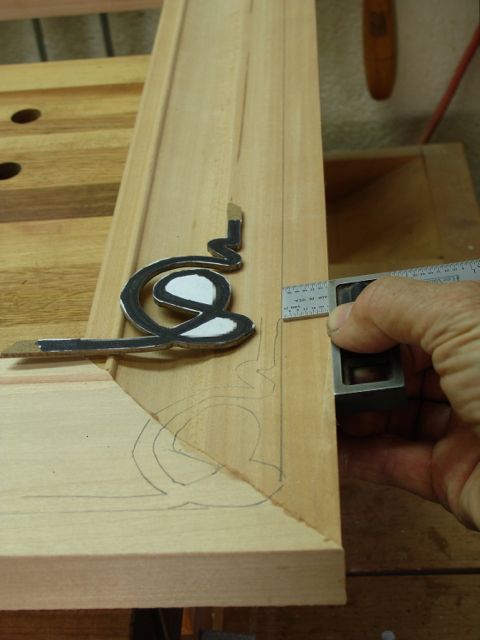
Laying out the Pattern

Every project has its new and unknown factors, that’s what keeps me motivated when I create something.  To make sure the corner pattern will be as close to the same on each corner as possible a template was made from some 1/4″ masonite and transferred to the actual frame.  Initially, lines were drawn completely around the frame and the pattern lined up with that.  The white areas of the design were drawn in freehand.

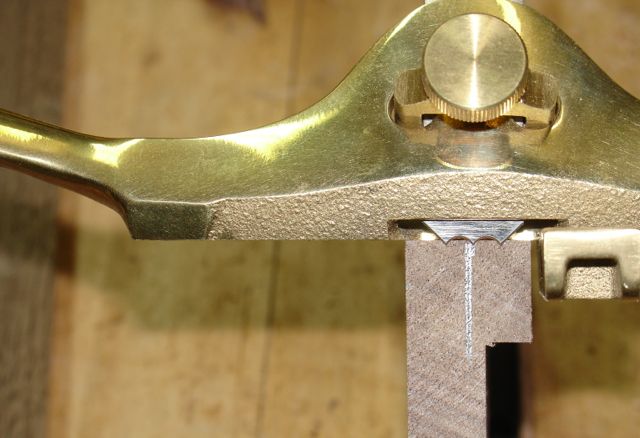
Next up was laying out the single line that connects the corner details.  Working at this craft is mostly a solitary pursuit so you need to come up with your own ways to do these things sometimes.  My dilemma was how to draw a straight line that would be consistently parallel to the edge of the frame and then equal width all the way around.  I chose to use my marking gauge for this and so far it seems to be working!  The marking gauge is one I made myself and I was able to extend the cutter (from Hamilton Tools) to get the depth needed.

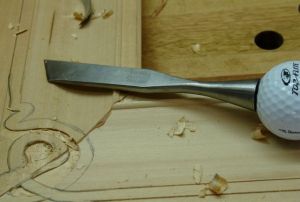
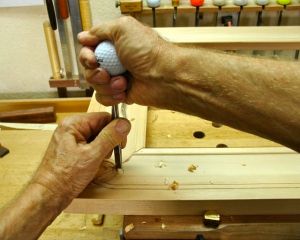
Now the work begins.  I suppose that oft quoted saying of “ask 10 woodworkers the same question and you’ll get 12 different answers” applies to this project.  A few years ago I took a carving workshop from Ian Agrell where I learned his techniques.  Essentially, each curvature of the carve is first outlined with the appropriate sweep and size of chisel and then the background is removed.  Well, it didn’t take long to discover that this requires a huge number of chisels ($$$!).  A  friend of mine here in Las Vegas, who is quite an accomplished carver; uses a knife to do almost all of the initial outlining.  I’ve had some success with that process but have a hard time making smooth curves as my hand seems to be in the way of seeing the line.  So, I improvised by modifying a double beveled, skewed chisel for this purpose.  This was a Marples, blue handled chisel I’d had for years but never cared for the look and feel of that handle —- enter the golf ball!

I’ve used golf balls for years on handles for files and rasps.  They fit comfortably in the hand and allow you to grip it in any position needed.  This method seems to be working for me but I wouldn’t turn down any advice from other carvers on how they would tackle a project such as this.


Posted in Carving, Gilding, Picture Frames | Tagged , , , , , , , | 8 Comments

Garage Side Door — Unorthodox Methods but Done!

Well, I was so glad to get the door completed and hung that I took a few shots of it with my iPhone and posted them on Facebook!  It brought a number of positive responses and I knew I wanted to share the final steps of this project with my readers so here it is.

Twin Tenons

Twin Tenons

First of all, the initial process of how I went about making this door and my reasons for it can be found in this first blog on the project through this  LINK .  Much larger in scale than my normal furniture work but sound construction practices included twin mortise and tenon joinery with tenons 5/8″ thick and 2 1/2″ long.  All the material used is 8/4 Poplar and the Speak Easy window is 7/8″ in thickness.    As expected, there is a little bit of a discrepancy in the flatness of that panel but that will probably fluctuate with the seasons anyway so I’m not overly concerned about that. I did build it more to furniture quality hardwood and oil finish standards rather than construction standards using Poplar and latex and found my fit was a bit snug!

Speak Easy adjustments

Speak Easy adjustments

I needed to relieve the corner where the panel pivots into the opening.  My first plan was using a piano hinge but that proved to not be a good one — too much flexibility.  I resorted to a couple of butt hinges which work much better.  The sides of the panel were trimmed as well and the opening is now sealed with weatherstripping.

Laying out bevel

Laying out bevel

The unorthodox method I used to hang this door included mortising and fitting the hinges to the stile before gluing the door together.  The same procedure was followed for setting in the lockset.  This was a much easier task for a one man operation before assembly and the resulting heavy door!


Beveling the Strike Edge

Beveling the Strike Edge

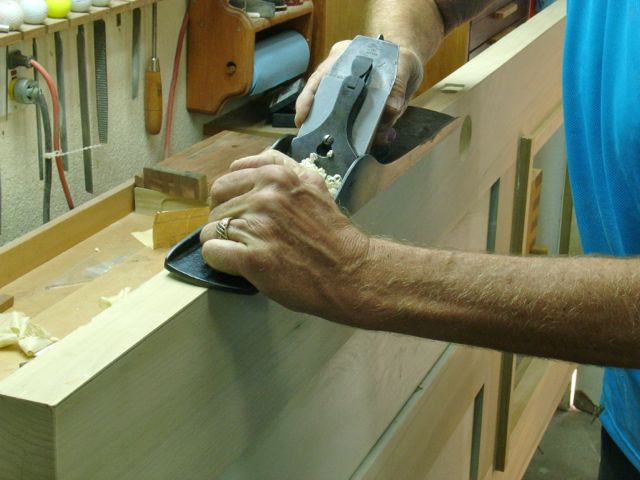
The only thing done after assembly was planing a slight angle on the strike side of the door.  The original door was 1/8″ smaller across the width on the front so that’s what I used to lay out my line.  I then planed to the line using a small bevel square to check my progress.


Out with the Old

Out with the Old

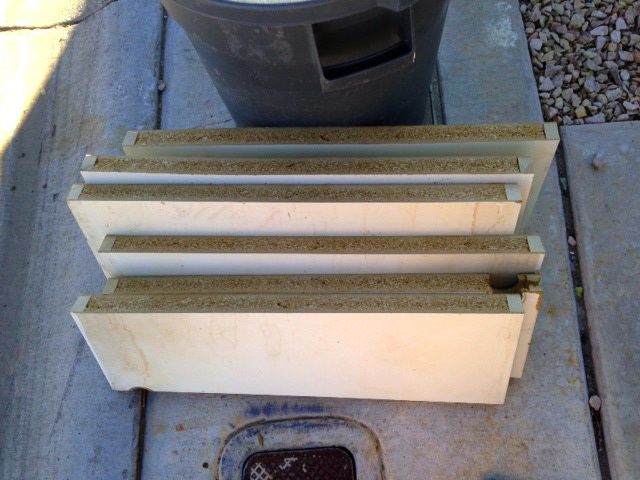
It took some final adjustments and fiddling around but all in all this project went rather smoothly.  There always seem to some unforeseen things in any project.  The positive things though is that I now have a door that isn’t delaminated and at the bottom and blistered on the surface, I can get light and air into my shop area and have full access to the tool chest and end vise, and finally don’t need to worry about Brandi getting out unnoticed!  Here’s the old door, right where it belongs with the trash.  Basically a solid block of particle board, yikes!

Last but certainly not least, let me leave you with this slide show of this custom, garage side door.  One of my friends coined it as the Vegas Dutch Door.

This slideshow requires JavaScript.

Posted in Home Remodel, Uncategorized | Tagged , , , , , , | 1 Comment

An Unorthodox Way to Hang a Door!

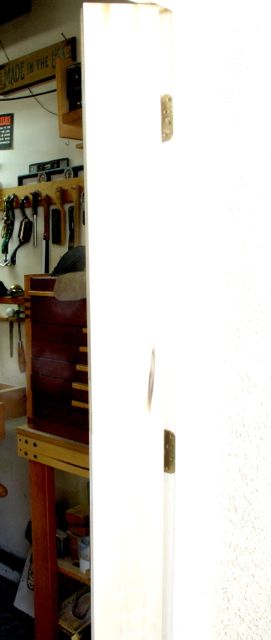
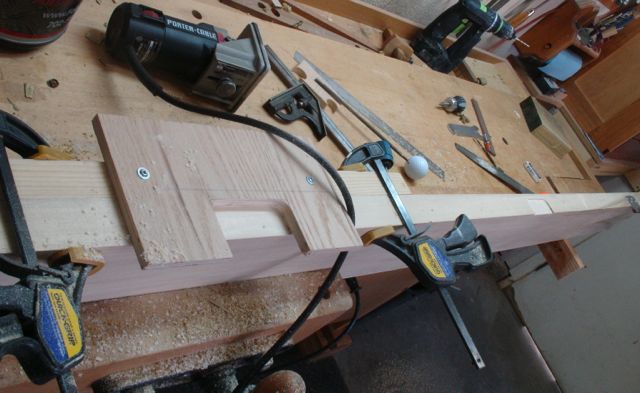
CrappyshotThis is a strange picture to say the least so I’ll try to explain what you’re seeing.  The lighting and then white against white makes it a bit hard to distinguish — actually it’s a really crappy picture but I can’t adjust it any better so please bear with me.  Since this is a solid 8/4 Poplar door (2/8 x 6/8) and I’m a one man operation I thought to myself: “do I want to fight this heavy door and put out my back?” Obvious answer was no!  So why not just set the hinges on the hinge stile of the door before assembling the door?  Well, since I couldn’t think of any argument against it, that’s what I did.  What you’re looking at is the hinge side of the door, pivoting nicely on the existing hinges.  To get to that point the center hinge was removed to make a template out of some 1/2″ plywood.

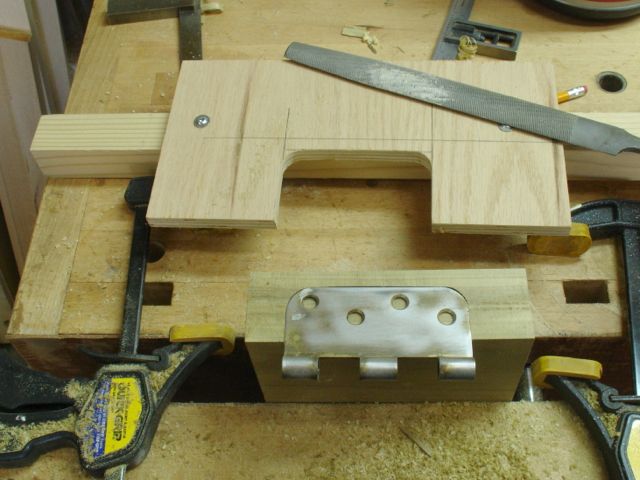
Hinge mortise jig test in scrap wood

Hinge mortise jig test in scrap wood

Had the hinges been square cornered it would have been just as easy to do the entire hinge mortise with chisels but the radius makes it tough to accomplish.  It took a little bit of adjusting with files but the end result was that the hinges fit snugly into the mortise.  After doing this test piece on some scrap the locations were carefully measured, transferred to the door, and all of the mortises were cut.  At this point I was able to remove the door, install the hinges onto the stile and give it a test.  If you’ve ever set a solid door you’ll understand how much easier it was only working with the one stile rather than the entire door!

All mortises cut

All mortises cut

Adjusting the backset

Adjusting the backset

As luck would have it and as I kind of expected, my template didn’t go into the door far enough so some hand fitting was required.  It was hard to get exact measurements for the setback on the old door due to multiple coats of paint and 18 years of weathering.  After setting a marking gauge and scribing the needed setback the mortise was adjusted with chisels to fit.  Once the fit was correct the first holes were plugged with 3/16″ dowels so there won’t be any weakness when the door is attached.

Lockset hole and mortise

Lockset hole and mortise

I used the same unorthodox way to drill the holes for the lockset.  Having just one stile I was able to set it up on the drill press to ensure straight and accurate holes without the use of a template guide.  Once the holes were drilled the mortise was cut for the latch.  Sure have been getting lots of use from the small, router plane on this project.


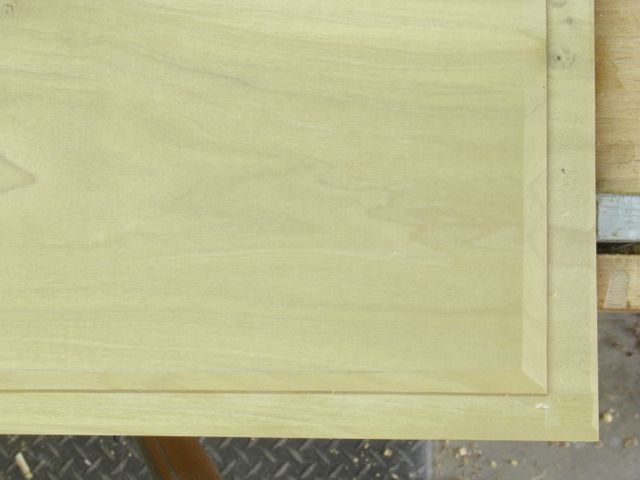
Chamfered Edge on Panel

Chamfered Edge on Panel

In the first post about this door I talked about the joinery and stock preparation.  The first piece to be assembled was the bottom and middle rail with the center stile.  To fill this area in there are two, 1″ thick Poplar panels.  They were initially formed with the use of a dado head to cut a 1/2″ long by 5/8″ wide tongue on the center of each panel.  These were trued up with a rabbet block plane and then a chamfer planed all around.  After penciling in a limit line the end grain was done first then the edges brought to them to get a crisp, mitered edge.  You know I absolutely hate to paint wood and had really thought about just clear coating this door with an exterior varnish but it really would look odd so they were painted white before assembly; however, I couldn’t resist hand planing them to get my optimum finish!

Please --- no Paint!!

Please — no Paint!!

At the end of the day I was able to assemble this door.  Here’s another odd shot to show the completed work.  I’ll use hand planes to bring all of the joints flush with one and other.  I used Gorilla Glue for this project, it should be a good choice for a lasting job plus it made the joints slide together nicely.

Glued and Clamped

Glued and Clamped

Only one of the pieces had a bit of a cup but this will be a good opportunity for me to brush up on my hand planing techniques.  Unfortunately, the entire project will be painted!  The only work still required will be planing the edge that closes at a slight angle (5 degrees or so) to make closing effortless.  The panel in the center needs to be laminated and the molding/stop needs to be designed and formed.  Getting anxious but it’s always the final steps that take the most time and care!

Posted in Uncategorized | Tagged , , , , , , , , , , | Leave a comment

Garage Side Door — Past Due Project

One of the things that rarely need to be replaced in our homes are the doors.  Sure, you may add a more decorative door to the entry to enhance the looks of the house or GarageSideDoorFrench doors to make a more dramatic entry to the back yard but all in all; the slab doors found in most of our tract homes will be there forever.  Add functionality and appearance into the equation plus the challenge envolved in making a door and you’ll understand why I’ve taken on this project.  The side entrance of my garage is barely visible from the street but being a masonite covered, mass produced slab is looking pretty poor.  It’s been repainted several times but the bottom is delaminating and allows water to seep into the shop during those rare desert rains.  That takes care of the appearance, as for the functionality of it the main problem is that when it is open it covers my tool chest plus interferes with the tail vise of the work bench.  I like it open for the light and the air circulation but an added concern is that Brandy, our miniature Dachshund can go unnoticed and end up out in the street —- not a good option at all!

The first type of door I considered was a Dutch door, one I’d created from a standard door in another shop.  That wouldn’t solve the access to the tool chest problem plus it still could interfere with the tail vise.  A door with a glass in it (BelAire style) sounds good but the glass creates a security problem plus it’s a western exposure so late afternoons would get pretty toasty.  I’ve decided to try my hand at designing a door with a large, “speak-easy” panel that will fold down, flat inside of the shop.  After pricing materials I choose to go with 8/4 Poplar for this project.  Having never made a door of this size and complexity before I’m headed into this with caution so will take my time to plan it out to the best of my abilities so it will be a success.  I selected the best materials I could find at our local Peterman Lumber, boy; that 8/4 Poplar in 16′ lengths is pretty heavy stuff, especially when it’s stored in upright racks!

Truing up the edges

Truing up the edges

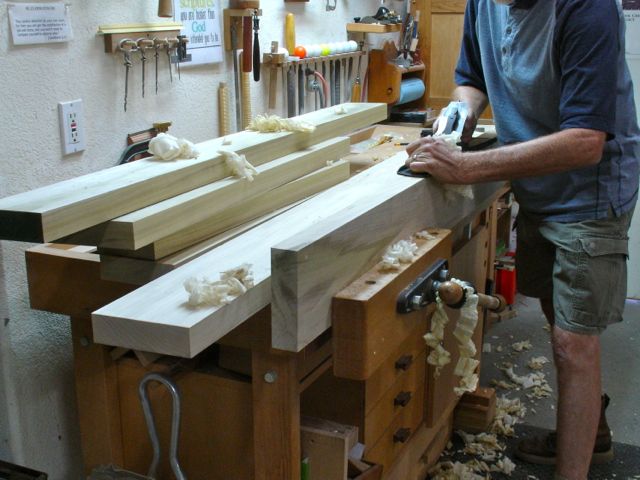
Once I got it home the first step was planing their straight line ripped edge with a #7 Joiner plane to square and true it up.  This was followed by ripping the pieces to width for the stiles and rails.  When I selected the stock I was careful to also find the 5/4 material wide enough to make one piece panels in the bottom section of the door and only need to glue two boards together for the top, “speak-easy” panel.  After ripping them to width the next step was to place a 5/8″ wide by 1/2″ deep dado for the panels where it belongs on each piece.  Since I’m using this material without bringing it all to uniform thickness first one face was marked so it’ll always be referenced against the fence of the tablesaw and mortising machine.

Mortising Stiles

Mortising Stiles

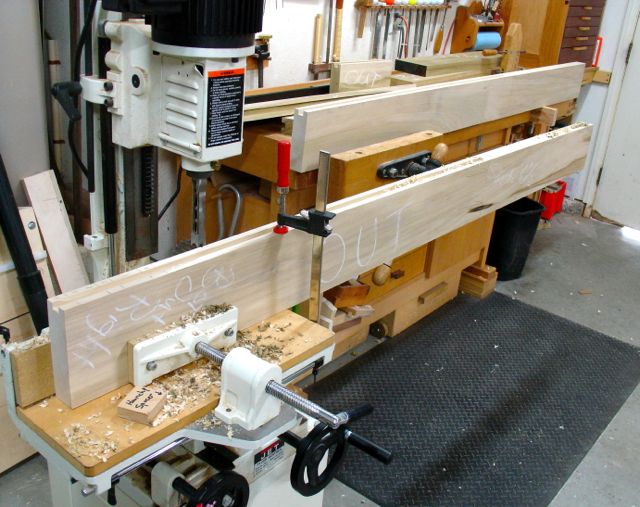
Next up was cutting the mortises where needed.  The stiles are 6 1/4″ wide while the rails are 7″ bottom, 5″ middle, and 6″ top.  The tenons will be 2 1/2″ deep for the horizontal rails and because of their width I’ll use twin mortise/tenon design.  Glad I have a hollow chisel mortiser for this operation.  I was concerned about the clamp holding the stock securely but with the addition of a clamp near the end of the table there were no problems.

Spacer for Haunch Depth

Spacer for Haunch Depth

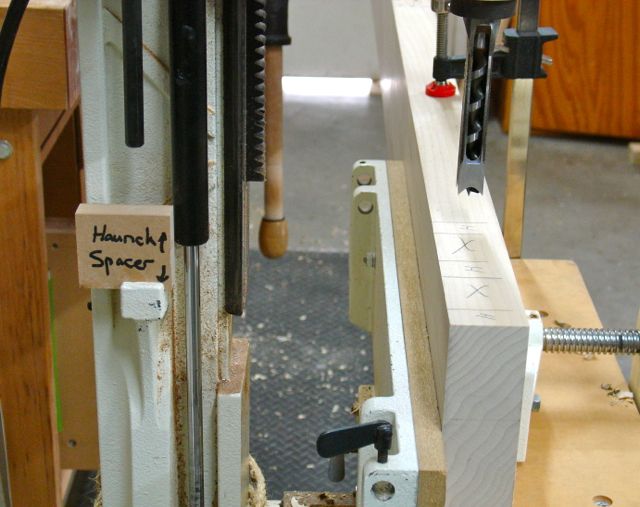
By using a spacer block as shown in this picture, it’s a simple matter to change the depth of cut as needed for the haunches.  You may notice the chalk markings on the board, I was careful to make sure the same surface of each piece is placed in the same orientation.  I’m certain there will be some touch up planing to get everything lined up once the door is assembled but this will simplify that process.

Cutting tenons on tablesaw

Cutting tenons on tablesaw

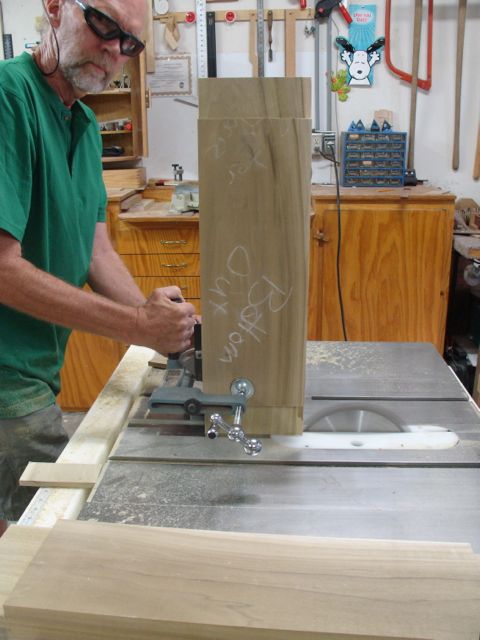
Next step was cutting the tenons on the ends of the rails.  Being a “hybrid” woodworker I used the tablesaw for the initial cuts and then fine tuned everything with hand tools.  These were probably the largest tenons I’ve ever cut but I want this door to last the rest of my lifetime.  After cutting the shoulders, the tenoning jig is used to complete the work.  At last, the noisy and dusty machine work is complete and I can turn my radio down and get into the quieter work of refining the joinery.


The process began by using a small router plane is used to make the haunch depth uniform on all of the pieces.  Ironically, the glass tile pieces recently used for the bathroom remodel were the same size as the haunch so that was used to pencil in that line.  Here’s a slideshow of the tenon cutting process:

This slideshow requires JavaScript.

Next up will be making the panels, locating the hinges and lockset, and putting it all together.

Posted in Home Remodel, Uncategorized | Tagged , , , , , , , , , , | 1 Comment

Updating the Bathroom

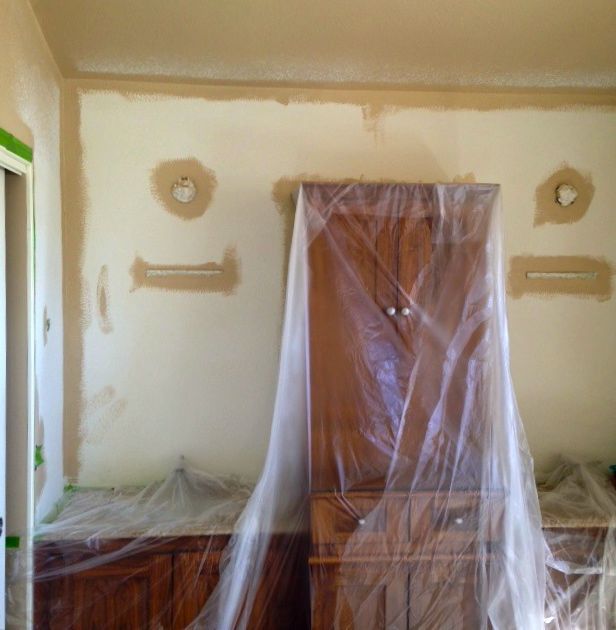
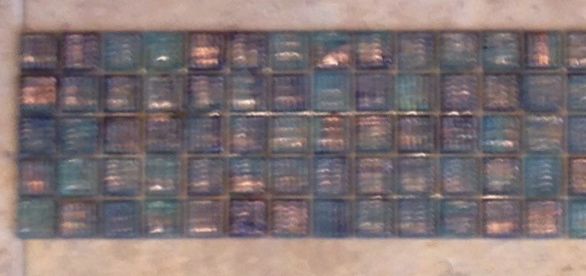
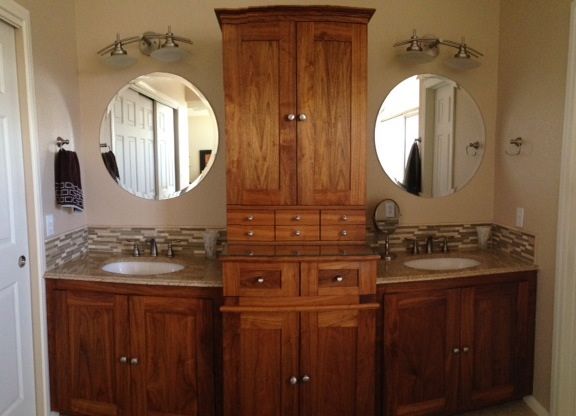
After living in our house for 18+ years we knew the bathroom would need some major work.  You know, tiles and grout are just not designed to last indefinitely and water does a lot of damage to any structure, no matter how well it was built to begin with.  Besides, just like everything else in houses, things do get dated and it’s a good idea to keep this major investment current.  More than 10 years ago, our master bathroom got an update in the form of flooring and cabinetry.  We removed the full wall mirror that was standard for tract homes in the 90’s and I built solid Walnut cabinets that included laundry baskets and a tall center unit flanked by 2 round mirrors.  We also did new granite counters with undermount sinks.  Image 1I don’t have any pictures of the original work but this one shows the current work in progress.  Here I had removed the older, blue glass tile backsplash, repaired the drywall, and was just starting to repaint.  Lucky for us, Home Depot was able to color match the paint from a section I peeled off above the center cabinet!  So after the drywall was replaced we called in a professional to skim coat and match the texture from the other walls.  old tileThis is a picture of what the original glass tiles looked like.  They’re okay but just not up to date anymore.

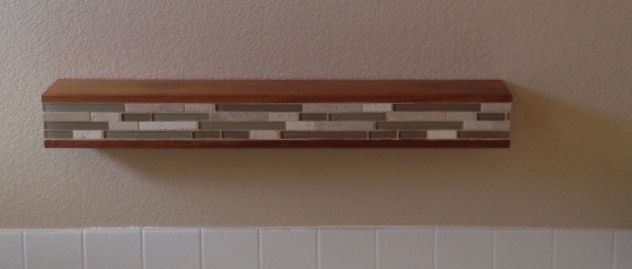
Bathroom ShelfWe selected a mosaic tile that consisted of  3/4″ wide pieces of glass and travertine stone. This was a new material for me to experiment/work with!  Luckily, my across the street friend and neighbor let me use his wet tile saw to cut all of the pieces for the job.  The first thing I attempted with this material was to re-do the Walnut and tile shelf that goes above the bathtub, it too had the blue glass tiles.

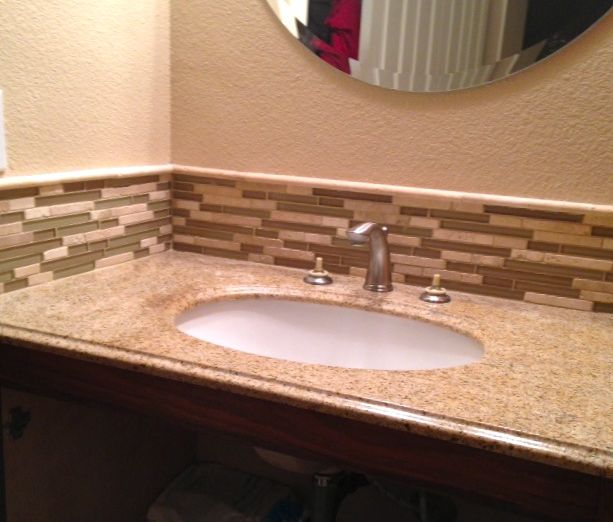
backsplash closeupOnce the walls were dry the tiling process began for the backsplash.  One day to adhere them to the wall and dry thoroughly  before grouting.  The travertine also required sealing before installation.  After the grout was pretty much set, the top cap was attached, again something I’d never attempted before.  Corners mitered and all came out as we hoped.  The doors were all removed and wiped down with my three part top coat that consists of pure gum turpentine, varathane, and boiled linseed oil.  This finish is rubbed into the wood with small pieces of denim and wiped completely dry.  Same process was used on the face frame and sides of the cabinets in the bathroom.  The shower pan and surround for it and the bath will be installed next week.  I don’t want to tackle that one!  We’re going with cultured onyx panels to eliminate all grout lines and possible water damage.  The final step to the update will be frameless glass doors for the shower.  Here’s a panoramic shot of the bath taken with an iPhone, it’s a little distorted but you get the idea:

Pano w:light off

Tomorrow it’s back to work on the side door for the shop/garage.  Haven’t started to blog about it yet but it’s a project that has been on my “to-do list” for quite some time.

Posted in Uncategorized | Tagged , , , , | 1 Comment

Dining Chair with Seagrass

Philosophical thought for the day:

Without experience you don’t know the pitfalls and potential problems of a project, it’s only by trying something new that you discover them.

Prototype with new seat

Prototype with new seat

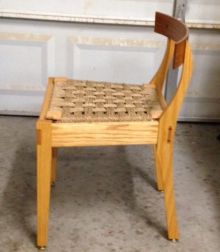
That thought came about during my  time spent caning a seat for the set of dining chairs I made back in 2009.  This was before I had my WordPress blog and was using the Blogger platform.  I’ve looked to find information on their construction but unable to locate that in the archives but here is a LINK to the original chair.  This one pictured is the final prototype made of Red Oak.  The laminated back is Canarywood which is what the final set of six were made of.  Following my wife’s lead of entering painting competitions I thought entering this chair in the Design in Wood competition sponsored by the San Diego Fine Woodworkers was worth pursuing.  To my surprise, it was juried in to the show and awarded an Honorable Mention!

As the years have gone by, the original fabric on them is beginning to fade and show some age.  Some of my recent projects have included woven seats like this one for our clubs Christmas Challenge.  I really like the look and feel a woven seat provides but you need a chair that has narrow stiles to wrap the grass around.  I happened to see an antique chair with an insert so thought this was a feasible option!  Notice the word “thought”, like my philosophical rant at the top of this post that’s the key word of the day!

The idea was to create a frame to wrap the cord around that would fit in the seat opening.  The original chairs have a seat of plywood and foam.  Using 5/8″ by 1 1/8″ Poplar and lap joints was how the frame was made, decided to stick with hand tools for this project since that’s the best way to maintain those skills.  It would have probably taken as much time to set up jigs, blades, etc. to machine the joints out.

Corner Blocks

Corner Blocks

Because of the angles, gluing the frame up was a bit tricky but by maneuvering the torsion boxes around proper clamping was possible.  The next step was adding blocks at each corner to fill in that space but the more important reason for them is a positive stop for the grass.  These were scribed to match the corners where the side rails met the leg and front rails.  They are located square in relationship to the front rail and overhang the frame by the diameter of the seagrass I’m using, about 3/16″.  No strength is required so a simple rub and clamp glue joint is sufficient. Now we begin the weaving process, here are the highlights in slideshow form:

This slideshow requires JavaScript.

Time spent weaving a seat is really quite enjoyable!  Well, until the strand of grass breaks in a place you can’t add another on, or you lose count and make two wraps where you should of made one, or you have too much slack in a weave you made 3-4 courses ago,   or ………..!  Seriously though, weaving is enjoyable.  Kind of like running my ultra marathons where instead of one foot in front of the other repetition it’s one strand over the other, count and repeat.  I get this material from Franks Cane and Rush out of Huntington Beach, he’s been very helpful and is a reliable source for all types of chair materials for me.

So, let’s go back to my original, philosophical outlook on this project.  I was feeling pretty good about the weaving.  It does take time but is very relaxing for the most part.  Just put  SOS on the radio, sing along and don’t lose count.  Occasionally the strands do break since Hong Kong Seagrass is a natural, twisted material.  I found that by wetting it for about 10 seconds in warm water it’ll work a bit easier.  Here’s the majorHongKongSeagrass-WoodworksbyJohn-PrototypeChair-Complete-2 pitfall I discovered after completing the insert.  Because the chair was designed for a slipseat, I placed the corner supports about 5/8″ below the top of the rails to accommodate a 1/2″ plywood base.  With the seagrass wrapping all the way around the corner blocks no longer fit flush with the tops of the rails and have an unattractive appearance.  The insert looks okay on the sides and front but at the corner block it shows the frame underneath.  I had thought of making corner blocks that wrap around the edges but that would create a very delicate piece with a good chance of breakage.  This chair is really comfortable and will go back to my study with the Seagrass seat, the others will be re-upholstered with a better quality material.

I now have the experience needed understand the pitfalls and potential problems of this type of seat construction.  To design a chair with a woven inset requires the corner braces being placed lower to accommodate the inset and grass.  Since these were glued and screwed into place, modifying the chairs is out of the question but —- now I know!

Posted in Uncategorized | Tagged , , , , , , , | Leave a comment

Of Beading Tools and Scratch Stocks

CustomPictureFrame-Walnut-HandBeaded-WoodworksbyJohn-LasVegas-4

If you followed my blog on the making of the Treble Clef custom box for an Etsy special order you’ll recall the carving that I did for the lid; here’s a LINK to that blog.  To be on the safe side I chose to do an example one at the same time so essentially, I ended up with two of the carved, treble clefs!  I decided that since I now have an unneeded, gold,  gilded piece that looked pretty decent why not build a frame for it and put it on the Etsy store to sell!

My first thought was to just chuck a bit in the router and hog out some Walnut for the frame but you know me, I do prefer hand work over the dust and noise of the machinery.  I used to always make my own scratch stocks and holders as the picture above shows.  Being a minimalist and frugal that always seemed best to me.  I had a good friend who I helped move from New Jersey.  During the drive he asked me what tool I really wanted and I told him that the Lie-Nielsen #66 beading tool was something I’ve always had my eye on but really went against my philosophy and frugal nature.  Well, he surprised me with it and I love using it on my work.  Something special about a hand beaded finish.

Adjusting Fence & Depth

Adjusting Fence

Since this was to be a shadow box type of frame the first step was cutting a deep rabbet in some 1 1/2″ wide Walnut that I had.  This was done on the tablesaw.  After deciding which cutter to use the fence and depth were adjusted.  Even if this in’t quite centered, as long as the fence is guided along the same edge it’ll be no problem.

CustomPictureFrame-Walnut-HandBeaded-WoodworksbyJohn-LasVegas-3


Some other woodworkers I’ve talked to mention that they have problems cutting with the #66 but if you begin by taking a series of fairly short (2″-3″ or so) cuts to introduce the cutter into the wood things should cut nicely and you can complete the piece with full strokes.  You do need to allow some extra at both ends since scraping that cleanly is difficult.

Nice cuts on Walnut

Nice cuts on Walnut

When everything is set up you will be able to achieve some very nice shavings.  There may be some chatter due to the grain of the wood but by tilting the tool slightly one way or the other you can usually overcome that.  Personally, I find that a slight amount chatter adds to the charm of the work.  Once the beading work was complete, the pieces were mitered and joined with glue.  The finish on the frame is oil with a 3 part top coat wet sanded for a traditional looking piece.  I think this will be ideal for a musician to hang on his or her wall or receive as a present.  Now I’ll have to wait and see if the Etsy shoppers feel the same way!

MusiciansWallArt-WoodworksbyJohn-GildedTrebleClef-1

Musicians Wall Art 7″ wide x 13″ tall

Posted in Carving, Picture Frames | Tagged , , , , , , , , | 1 Comment

The Real Reward!

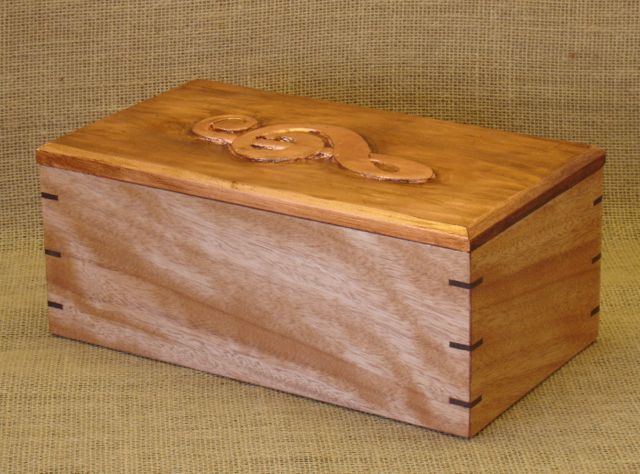
Completed Box, Ready for Shipment

Completed Box, Ready for Shipment


Those of you that have been following the creation of this box may recall that I sent my client images of the lid in its almost completed state.  When you do things like that you run the risk of them not liking the work so far due to the quality or angle of the photograph and you know that seeing and touching the actual object will never compare to an image.   I’d like to share her response with you:

“I love it, love it, love it! My house is full of antiques. (Heck, my house is an antique – built in 1908.) So this custom box will fit right in and everyone who knows me as the music nut will understand it perfectly. I’m looking forward to getting my hands on it.”

Any of us that work in creative endeavors know that the satisfaction of your client means so much more than the monetary rewards.  That expression “starving artist” is a valid one as many of you may agree with.  This project was really fun for me, trying to create what someone else envisioned and having it all work out.  The wood used is African Okoume which I bought from Cook Hardwoods.  I’m on their weekly email list and the information they send is always tempting!  I enjoy working with unusual, exotic woods and as you can see in the picture, there is a lot of figure which I’ve emphasized by making sure the grain is continuous as it works its way around the box.  The mitered keys are Walnut.

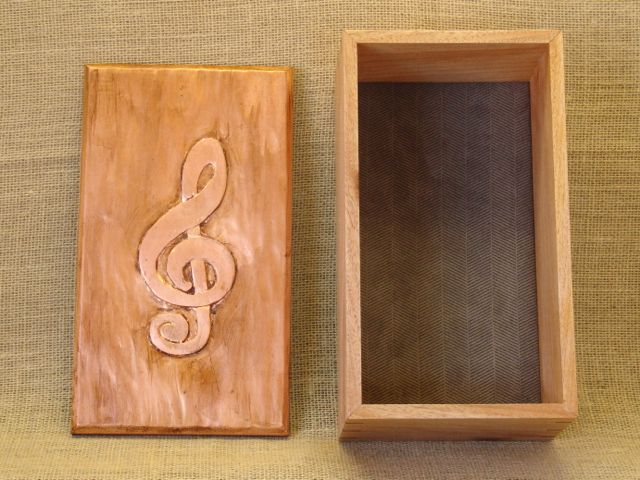
The top was the biggest challenge as it’s the focal point.  It’s so nice being able to do a Goggle search for images, copy it to your Pages program and then manipulate it to fit the needed space in the project.  At her request, after carving it was gilded with copper leaf.  The toning was accomplished by first taking the sheen off with 4/0 steel wool followed by  shellac and thinned down asphaltum.  As I mentioned in the blog on that, toning is where things can go either great or horribly wrong!

In any case, the box was shipped out yesterday morning and I’m looking forward to the next commission.  It would be nice if it were a furniture piece but anything that keeps me in the shop is a good one!  Several personal projects to start that include weaving seats and building a door for the side of the garage — this western, desert exposure is murder on a mass produced, big box quality door!  Here is the final look at the completed Treble Clef box:TrebleClefBox-Etsy-AfricanOkoume-WoodworksbyJohn-4


Posted in Carving, Gilding, Mitered Box | Tagged , , , , , | Leave a comment

Treble Clef Box Update


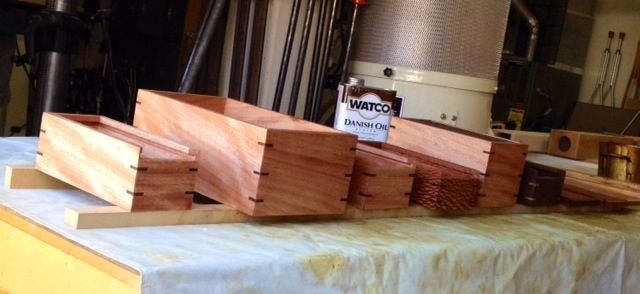
Pretty Boxes All in a Row

Pretty Boxes All in a Row

Always hesitate showing work in progress; worst case scenario is that your client wouldn’t like what’s going on due to the picture, angle, etc.  Heck, I like to take chances and since it’s been a while since I’ve written anything about this series of boxes it’s time to blog something!  This is when time seems to stand still during the creation of a project.   Doesn’t matter if it’s a box or a dining table with 6 chairs, when you begin the finish process you feel as if you’re working slowly.  It’s just the nature of the beast; I’m using Watco oil on these which is wet sanded into the wood.  There will be a total of 5 coats and each needs to dry/cure overnight so that’s where the progress seems to slow down.  In the picture above, all but the second from the right and second from left are sliding lid boxes.  Second box from the left is the custom ordered one for my Etsy client and will have the lift off lid.  The second from right will be hinged after I separate the lid from the rest of the box.  Pretty much all that remains is to apply a final coat of wax and line the bottoms of each box.

The carved lid is another story!  When it comes to adding a wash or toning a gilded surface you’re never quite sure of the outcome and, to make things even more dicey; things can go bad in a heartbeat!  My goal was to create a surface that would reflect the light as it’s viewed from different angles.  My client requested copper and wanted it to appear as if it had been around for a long time.  Here’s a slide show taken with an iPhone while the lid is on a turntable.  I rotated it 90 degrees for each picture:

This slideshow requires JavaScript.

Personally I’m pleased with the outcome.  As often seems to be the case, carving and creating these boxes took more time than I anticipated but that’s the nature of the beast when you’re involved with artistic endeavors.  Diane and I have decided that two, starving artists on a fixed pension makes for a happy couple of people!  Hope this box is everything my client envisioned and the others find success on the Etsy store or the next craft fair.

Posted in Etsy custom order, Gilding, Sliding Lid Box | Tagged , , , , , | Leave a comment

Treble Clef Box Lid

CopperGildedTrebleClefThe request for this custom order from Etsy was a large box to store remote controls for her music system.  Just so there wasn’t any confusion as to what the box will contain she asked if I could carve a treble clef on the lid and then gild it with copper leaf.  I just completed the gilding of it this morning and this is what it looks like before the copper is toned down a bit and sealed.  One of the things about copper is that it began to tarnish almost immediately, once the size is completely cured it will get a very light scuffing with  4/0 steel wool and then sealed with shellac.  The shellac will more than likely be tinted to soften the coppers shine.

The way I went about this particular carving was to use a spray adhesive to fasten it to the wood.  I thought I’d try this rather than using tracing paper to get the design on the wood.  Then it was a matter of cutting the outline, for this I like using a chip carving knife from Hock Tools, Ron really knows how to work blades and I’ve used his plane blades to make my own scrub plane.  I chose this rather than a V-chisel because the Basswood didn’t cut too cleanly with it when going across the grain.  I found that an advantage of gluing the design directly to the wood is that the inside shapes and lines remained where they were supposed to, the only downside is that the residue of the adhesive was a little difficult to remove from the surrounding area.  Next time I’ll only apply the adhesive to the back of the paper rather than the entire board.  Here’s a slide show to give you an idea of how the work progressed:

This slideshow requires JavaScript.

Usually boxes are smaller than this one so adding texture and shape to the lid background is pretty straight forward.  The background is always a dance; you don’t want it to look as if it were hacked out crudely but you also don’t want it to look as if it were done with a machine.  At this point I try to create a uniform flow of valleys and peaks to catch the light.  Once I was satisfied with the overall appearance the edges needed to be chamfered a bit.  I suppose this could have been accomplished with the table saw but it’s more enjoyable planing a 45 degree chamfer by hand with a block plane.  The first step is to pencil in a line on the top and sides to work to.  This one is 1/4″ from the edge.  It’s really matter of controlling the plane and locking you hand to the correct angle.  Always start with the end grain since it may split out at the ends.  After making a few passes, check to see that the angle is correct, if not adjust your hands.  Your goal is to work down to both lines equally.  Once the end grain is done it’s time to do the long grain edges.  By now you have a feel for the proper angle and the important thing now is to watch the corners.  There should be a straight line from the junction of the chamfer on the lid directly to the edge, here’s another slideshow to illustrate that:

This slideshow requires JavaScript.

We’re getting down to the final steps on this project and the 5 other boxes of this series.  The copper gild needs to dry thoroughly before it’s toned and sealed so in the meantime I’ll be trimming the keys on the mitered edges and beginning the finish process.  The lids are ready to be fitted now that the humidity levels are getting more desert like after the recent monsoons.  You may have seen how the interstate (I-15) had a 2 mile stretch washed out between here and St. George — that was quite a heavy rain from the remnants of Hurricane Norbert!

Posted in Carving, Etsy custom order, Gilding, Hand Tool Woodworking, Mitered Box | Tagged , , , , , , , , | 1 Comment