First Scottsdale Adventure Picture Frame

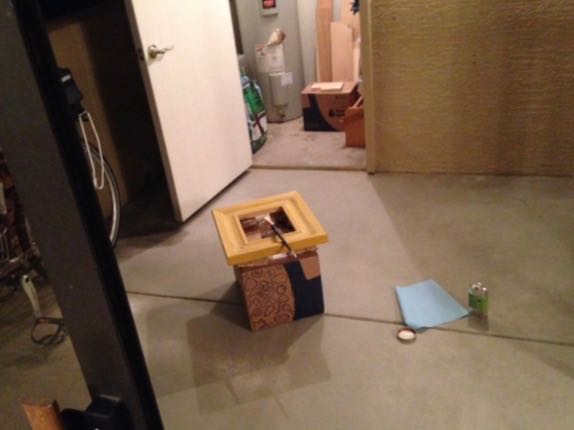
Clayed Up & Ready for Gold!

Clayed Up & Ready for Gold!

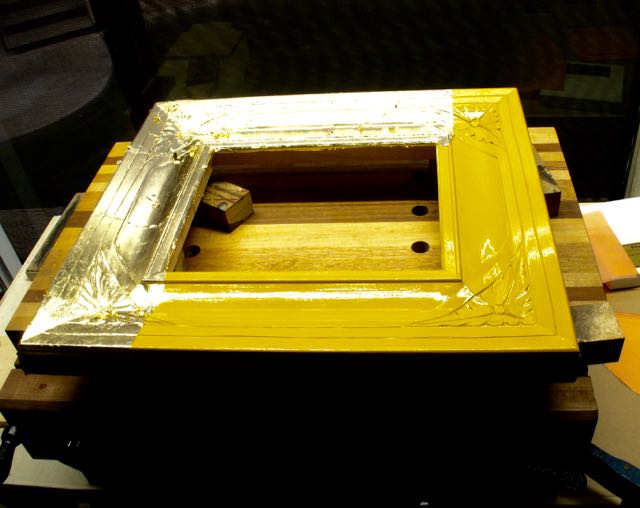
So it begins — the first of hopefully many frames that I’ll be able to accomplish on our 6 months Scottsdale adventure!  This one features the corner leaf design from Chris Pye’s series.  What you see is ready to be gilded but I’m waiting for the slow set gilding size to arrive from LA Gold Leaf.  Silly me, thought it would be a cinch to find it here in the Phoenix area but neither Dick Blick, Jerry’s Artarama, or the local Arizona Art Supply carry oil based — just that water borne stuff I don’t like!  Thought I’d begin this blog by showing the final results and then back track and explain the process used to get here.  Very anxious to see how the composition gold (which I like to refer to as Dutch Gold) will confirm to the depth of this carving — that’s the unknown at this point.

This frame is for an 8″ x 10″ painting and measures about 4″ wide.  It’s modified from the remaining molding Diane had custom made at Foster Planing Mill.  After doing three exercises of the corner leaf motif from CP’s website I decided it could make a nice frame.  The challenges were to incorporate a design from a flat piece of wood to the coved profile of this frame.  First up was to draw in a double ribbon that would go around the entire frame then diagonally across the coved area as the border of the design calls for.  Drawing free-hand is not one of my strong suits so several templates were made.  Using the plastic from salad containers will give you a template that has some real advantages.  First of all it’s flexible enough to conform to the coves, you only need to make a half pattern since you can flip it over to do opposite sides of the corner, and lastly it is clear so you can see through it for proper placement.  It took two templates to accomplish the inside ribbon, the outside of the straight frame sections were done with a combination square and pencil.

Notice in picture #2, a diagonal line was drawn across the width of the ribbon to determine the template location to add the width.   This “ribbon” may look a little bit off but that’s probably because of the cove of the profile.  Pretty tricky to outline it with the V-chisel too!  There is a pretty hard line where the flat section of the frame transitions to the cove which was softened with a #3/20

gouge.  At this point the entire frame was sanded with 220 grit paper.  Since I want the carving to be crisp there’ll be no more sanding after this.

Center Boss in corners of frame

Center Boss in corners of frame

Once the ribbon was complete around the frame it was outlined with the V-chisel in its entirety.  It’s not perfect and I’m considering taking a marking gauge the next time I need to carve a straight line completely around the frame — it may give the V-chisel a guiding point.  Now it’s time to locate the center boss, this too was awkward to the profile but I’m happy with how it turned out.  Cut with a #8/8mm using hand pressure only.  My concern here was popping it out accidentally or having it separate since it’s located right on the mitered joint; all’s good!

Being symmetrical is important in a picture frame.  There is that saying about the beauty of an item crafted by hand are its imperfections but you don’t want to take that too literal!  The goal is that they’re all pretty similar but not so hard edged that they appear to be either compo or CNC routed.  After drawing in and cutting the three main leaf separations on each corner (again with the help of a template) the details were drawn in on all sides before any carving began.  In this picture you can see those 3 main lines that radiate from the corners and the top of the miter.  Notice how steeply the cove comes into the miter making it pretty interesting to carve!CornerLeafFrame-WoodworksbyJohn-Design-InitialCarve - 1

The motif on the right side has been outlined with a variety of #5 and #3 gouges that approximated the shapes of the leaf.  Once that was complete on all four corners the modeling began.

In this next photo, the right side has been modeled, primarily with #8 gouges and then the edges were rounded over with a small #3 fishtail.  It’s beginning to look like a real leaf!

In Progress

In Progress

That leads us back to the first picture where the entire frame is now covered with a yellow burnisher/sealer that I get from LA Gold Leaf too.  I’ve found that with the yellow, any cracking of the composition gold is less noticeable.  That’s the next step, still trying to figure the logistics of that process.  When Diane came home after I had applied the size she noticed the smell right away!

Posted in Carving, Picture Frames, Scottsdale Adventure | Tagged , | 3 Comments

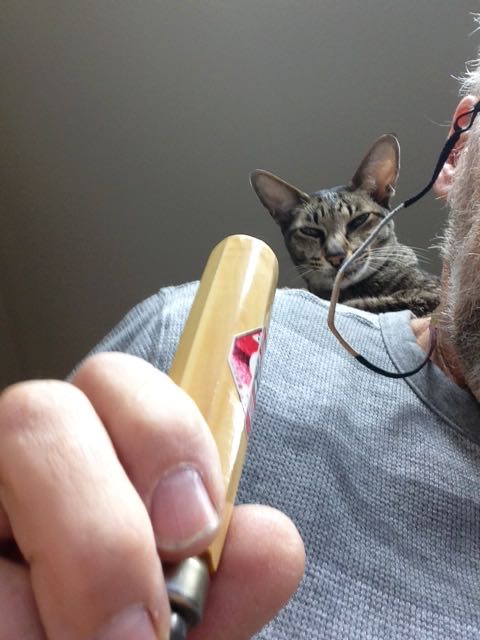
More than one way to skin a Cat!

          ….and I don’t mean this one!

Ali checking it out!

Ali checking it out!

Just thought I’d start this out with a little bit of humor and show you how close to me my cat likes to be.  When we first began our search for a 6 month place to live, finding one with a garage was high on the list.  This proved to be hard to come by and now I really like my little corner of the bedroom where the bench is set up.  An advantage too, is that my Oriental Shorthair (who is bonded with me to the max) can spend more time in my company.  I also wanted to use the title as a lead in to my self imposed teaching.  The phrase, more than one way to skin a cat; is one I used when I taught construction at the boy’s prison — funny how some of the boys took that literally!  Just as I explained to them that there can be more than one way to complete a job successfully, now that I’m on the other side of the desk I’m reminded of exactly how true that is.  While watching both of the workshops I’m enrolled in I see differences in Mary May and Chris Pye approaches as they do similar work.  My task as the student is to experiment using both of their techniques or a modification of them to see which works best for me.  It’s a definite learning process that brings me enjoyment and maybe a bit of frustration thrown in for good measure too!

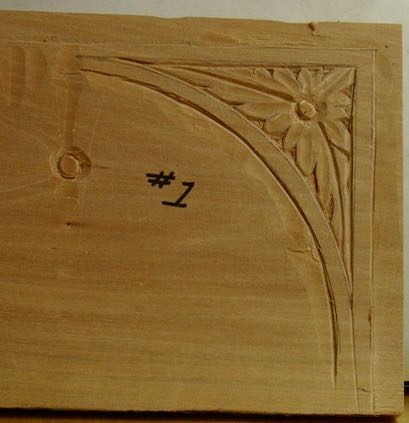
Corner Motif #1

Corner Motif #1

This project is one I wanted to incorporate into a picture frame.  It’s based on a mirror frame that Chris Pye has on his site.  Essentially it has an 8″ diameter mirror on a flat piece of Lime wood , I was attracted to the leaf motifs in the corners and thought they could be incorporated into a design for a frame.  This is the first attempt on a piece of the Basswood brought from home that is somewhat grainy — excuse? yep!  After quite a bit of experimentation this is the final result.  It’s interesting, being on the student side of the desk and watching CP (Chris Pye) take out those little pieces that outline the edges of the leaf — cut here, cut there, and out it pops!  Took quite some time and practice to get that process down.  Just a side note here, I have some friends (you know who you are Bill!) that have suggested that if I didn’t spend the time to photograph and blog I could probably get done quicker.  The bottom line is that by following this process it makes me stop and think, plus there is now reference material on line for me to refresh my memory when this process is needed again.

Corner Motif #2

Corner Motif #2

The next step was putting this leaf motif onto another Basswood piece, this time mocked up to mimic the miter joinery found on picture frames.  Grain direction would really be interesting here!  I had some concern about the boss in the center of the leaves but the results were acceptable.  Laying out the inner curve was interesting and will be even more so when it comes time to do the actual frame.  That penciled in line on the inner edge shows where there is a ridge on the actual molding.

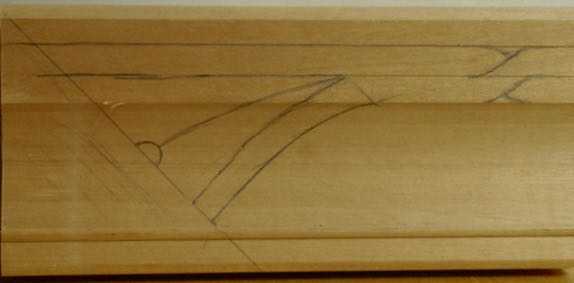
Molding Profile

Molding Profile


Okay, it didn’t come out too badly on the flat surface in #2 but the frame in mind has a very pronounced ridge and cove to it’s profile.  MM (Mary May) had a video where she did an altar piece that was already assembled with mitered joints.  Watching that gave some inspiration of how I may approach this.  Lay-out was tricky but I’ll explain that more when I do the actual frame.  Here’s a piece of the molding with the design partially drawn on it.  It’s not mitered so that’s only penciled in.  The design will have two “ribbons” that separate in the corners and I’d like to have them crisscross in the middle of each leg.

Corner Motif #3

Corner Motif #3

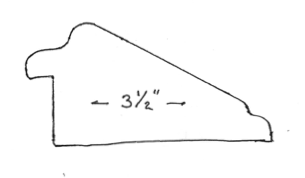
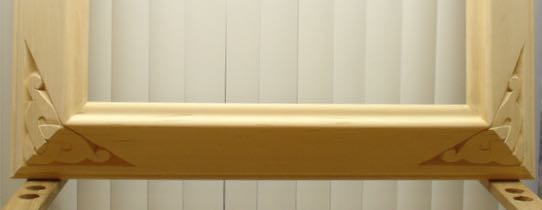
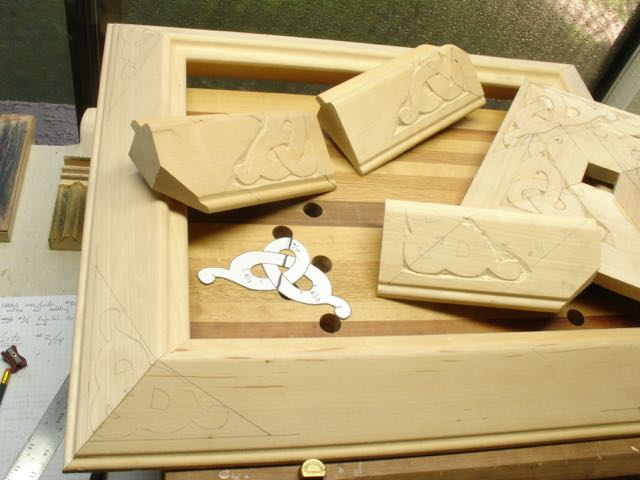
Work began by rounding over the pronounced ridge before starting work on the design itself.  Any problems encountered now will only be magnified when working on the already assembled.  In any case here’s the results on the molding profile sample.  I can see I was a bit too aggressive with the initial outline of the area with the V-tool.  Also need to be more careful to maintain a uniform width where the ribbon dives into the corner.  All I can say is “so far – so good”.  Many unknowns at this point which can only be solved by doing.  The carving needs to be deep enough to be clear under the gesso (sealer/burnisher) but not so deep that it’s difficult to lay the leaf without it cracking and leaving many voids.  Onward and upward — anxious to see how this will all end on my first, Scottsdale Adventure frame!  I’ll leave you with this picture of the pre-assembled, uncarved frame and the sample piece.  This frame is for an 8″ x 10″ painting.

Frame to Be!

Frame to Be!

Posted in Picture Frames, Scottsdale Adventure | Tagged , , , | Leave a comment

Rosette/Patera Final Post

This blog about the Rosette will start with two pictures, taken at the same time with my iPhone but at slightly different angles to illustrate the way the light hits the carving.  I’m super happy with the “fruits of my labor” and since my blog is all about sharing my woodworking journey with you, hopefully you’ll not find all of this boring!  The purpose of our Scottsdale Adventure for Diane is to focus on her painting and really get involved with the Scottsdale Artists School.  Mine is to become a better carver, concentrating primarily on picture frames — that’s where I have a slight quandary!  I love the modeling and the effect of the light illustrated by these pictures but realistically that would probably not be found on a gilded picture frame.  With gilding, much of the detail would be obscured by the gesso applied prior to the gold leaf.  Even at that, my perfectionism drives me to get the cleanest, sharpest carving I possibly can and after the third Rosette feel it’s time to move on.  Those of you that know me personally know of my obsessiveness and difficulitng in knowing when to say “enough is enough”.

Okay, I’ll say it now, it’s enough!  The next carve I want to tackle is one that can also be done on one of the frames I brought along with us.  One area of the Rosette that really gave me lots of trouble was scooping out the insides of the main petals, can you see the progression of that area in these pictures?

Using Chris Pye’s video workshop is a real benefit and I’ve watched him doing that scoop section over and over.  Finally (after the umpteenth time) I grasped onto what he was doing with the gouge and now it won’t be forgotten.  It was all about the slicing motion up and out of the hollow when he reached the center point.  Almost as if he used the gouge to create a faint vein line there.  Maybe this will explain it better:

This slideshow requires JavaScript.

It’s like so many things we learn, seems really daunting at first but after several attempts you have that ah-ha moment and you wonder why that didn’t happen sooner!  Like Diane says, if it was easy everybody would do it!

Enough work and blogs about this project though  The over-all goal for me is to keep learning these small steps and strife to incorporate them into larger projects.  My focus will be teaching myself to become more proficient at carving plus improving my sharpening techniques to make it somewhat easier.  Invested in some DMT continuous diamond stones today since they are very highly rated and not as messy as oil stones — want to make sure we get our cleaning deposit back for the apartment.  Shavings are easy enough to get off the carpet, sharpening oil and sharpening residue would be a different story!  Besides, Woodcraft gave me a 10% off coupon for my upcoming birthday that just had to be used.

Posted in Carving, Scottsdale Adventure | Tagged , , | 1 Comment

Some Issues (problems) but also some Solutions!

Even though I’m over half way into my sixth decade I really dislike the word “retired”; like Diane says it gives her the connotation of giving up.  At church there is a group called The Next Chapter so that’s what I’m adopting at this stage —- I’m into my next chapter!  Looking back over the years there have been many, many chapters of my life so why stop now.  The goal is to end each day a little more skilled and with a bit more experience than the day before even if it’s accompanied by a bit of frustration.  Okay, enough philosophizing, you can  probably imagine how my day went!

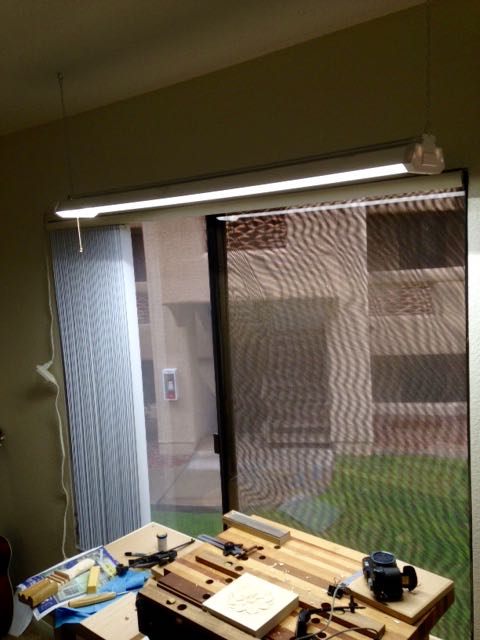
Rockler LED Shop Light

Rockler LED Shop Light

First issue I’ve had to deal with is the lighting.  Planned to visit the Rockler store here in Phoenix to also see about doing hand cut dovetail lessons and while perusing the aisles found their 4′ LED Shop Light.  Here you can see how much bright, daylight this thing puts out.  Very light in weight and the apartment managers said any hole up to the size of a quarter was acceptable.  Hung this with plastic anchors, hooks, and chain provided.  There are two strips of LED’s with an aluminum reflector and, much to my Dutch guys approval — it’s currently on sale!

For the sake of comparison, here are the before and after pictures.  I’ll need to play around with the settings on the camera to find the best quality picture.  Needless to say, this old camera doesn’t have a light source setting for LED!

I suppose that this means I can’t use the lack of being able to see what I’m doing as an excuse anymore.

The second issue is one that I’m sure plaques anyone who carves or works wood and that’s sharpening.  On this project I’m doing it’s become obvious that chisels that don’t have the sharpest possible edge just lead to frustration.  You’ve heard me say that if you ask 12 woodworkers the same question you’ll get 13 different answers and this is no exception.  I checked out the videos from both Chris Pye and Mary May and guess what — they both have a slightly different take on it.  As Chris says: “Sharpening is not a mystery but a skill — a make or break aspect of carving”.  Although my sharpening skills for cabinet chisels and planes is where I’d like it to be using water stones and jigs, carving gouges are a different matter.

Chris Pye suggests taking one chisel and really working it until it’s right.  He calls for quite a pronounced inner bevel (Mary May disagrees) so I’m combing their advice for my work.  For these I’ll be using oil stones, old ones that I’ve had for probably 30-40 years!  No power since that can mess things up in a hurry, and not water stones since they’re difficult to keep flat especially in our current apartment situation.  Carved Ram's Horn Table Big Leaf Maple and Chakte KokI began with one of the chisels I’ve had the longest, a #5/19 that I bought for this commission.  I also had a #5/23 which I’ll use for comparison.  This was a table for an art gallery and my first attempt at adding a carved element to my furniture.  That makes this chisel at least a dozen years old or so and during that time most of the honing has been done on a paper wheel charged with compound.  Pretty obvious when I look at it closely that it has many facets and some rounding over.  Rather than bore you with a lot of verbiage let me explain what was done with this slideshow:

This slideshow requires JavaScript.

After working it on the rough stone and finally raising a burr on the inside, I switched to a finer stone.  This was followed up by stropping.  I can see that the bevel is square but the heel is slightly off.  I could use a finer stone to get more polish but this is what I have for now.  The adage I tell my students when I teach sharpening is true here too: “if you see something, you have nothing!”  When you inspect the cutting edge any light reflected means there is a dull spot.  I’m pleasedwith being able to establish one long bevel from heel to the tip by hand which did take some time.  Used the technique of locking in my elbow, swaying my body from side to side, and rotating the gouge at the same time.  This is how both Chris and Mary approach sharpening.

Well, that takes care of a couple of issues which leaves one major one to solve ……

Operator Technique!

Posted in Uncategorized | Tagged , , , | Leave a comment

Always Learning & That’s a Good Thing!

As we’re coming up on our first full week here in Scottsdale I’m finding that I, a life long teacher; am now in the different role as the student!  I’ve taken classes through-out my life (much to the chagrin of my high school teachers!) where I’ve listened, taken notes, followed directions, etc. but this is proving to be an entirely different experience.  As a student I’m really hard on myself and expect my efforts to be first class the first time out of the gate — reality shows that to never be the case.  Now I need to self motivate, listen to the videos very carefully, take notes, and (as I’m learning) watch them more than once to really grasp what is being shown.  As an ultra-runner I had no problems putting in the miles to prepare myself for an upcoming 50 or 100 mile race knowing it would take lots of training to achieve that goal.  Don’t quite understand why but, mentally; I feel I should be able to master the carving first time out — just not reality.  I am settling down to that and determined to meet my final goal of carving that Edwardian style frame Chris Pye’s newsletter mentioned last month.  I’m thinking of that to be my Doctoral Thesis at the end of this adventure.

First Carving Day Teachings
My buddy -- Ali

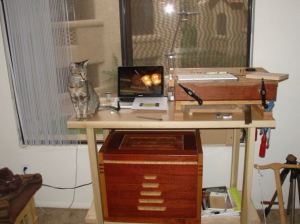
My buddy — Ali

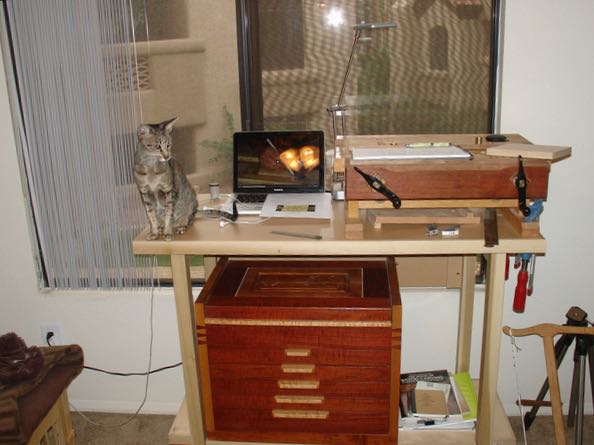
After setting up the work area in the master bedroom the first slight problem was Ali, my totally dedicated cat with more loyal, dog like tendencies then most cats tend to have.  She’s an Oriental Shorthair and has really bonded with me over the years.  As you can see, she wants to be right in the middle of whatever I’m doing!  Even striking the chisels with a mallet doesn’t seem to deter her.  I’m realizing how small my space is but it’s all good.  There is room for my laptop so videos’s can be seen (over and over as needed) and some space at the left for tools.  One of the first things I discovered is that the over-all height of the bench is too high.  This is the same height as my bench at home so it took a while to figure out what the problem was.  Eighty percent of the work I do on the portable bench mounted on the right is dovetail and mortise & tenon type work.  For that the chisel is held either vertically or horizontal.  Carving, on the other hand, has a more inclined angle and I found myself standing on tippy toe to get the angle needed to carve.  That resulted in some cramped calves that night.  In any case though, here is what I accomplished on the first carving day:

Other than the figuring out the bench is too high I also came to realize that not all Basswood is created equal!  The pieces of Basswood I brought are nothing like the quality of the picture frame material from Foster Planing Mill or the wood I ordered from somewhere in the Northeast for the sculpted shorts I did, check out this BLOG for that project.  In any case, this wood is grainy and even somewhat stringy resulting in a rougher cut then I want.  I did bring a small, remaining piece of Basswood left from the shorts project and plan to do this carving again on it.  Next problem is the bench height; what did we do  before the internet? After searching through much of the info and finding photos of people carving I came up with what I hoped would be the right dimension.  One thing that kept coming up was to bend your arm at 90 degrees then subtract a few inches from that for the optimum height.  Tried that and also held a carving chisel at what seemed to be the correct angle and had Diane measure where the chisel was.  By the end of the evening, the decision had been made to cut 4 1/2″ off of the legs.  Not having access to my shop and assorted pieces of wood to make temporary platforms to find the height I decided to just go for it and cut first thing in the morning.

Second Day Teachings
My buddy Ali -- day 2!

My buddy Ali — day 2!

By contrast to the first day, here’s how the second day looked after cutting that 4 1/2″ off of each leg.  Ali has decided that she didn’t need to be right on top of me — most of the time!  Since everything has to do double duty, Brandy’s apartment has now become Ali’s roof top terrace, safe place and also a place for me to sit while watching Chris Pye’s videos.
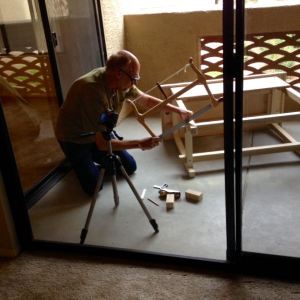
Cutting on the Balcony

Cutting on the Balcony

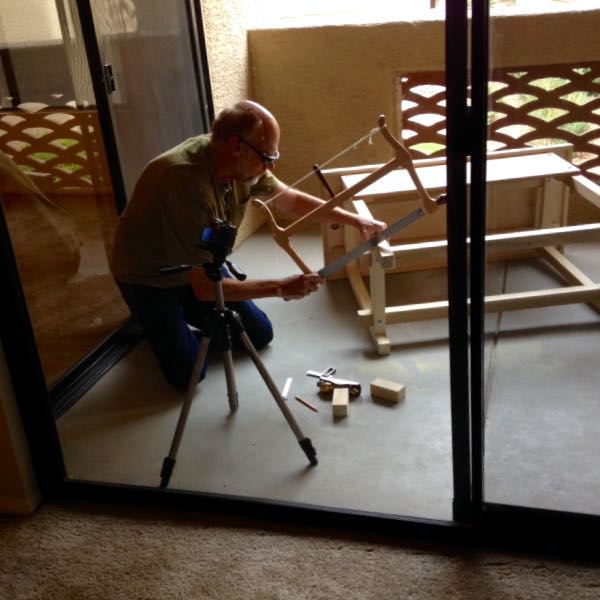
My Christmas present of the bow saw from CME Handworks proved to be a good one.  As I mentioned before, it’s a tool that has always intrigued me and admittedly I’m not sure of it’s proper name: bowsaw or frame saw?  This one was purchased on eBay and is hand crafted of Curly Maple and Walnut.  The blade is a rip/joinery combination and has 9tpi.  The saw is advertised as an 18″ and since the blade is 1 1/2″ wide I soon learned that it’s quite accurate.  The saw is very light, holding it loosely in my hand and letting the saw do the work gave me a surprisingly accurate cut.  I really do like this tool!  This bench is made of 8/4 Poplar and I really didn’t want to use a dovetail saw on that.

This slideshow requires JavaScript.

The altered height of the bench turned out to be much better.  I can get more control and approach the wood at the proper angle.  Learning how to model the wood to make it appear to be an actual petal will take time but I’m pleased with the results so far.  As I mentioned, I want to do this same carving in the better piece of Basswood I have and apply what I’ve learned on this piece to that one.  Here’s a look at the final rosette.  There is a problem with removing pencil marks from wood, especially a soft species like this.  Attempting to sand it without touching the carving proved to be difficult.  As a furniture builder I always want hand planed surfaces so will aim for chisel cut surfaces in my carving as well.  Sanding wood just seems to obscure the grain and beauty of the wood — even this Basswood!
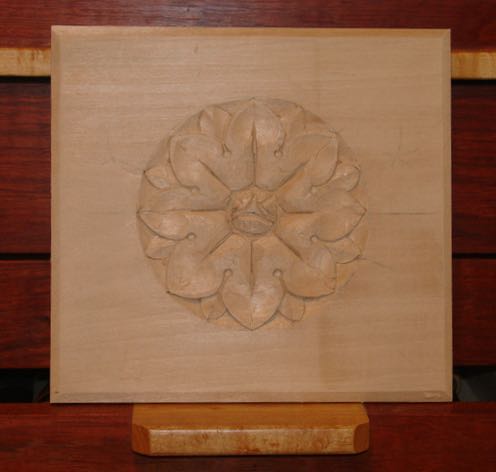
Completed Rosette, first Scottsdale project

Completed Rosette, first Scottsdale project

As we’re settling in there will always be some problems to figure out.  Scottsdale has been getting its share of rain so the overcast skies aren’t helping the lighting situation.  Although I’m set up in front of the window which faces west, I’m not getting a lot of light on my work.  Other units block direct sunlight because of their height.  The overhead light in the bedroom is behind me and I do have the LED desk light to illuminate my work area. I’m not complaining though because it’ll give me an excuse for less than perfection on my carving!

Posted in Scottsdale Adventure | Tagged , , , , , , | Leave a comment

Settling in to Scottsdale

Here we are getting ready to wind up the first whirlwind week of our Scottsdale adventure.   It’s beginning to feel like home rather than an apartment/condo for an extended vacation. Well, I suppose it really is an extended one — 6 months is a pretty good extension!  The grounds and facilities here at the San Tropez are really nice and well kept.  Any dealings we’ve had with the management has been good and the work-out facility is first rate as well.  Trying to get Brandy used to “doing her business” at the end of a leash rather than in the privacy of her own backyard is an ongoing process but luckily; no accidents.  Ali and her litter box are much easier: one point for the cats!  Diane needed to sew up an additional barrier for the room divider since Brandy was able to get under it.

Chilling on the couch, Brandy and Ali

Chilling on the couch, Brandy and Ali

Not sure if it’s the close proximity they now have or maybe the atmosphere in Scottsdale is calming but the two of them can be in the same room, watching TV with us at night without too much hassle — nice!  We’ve also found a church that is less than 5 minutes away, walking distance actually.  It’s called Scottsdale Christian Church.  What’s really nice is that they use the same type of contemporary music Diane and I both like and it’s much smaller then our home church, The Crossing in Las Vegas.  The smallness and intimacy of it is a nice change from The Crossing where we’ve been going for almost 20 years.  Our adventure is all about change and experiencing different things so that’s a good thing.

Ready to make some chips!

Ready to make some chips!

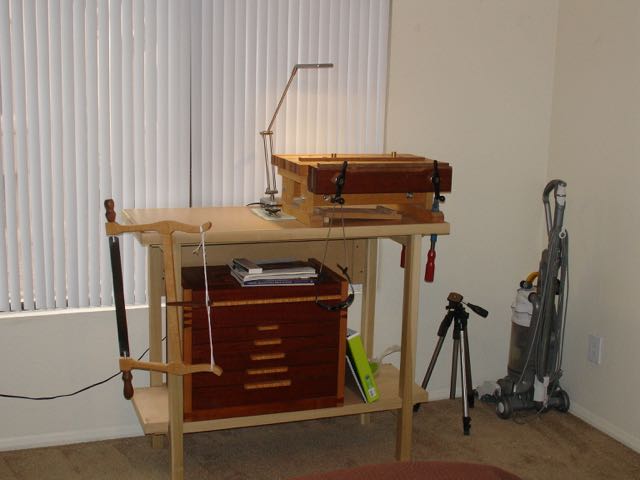
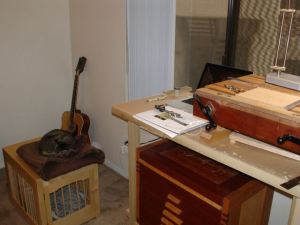
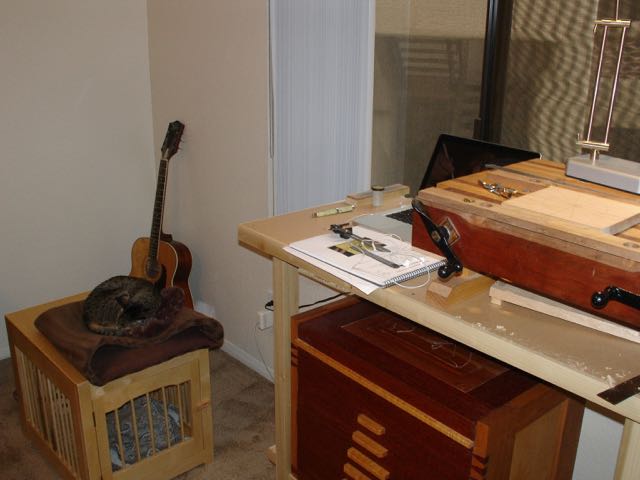
Speaking of change, let’s talk about my shop area.  I’ve gone from half of a 3 car garage to my personal little corner of the master bedroom.  One of my Christmas presents is the bow saw purchased from CME Handworks from Ebay.  It’s a beauty and I’ve always wanted one of these.  Perfect opportunity to get one as my only saw for ripping and cutting things to size.  Although I’ll mostly be concentrating on carving and gilding this will come in handy.  Made my first cut with it last night, square to the face but not the edge but very smooth cutting action and a beautifully made saw.  All of my carving chisels, planes, and mallets are in the chest on the bottom shelf.  There’s some space for reference material, and; of course a vacuum to clean all of the chips and shavings from the carper — now that’s a new experience for sure!

There is a covered balcony to the right of the bench with access through a large sliding glass door.  When I work I’ll open the blinds on the window behind the bench plus the ones on the slider for light.  I also have an LED light to focus on what I’m doing.  The portable carving bench fits nicely on one side and brings the work up to the level I like.   There is an additional storage area off the balcony and I was able to get some space in Diane’s large closet that’s in the front bedroom aka her studio space. Not sure how the management will go for it but my intention is to spray shellac on the balcony; nothing like the smell of shellac in the morning!
So, we are definitely settling into our new space.  For sure there will be challenges along the way as we transition from our house in Las Vegas with its large work areas, outdoor spaces, tools, etc.  but this is a chance of our lifetime.  My challenge will be to complete carving projects from the video workshops I’ve enrolled in from both Chris Pye and Mary May with the ultimate goal of taking what I learn to complete the dozen frames or so that I brought with.

Hope you enjoy the ride as I blog about this adventure — the good, the bad, but hopefully none of the ugly!

Posted in Scottsdale Adventure | Tagged , , , | 2 Comments

20th. Anniversary Scottsdale Trip Update

Well, we’re here and the trip was uneventful which is a good thing!  Going in we knew there would be some bumps along the way, things we should have brought, and things maybe we didn’t need.  I like how Diane put it in her blog, words to the effect of how to put 20 years of living in a 5 bedroom home into a 6′ x 12′ trailer for a six month trip.  We did manage to pack it in as these pictures show:
Seems as if we spent many days packing what we thought we’d need, Diane went so far as to make a list and check it all off as she packed it in.  The day before the move we taped off the size of the trailer on the garage and staged the larger items like the studio tables, chairs, outdoor bench aka living room couch, etc.   My neighbor Richard helped me move those items into the trailer and then it was a matter of stacking boxes around them.  The knock down carving bench I made went into the back of the truck along with my bicycle and portable carving bench.  With everything except the last minute items loaded we had dinner with our good friends and neighbors Richard and Carol and tried to get a good nights sleep for the journey ahead.

Eugster Convoy to Scottsdale

Eugster Convoy to Scottsdale

So, there we are bright and early as you can see the sun is just starting to hit the rooftops of the houses.  Brandy is in her “apartment” behind the seat with Diane in the Mini and Ali is in her carrier next to me in the truck.  She meowed to me for a good period of time of our almost 7 hour trip.  Speed and gas milage suffered somewhat with the weight of the trailer.  On arrival we needed to go over some final paper work and were unloaded by 6:00 pm; much quicker to unload than it is to load.  We’re on the second level which meant 10 steps up each time, that’ll take the place of our leg work out!  I was happy to learn that the U-Haul location was less than 10 minutes away and since they closed at 7:00pm I had time to get rid of the trailer — couldn’t figure out where I could have possibly parked it at the complex!
The first day was spent putting it all together, unpacking, and settling in.  Diane had such a good idea of re-purposing our outdoor furniture to use for our living room.  She also recovered the folding chairs and table top which is now our dining room set!  Check out this picture looking from the dining area:

Living Room - 1

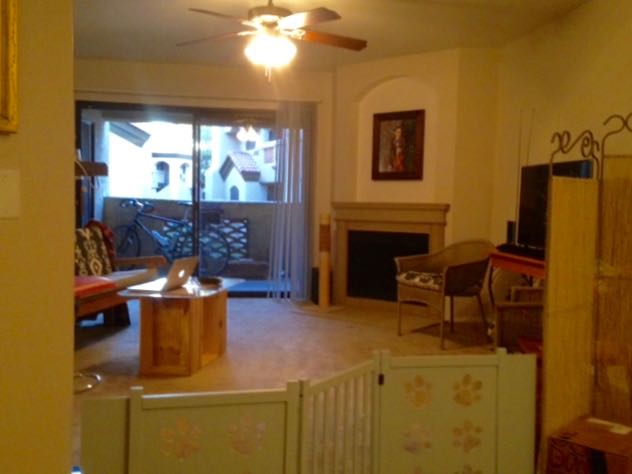
View from Dining Room

In the forefront is the separation of dog and cat.  After extending this screen and painting it we can easily go from the dog zone to the cat zone.  Ali and I have the living room and master bedroom where my carving bench is set up.  Diane and Brandy have the front bedroom, kitchen, and dining area.  The animals are adjusting well, thanks goodness!  The “coffee table” is made of 4 wooden wine boxes and a piece of plexiglas.  Double duty, they first held things to be moved and now they’re our table.  You can see my bike on the balcony where I’ll also spray shellac (shhh, don’t tell the management!).

Here’s some little things I’m discovering as we settle in to our new location.  It reminded me of a design class I took at SFSU way back in the 70’s!  You don’t realize how habitual your life tends to be.  For example, the kitchen sink here has the disposal on the left, at home it’s on the right so that’s the side you put dirty dishes in.  Even seemingly minor items like what side the toilet paper is “supposed” to be on require you to re-think what you’ve taken for granted the last 20 years.

And so, the adventure begins.  Diane’s first session at the Scottsdale Artist School is Monday.  I intend to begin work on one of the many projects available on Chris Pye’s video workshops before I start on one of the dozen frames I have ready for carving and gilding.  What a kick — a six months long, 20th anniversary trip.  One of our field trips today was to IKEA to spend some of the gift certificate that Adam gave to Diane for her birthday.

Happy New Year to all of my readers — May your 2016 be as adventurous as I hope ours will be!!

Posted in Scottsdale Adventure | 4 Comments

Scottsdale — 8 Days and Counting

Diane and I are getting much closer to our Scottsdale adventure, must admit my to-do list seems to be getting longer rather than shorter!  Of course, I’m the one at fault there as I just had to add one more frame to the bunch I have ready to go.  Until this one came along, I had twelve frames assembled and ready for carving and gilding, here they are strapped and waiting for me to put them into the U-Haul trailer:

I had thought that these, along with short lengths of the same molding and other pieces of wood, should be enough for our 6 months anniversary trip and adventure.

Screen Shot 2015-12-21 at 4.10.37 PM

Chris Pye Edwardian Frame aka My Scottsdale Challenge

But, what should come across my emails today but Chris Pye’s carving newsletter.  I had some correspondence with him regarding picture frames and he mentioned that he had a frame in the works with a video workshop scheduled for early 2016.  Well, in this newsletter he had a snapshot of the frame and I decided right then and there that this would be my Scottsdale Challenge!  The intricacy of the carving is so far beyond my current skill level that I just had to challenge myself with it.  I’ve done an acanthus leaf but nothing like this with all of the scrolling elements, leaves, and berries.  I asked Diane what size of a frame she’d like to see this in and her reply was a 16″ x 20″.  After studying this small image I see that there is a simple chamfer on the sight edge and the rest appears to be flat.  A good width for a picture of that size is around 4″ so that’s what I decided to go with and fit the pattern to that.  So, my dilemma today and the thing that kept me from checking off items on the to-do list was making this frame.  Since I won’t have any of the needed tools to assemble a frame in our Scottsdale apartment, it had to be made here.

Nice Piece -- 4/4 and 12+" wide

Nice Piece — 4/4 and 12+” wide

The choice of wood was next, the screen grab I took seems to be a light colored wood such as Oak or Birch.  I prefer a darker wood so decided to go with Cherry which carves pretty nicely.  After going through the stacks at Peterman Lumber and finding that most pieces were full of sapwood I decided to see what was available in the premium priced wide stock.  When I build furniture it’s important to me to have the wood come from as few boards as possible and also as closely matched in color and grain as possible.  I uncovered this 8′ board that is over 12″ wide.  You probably notice the checking and splits on the right side but there was over 8″ of good material on the other.  The coloration was even and most importantly — no sapwood!

Profile

Profile

Once home, the first step was planing a working edge followed by ripping to a uniform 4″ width.  Next up, a 1/4″ chamfer was cut on the tablesaw for the sight edge and sweetened up with a block plane.  Rather than take the time to set up a dado head the rabbet was cut in two passes with this being the resulting profile for the frame.

Glued up and almost done

Glued up and almost done

This complete the corners were mitered, cut for a #20 biscuit, and glued and clamped.  Diane paints on either 1/4″ panels or stretched canvas.  As it is now, the frame can only be used with a panel so I’ll add another 3/4″ piece on the underside so a stretched canvas will fit as well.  I think a frame that is only 3/4″ thick looks rather anemic, especially for a frame of this size.  Rather than have an extra band like the tongue and groove one on the recent Tropical Walnut frame this one will simply be mitered and glued to the bottom of the frame.  After planing the sides even it may be embellished with a few small coves.

Lower band ready for assembly

Lower band ready for assembly

The pieces are rough cut as you can see in this picture but I’ll do that first thing tomorrow morning and then honest; I will get to my to-do list!  Knowing that we’ll have a 6′ x 12′ trailer plus the back of the truck and Diane’s Mini means we need to pack light.  Besides clothes, pots & pans, dishes, cat & dog stuff, minimum furniture (blow up bed!) we also need to take the tools of our trade.  For Diane that means all of her canvases and panels she’s been busy preparing, easel, brushes, paints, solvents, etc.  I need to not only take the carving chisels and mallets, plus sharpening equipment, planes, gilding and toning supplies, air brush, solvents, and on and on.  It’s somewhat ironic that while we’ll be living like college students a number of friends and family will be enjoying the comfort of our home!


Posted in Picture Frames, Scottsdale Adventure | Tagged , , , , , | 1 Comment

La Niña Mariachi Frame Complete


I must admit that I’m more than pleased with this frame and the painting:

La Nina Mariachi by Diane Eugster

La Nina Mariachi by Diane Eugster

In the blog I wrote about the development of this frame I mentioned how watching the painting develop each time I walked by Diane’s studio gave me the inspiration for this frame. Having recently purchased some Tropical Walnut I thought this would be a good time to see how it worked as well.  Not impressed with the ability to carve this wood as I mentioned in the blog due to the ever changing grain directions but did like how it has a consistent, dark chocolate color.  If you’re interested in how the frame was constructed you can check the blog but I was after a very subtle motif and since a violin is in the painting thought that the f-holes were appropriate.

The frame consists of a panel with a band at the edge to achieve the depth needed for stretched canvas work.  Keeping with the subtleness of the f-holes the panel was also textured with gouges of different sweeps adding some shadows and depth.  The finish is natural Danish Oil followed by the wet sanded mixture of urethane, boiled linseed oil, and pure gum turpentine I use for my furniture.  Starting with 320 grit wet/dry paper and working up to 1000 grit gave me the sheen I like to see.  Here are a couple of pictures with differing light to illustrate the finish and texture affect, I like how that the way the light hits the surface can change what you see:

Diane blogged the story behind this painting as well, you can read her narrative of how the painting developed in her blog titled Making it Your Own.  You can view it and her other work on her gallery site.  This frame will add $300.00 to the price she has listed of $500.00.

Posted in Picture Frames | Tagged , , | 2 Comments

Artist Wet Canvas/Panel Carrier

Ever since Diane and I decided to take our really long 20th. anniversary trip to Scottsdale we’ve been busily preparing for it.  In case you missed it, we will move to Scottsdale shortly after Christmas and stay through the end of June.  The house will be watched by neighbors and be home for a number of relatives who’ve always wanted to spend time in Las Vegas (good luck at the casinos!).  Diane was awarded a scholarship at the Scottsdale Artist School and is looking forward to taking full advantage of all the art education it has to offer by signing up for several other workshops and activities.  I’ll be focusing on frames and am readying myself for that as well.  Yesterday was spent working on two projects, one was fairly simple stand with an adjustable height platform for Diane’s iPad.  She now uses the iPad rather than her photographs when she’s in the studio.  She tells me it allows her to zoom in up close on features that are otherwise hard to discern.  The other is the panel carrier I’ll talk about in this blog.

Wet Panel/Canvas Carrier by John

Wet Panel/Canvas Carrier by John

Many years ago I made something similar that she used for a workshop at the artist school.  One of the others in the class really liked it so at the end of the class Diane sold it to her!  Her reasoning was sound, I could always make another.  It had a few short-comings which I solved in this version, pictured on the left.  If you do a Google search for these, many come up.  Some are okay, others are flimsy, limit the space, don’t hold securely, or a host of other drawbacks including the cost.  In any case, this one is made of 1/2″ Baltic Birch plywood and 5/4 Poplar for the pieces that hold the panel or canvas in place.  Each side easily holds one canvas and has a slotted area for a standard 1/4″ panel.  If you needed to carry a total of 4 panels you could put two on each side as long as they were the same size.  This will accomodate panels and canvases as small as 8″ x 10″ and as large as 16″ x 20″.  You’ll notice that the bottom carrier pieces are staggered.  This is to make sure there is ample strength.  The stagger gave me access needed to glue and screw them to the plywood.  On the raised carrier I’ve added a foot so the unit sits level.  There are carriers that simply screw the  bottom carrier to the end of the plywood but that is way too weak of a joint — the artist wouldn’t be too thrilled if that gave way and dropped their work after spending a day painting their masterpiece!  By the way, the carrier with that design lists for almost $150.00.

Panel and Canvas held securely

Panel and Canvas held securely

At the right is how it would look if you were carrying one 16″ x 20″ canvas on one side and a 8″ x 10″ panel on the other.


Handle Detail

Handle Detail


To keep this project simple and knowing that before long it will be covered with the brilliant hues of an artists’ palette it is simply waxed with BriWax which will give it a degree of protection but still allow the owner to add their own patina to it.  The handle is formed into the top rather than adding a separate.  Weight is always a concern and with the integral handle there is no chance of a screw coming loose and the artists’ work ruined.

Here are detail photos of how the carriers were designed to accommodate either a canvas or a panel.  After placing the painting in the bottom carrier it is held securely in place by sliding the top carrier to the top of the painting and securing it with the thumbscrew.

Diane will be my “traveling sales rep” when she uses her at the school.  This project is fairly simple and making a run of more then one would be something I’d happily take on to help finance our long anniversary trip.

Posted in Artist Furniture | Tagged , , , , , | 5 Comments