Current Work — Tropical Walnut Picture Frame

laNinaLR

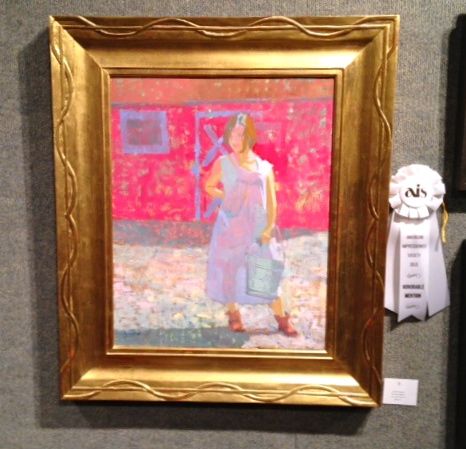
la Niña Mariachi by Diane Eugster

Diane recently completed a painting that moved me quite a bit.  I would peek into her studio every time I came into the house from the shop.  Watching this image unfold was fascinating.  She wrote a blog about it and you can follow this LINK to see it if you’d like.  The texture and darker palette of the piece inspired me to design a frame that I hope will do it justice.  When I mentioned it to her she was all for it so I began to think of a design.


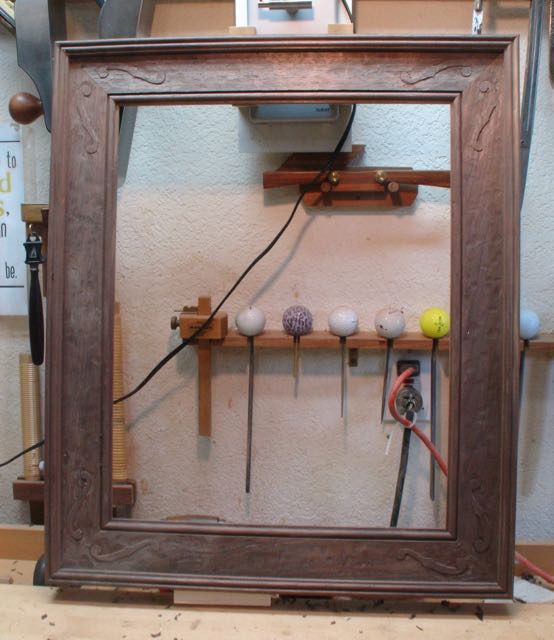
Detail of Frame

Recently, Woodworkers Source had a special on Tropical Walnut.  I had heard about this wood and the appeal is the claim it is mostly a nice dark, brown color with very little sapwood.  That part is true and when cut it does smell like Black Walnut.  It machined pretty well both with a shaper and router and also worked well getting the final finish with a smooth plane.  The main difference between it and Black Walnut became apparent when I began to carve the frame.   Let me back up here;  let’s say I’m a work in progress when it comes to carving but working on perfecting my technique.  The design of the frame is shown here, you can see how it was made in this blog.  I wasn’t sure if I wanted to do the carving on the panel before applying the banding or after.  In the end, I decided to attach the banding and anticipated some difficulties due to the rim on the edge.  Now it was time to come up with a suitable motif.  We were driving somewhere and it hit me “F-holes” I exclaimed to Diane.  Her reply was “I beg your pardon?”  Getting her drift I said, no, no that’s the name of the holes in a violin!  She didn’t believe me until after we got home and I Googled it as proof.  Now that my motif had been decided on the next step was the execution of it.

Like many of you probably do too, an  image was found on the internet, downloaded, then sized to fit the frame.  For frame patterns that are in the corner you need to flip it over after drawing on one leg of each corner.   I’ve found that the plastic containers from salad greens are perfect for this, here’s what mine looked like.  Once the pattern is positioned I’ll cut the miter and trim one side to fit against the banding making locating it easier on each of the legs.  After drawing it on leg simply flip it over to draw in the adjacent side of the frame.  There also happened to be a line on the print which also lined up with the inside of the molding.

Before actual work began on the frame I did a few practice pieces; here’s where I learned about the grain.  Honestly, it will change directions not only in the short length of this pattern but also be different from one side to the other!  I’d love to hear from any carver who happens to be reading this and get your advice.  I understand that ideally, I would have a gouge of the correct sweep and width to first outline the entire pattern.  I have found though that I can get away with a sharp V-tool or even a knife to outline things in Basswood but this Tropical Walnut wasn’t going to cooperate with that.  My question to you carvers is this: Should I eventually invest in tools so that I have enough to outline virtually any shape I might need?  There really isn’t a shortcut to this is there?

My concept for the frame is to have the f-hole be very subtle.  Just like Diane’s paintings she likes the viewer to discover things in her work when they view it.  After drawing the design, I used a #8/13 to outline the curves at either end.  A #8/6 took care of the curl, after that it was a matter of making a very shallow cut with a small V-tool to outline the design.

Work in Progress

Work in Progress

You can imagine the difficulties I had due to the edge banding and the radius on the sight edge of the frame.  Subtle; that’s my goal.  To tie the rest of the frame in with the carving at each corner I choose to use the gouges to create a series of small cuts in the entire piece.  This was a technique used years ago on a frame that was gilded and the way the light danced on it was quite nice.  After the first few cuts I was committed — no turning back now!  Here’s what the frame looks like as the gouges cut little divers randomly into the frame.  You know, it’s really hard to be random!  My goal here is to have the light play on the ins and outs of the random cuts made with the gouges.  Again, the constant change of the grain direction gave me some difficulties.
In the Sunlight

In the Sunlight

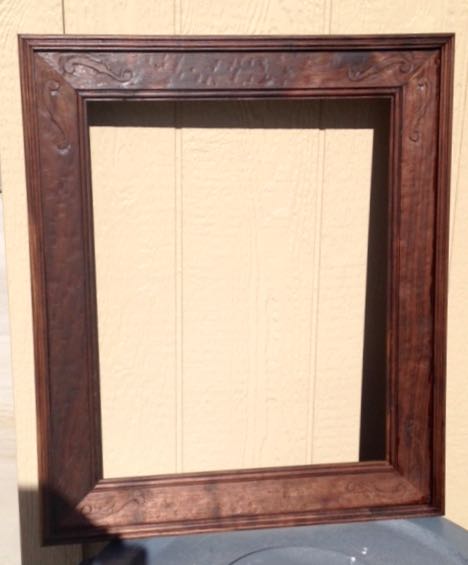
The frame will be finished with Watco natural Danish Oil that will be wet sanded.  At this point, there is only one coat on the piece and I’ll treat it as a witness coat.  I took this picture outside and you may notice little flecks of blue towel that is caught in some wild grain on the frame.  My next step will be to carefully chisel those areas smooth and take a critical look at the “random gouge cuts”.  This will be done outside in full sunlight so I can really see what I’m looking at.  Probably at least one more coat of the oil sanded in followed by multiple coats of my 3 part top coat, each sanded in with successively finer wet/dry paper.  As of now, I believe my vision is coming true.  The f-holes are subtle, my goal is for them to be discovered as the viewer takes in the painting and the frame and discovers their common theme.  Even though this picture shows the frame with its initial coat of oil, it seems to me that what I was after is coming to life.

I’d appreciate your comments, especially from you more experienced carvers on buying tools.  I really like the quality and feel of the Pfiel chisels and have recently ordered 5 more fishtails from Woodcraft.

Posted in Carving, Picture Frames | Tagged , , , , , , , | 7 Comments

Shop Happenings & A SawStop Trick

As I mentioned in my last post the emphasis right now is preparing picture frames, ready for carving, gilding, and finishing for our adventure Scottsdale — doesn’t really make for a real exciting blog post!  One complaint I’ve heard about the sliding table on the SawStop is that when you are ripping long, wide boards the slider section needs to be removed.  That in itself is not a big deal, two easily accessible allen head fasteners accomplish that.  The complaint is adjusting the fence back to a perfect 90 degree relationship with the blade.  I mentioned this to Christian, the owner of Woodworkers Emporium where I bought the saw.  I use a large drafting triangle to set slider back to 90 degrees which works pretty well.  He suggested instead, that I use a large piece of material, cutting an exact 90 degree corner on it and then notching it to clear the teeth of the blade.  I took his advice and it works great, I had a piece of Marlite that measures roughly 16″ x 18″ and here’s the results:

After raising the blade to full height the notches clear the teeth so there is lots of area to align the fence to.  Thanks Christian!

Computer Cord Grommet

Computer Cord Grommet

One other shop happening is that the client I designed the Mechanical Cellarette for gave me a call.  By the way, if you’re not familiar with the Mechanical Cellarette there’s a video showing it in operation on the link.  Back to the “shop happening”; he updated his computer system and was having a problem routing the wires.  In previous conversations with him I knew he was really fond of his desk.  The wiring running over the top of it wasn’t attractive to say the least!  The only solution I could come up with was a grommet right in the middle of the leather covered top.  I considered using a hole saw and getting the job done quickly but had visions of it grabbing on to the leather and thoroughly shredding it right off!  With that vision in my head I made a template and used a plunge router with a bushing to accomplish the task.  The initial cut was very light, just enough to cut the leather, then successive plunges until the piece fell out.  Happy to say it went flawlessly; my client was happy and I was relieved to know I didn’t need to learn (OJT) how to repair ripped leather on an expensive office desk!  Here’s a picture of the completed job, I think it blended in perfectly.

Posted in SawStop Sliding Table, Uncategorized | Tagged , , , , | 1 Comment

Change in Focus — Picture Frames, Carving, & Gilding

Although making and selling boxes on my Etsy store is a rewarding way to fill my shop time between commissions I’ve decided to re-focus on doing picture frames.  Although most of my frames are designed for Diane’s work my goal is to branch out and establish my work with other artists.  Besides, now that her focus is geared towards her on-line gallery as opposed to being in brick and mortar galleries, most of her work is sold unframed.  You may recall that quite some time ago we went to Foster Planing Mills and picked up quite a bit of wide basswood moldings from their seconds area.  My plan is to make as many frames from this material plus some custom designs of my own.  Here is what’s been accomplished during the past week or so (click on image for full size):

The two frames on the left are from some of the moldings we got at Foster Planing Mill.  The other three are a custom profile I designed and made in the shop.  In this blog I’ll explain the process for making these from 4/4 stock.  Just some background information, artists usually paint on either 1/4″ gessoed or linen panels or else a stretched canvas that can be anywhere from 3/4″ to 1″ in thickness.  For the panels it’s no problem using 4/4″ wood to create a frame but the stretched canvas work needs thicker stock (8/4 or so) to accommodate the thickness of the stretcher bars.  One way you can make a frame for the canvas from 4/4 stock is to cut a bevel on one edge which angles the piece up, away from the wall.  I’ve done these in the past and will do a blog explaining that technique in the future.

Detail of Frame

Detail of Frame

These three frames consist of a panel and edging to get the clearance needed for stretched canvas work.  Two are made of Basswood which will be easier to carve and the other is made of Walnut for a painting already completed.  Diane prefers a wide molding so I let the widths  of the rough material determine the size.  It ended up that the panel is about 2 3/4″ in width and the edging is 2″. The picture at the left is some of the scraps left over and mocked up to illustrate the profile.  The Walnut frame is for a 14″ x 18″ painting, the Basswood ones are 12″ x 16″.

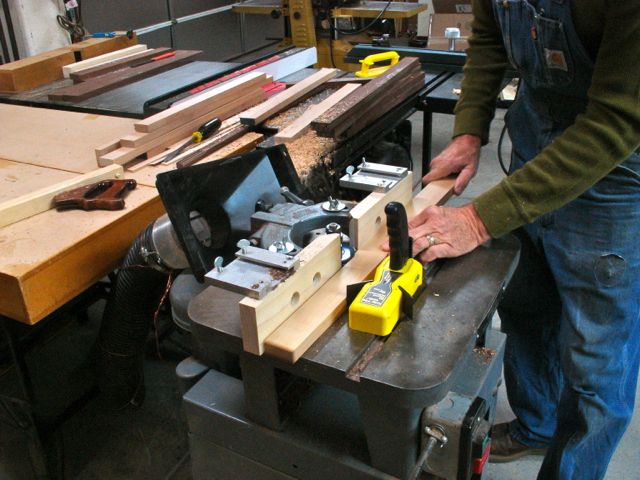
Shaper for Edging

Shaper for Edging

After the pieces were cut and planed to size the shaping began.  The edging is pretty straight forward and was cut on the shaper using a triple bead cutter.  After running the edge through the shaper, the pieces needed to be planed down slightly — the triple beaded cutter cut about 2 and 1/3 bead!  I suppose I could have planed them to the required thickness first but this worked out just fine.  I hear from many woodworkers that they are reluctant to use shapers but this almost antique one of mine works great.  Truth be told, I feel more comfortable on this with its relatively low rpm’s when compared to a router table.  The only other thing required for the edging is a dado to accommodate the panel, you can see that in the detailed picture above.

The panel require more work.  First up was shaping the sight edge using a single bead router bit.  Here’s where I really like the set up for the SawStop using the auxiliary fence with the vacuum hooked up.  When using either the shaper or a router table it’s important that your feed is constant, not so fast that it leaves a rough cut but also not so slow to leave a burned cut.  For any inconsistencies you can use an appropriate size tadpole sander to smooth it out.

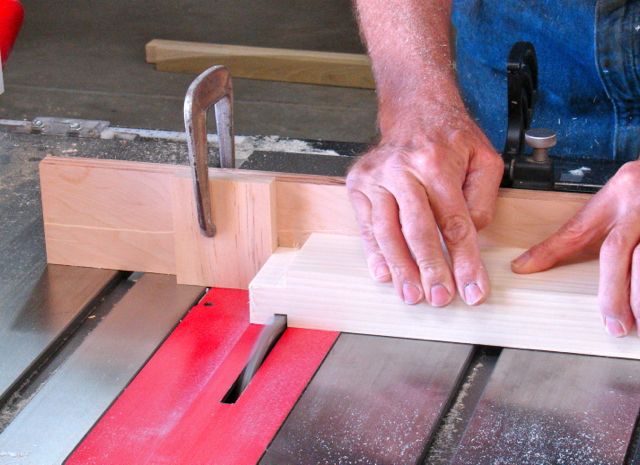
After the sight edge was completed on the router, two rabbets were cut on the tablesaw.  One to fit into the dado of the edging and another to accommodate the painting. These were both cut using a dado head in the tablesaw.  Using an L-Shaped fence to cut the dado required for the edging insures that it will be consistent all the way around.  The edging also needed a dado to accommodate the panel.

To assemble these frames, the panels were glued up first, miters are reinforced with a #10 biscuit.  The edging is mitered and glued into the dado, some planing to get a good fit was required and done with a rabbet block plane.

So now these frames are complete, I’m saving the cut-offs of the moldings to practice carving on.  Diane has been awarded a scholarship at the Scottsdale Artist School so we’ll be spending some time in Scottsdale.  You may have seen my previous blog post about making the portable bench for gilding and carving; that’s what is going with us for me to work on.  Looking forward to the challenge of  carving and gilding these frames.

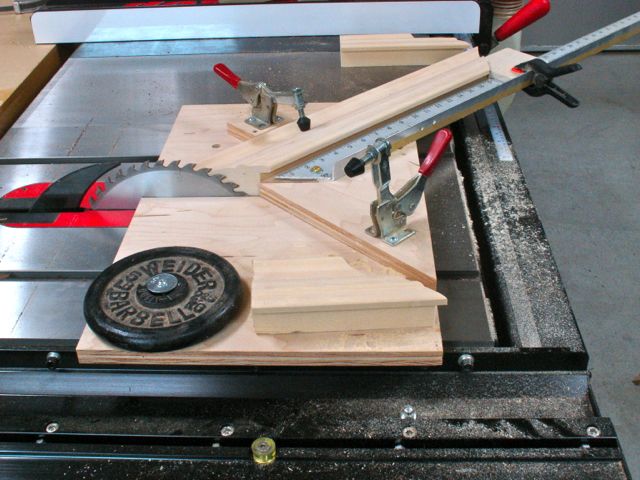
Counter weight for miter jib

Counter weight for miter jib

Just a side note regarding the jig I use for cutting the miters.  You may recall I mentioned it would tilt off the table for longer, heavier moldings.  Well, here is how I solved that problem — a 5 pound weight attached to the opposite corner.  This jig allows me to cut each leg of the frame accurately which makes assembly a bit easier.

Cinder clock to keep frame flat

Cinder clock to keep frame flat

Frame shops generally use a V-nailer which joins the frame members from underneath.  I use biscuits and a band clamp for my work.  A problem with the wider moldings is that the band clamp causes the inner edge of the molding to raise up.  Here’s the low tech way I attempt to solve that dilemma — a cinder block!

Posted in Uncategorized | Tagged , , , , , , , | 2 Comments

Bench for Carving & Gilding

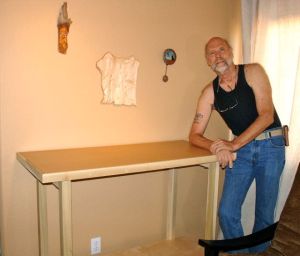
When you’re a woodworker there are times you build a project just because you can!  That’s the case with this one, a semi-portable bench that I can put in the house whose main purpose is providing a base for carving and then gilding picture frames.  The carving can easily be done in the shop but the gilding requires more of a dust free area to allow the size to dry (12-14 hours) without picking up a lot of dust.  Hmm, dust and woodshop seem to be inseparable in my world.

We have a spiral staircase which made having this be a knockdown affair crucial.  Light weight was another consideration so I chose 8/4 Poplar and 3/4″ Baltic Birch ply for the materials.  Stability was important as well but most picture frame carving is of low relief so the bench doesn’t need to be as stable as my main bench where you’d use a mallet as well.  For me, at 6’2″; the height of the bench is very important.  This one is 39″ tall which makes it a good height, harder to straighten up the more years I add to my life!  When I carve, the portable bench I use will add another 10″ to my working level which is comfortable for me.  The top measures 21″ in width and 45″ in length.

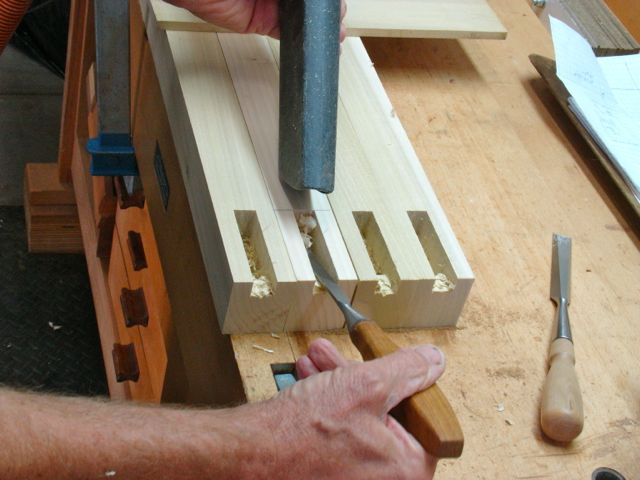
Cleaning Mortise; Chisel and Vacuum

Cleaning Mortise; Chisel and Vacuum

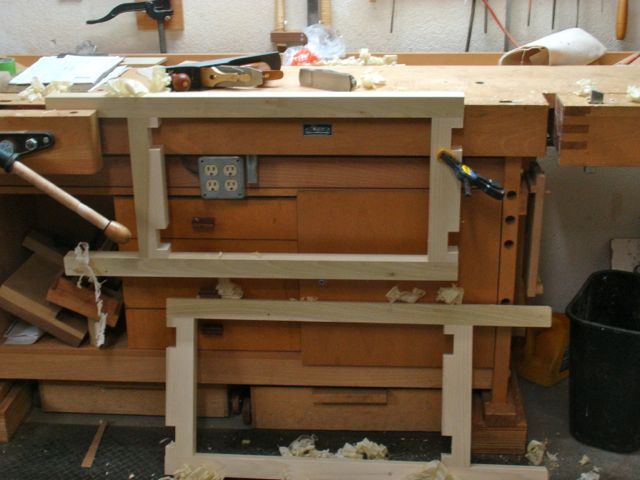
Let’s get into the construction of this thing.  After cutting the Poplar to size and planing to uniform thickness, 5/8″ x 1 1/2″ mortises were cut into the legs. As much as I enjoy hand tool woodwork these are times I’m thankful for my hollow chisel mortiser.  A vacuum and chisel help clear away the chips.  The plan is to have the side pieces of the bench mortised and tenoned and glued up for strength.  There are stretchers that will be bolted to them using  large lap joints.  I debated whether to use a tenon jig or a dado head to cut them but in the end the dado won out.  Unfortunately, the SawStop requires an 8″ dado head which I don’t have! The next best option is an 8″ box cutter set from Freud which worked just fine.  I’m really liking the SawStop with the sliding table, so much more accuracy and ease of movement than the shop made tablesaw sleds I used to make.

Tenons

Tenons

Cutting the tenons is pretty straight forward by clamping a stop block to a sacrificial fence.  These are cut ever so slightly over-sized so they can be fitted precisely with a rabbet block plane.  Cutting the half lap joints with this setup was nice too.  By combining the stops on the arm of the sliding table with the rip fence, I was able to dial the width of them in precisely.  If you click on the images you’ll get the entire picture.

Before gluing up the leg assemblies they needed to be drilled for the bolts.

All parts were marked with machinists letter stamps for a permanent system — don’t know how often or where this may be moved to in the future but might as well do it right.  The bolts are 3/8″ x 3″ and you can see the process used for assembly in the pictures above.

Preparing for Finish

Preparing for Finish

After the frames were glued together they were surfaced using a smooth and block plane.  Since I had some Helmsmen water based, satin spar finish left it was the obvious choice for my finish.  I can spray it on the driveway and was able to get two coats on before I ran out — not to worry though; this will give it a bit of protection.  The top and shelf are made of 3/4″ Baltic Birch plywood that is banded with a rabbeted piece of Poplar.  Since I tend to pre-worry there is also a removable piece of 1/4″ MDF on the top that I can flip over and replace if necessary.

Now that all was set the pieces were brought upstairs for assembly.  The study is painted a light, peanut butter color which really created an odd color cast on these pictures but you can get the idea of how it went.  The shelf simply fits between the legs and is left loose.  The top is bolted to the stretcher, there is a piece of Poplar glued/screwed to the underside of the top which you can see in the slide show here:

This slideshow requires JavaScript.

As luck would have it, shortly after buying the materials for this project, Harbor Freight came out with an advertisement for a bench at $159.00.  Mine cost about $30.00 less and is perfectly sized to meet my requirements so I’m happy with that.


Posted in Artist Furniture, Mortise and Tenon Joint, SawStop Sliding Table | Tagged , , , , , | 1 Comment

Small Picture Frames Complete

SmallPictureFrames-WoodworksbyJohn-Complete

Here is one of the 12 small picture frames with a painting by Diane Eugster.  This is one of the thirty paintings she did for the challenge I mentioned in the previous blog.  You can probably guess why I choose this one for an illustration!

Let’s finish talking about these frames.  As you recall, this project was a need for a simple black frame that showed a bit of age to it.  The last thing Diane and I both wanted was to have it look like a shiny one, right off of the import boat.  Just for fun, I kept track of the cost ($23.50) and the time (4.5 hours) and figured that each frame has just under $2.00 in materials and took about 23 minutes of time.  Honestly, if she sells them for $15.00-$20.00 each we’d be fine with that.  I’ll talk you through the final steps in case this is something you’d like to take on as a project yourself.  As much as I dislike production line work, this is the only way you can really make these and hope for some kind of profit.

Production Mode

Production Mode

You can see from this picture there was a lot of moving a piece from one pile, sanding (or whatever) and then moving it to another pile.  Lots of counting to 4 as each leg of the frame was completed.  Here I’m using a tadpole sander to smooth out the cove, this was followed by a block to do the sides, then the top side was done by hand ……. grab a frame, side 1, side 2, side 3, side 4, then stack on the left and repeat!!  Seems like a long drawn out process but in actuality it really wasn’t.

Red Primed Frames

Red Primed Frames

A traditional finish would have used actual red clay.  For a Dutch Gold frame you’d choose either a red or yellow burnisher/sealer.  For these I chose rattle can, Rustoleum Flat Red Primer.  Just a note on spray paints aka rattle can finish.  It seems that due to EPA standards the formulation of them changes.  A bit later, when I talk about aging the finish it used to be that Krylon brand rubs back easier than the Rustoleum product.  A fairly minor point but if possible, experiment first.  I have a turntable that you can barely see in the foreground, but these were sprayed and then allowed to dry over-night.  This was repeated the next day with a satin black finish.  Notice the three pieces of the molding between the frames at the right?  These are my sample sticks to determine if the black will be ready to rub back and expose a bit of the red undercoat.

Rubbing back to expose primer

Rubbing back to expose primer

Quite some time ago I wrote a blog regarding waxes and how they affect a painted finish.  Here is a LINK to it, let me explain it in a nutshell.  For final finish on picture frames or shellacked surfaces I’ll use Liberon Black Bison.  It doesn’t seem to have as much solvent as Johnson’s or BriWax which seems to have the most.  Your goal is exposing a small amount of the undercoat which will give your frame some richness.  For this project BriWax was chosen.  I’ll use it in conjunction with a white scotch pad and towels.  Use those sample pieces to experiment with.  In this instance I applied wax to the tops of the frame with the scotch pad, then a clean section of the pad was used a bit more vigorously to wear away the black.  Here’s where you need to develop a “touch”; just before the paint starts to abrade you’ll notice some drag on the pad — lighten up and remove the wax.  I’ll use the towel to do the sides then buff all of the wax off.  Keep in mind that the most wear would be visible on the corners and tops.  Some on the inner edges of the cove should be taken back too to replicate years of dusting the frame too.  It’s not a fool proof method, I found that in some instances both the black and the undercoat were removed  but in my eye, that looked okay too.  Here’s a little collage of some of my results, you’re after subtleness!

Last thing to do was attaching a sawtooth hanger to the backs.  This gave me an opportunity to orient the frame the way I wanted.  There were about 4 of them that had a large piece of the finish come off the inner lip, by orienting that at the top it’s hardly visible.  Small, but time consuming step believe it or not.

This slideshow requires JavaScript.

Back Page Addition!

Have you ever heard of Cottonwood Bark carving?  I hadn’t but a good friend of mine is an avid carver.  He was one of the founders of our local carving group; Woodcarvers of Las Vegas.  Anyway, last Saturday they had a demo/class showing how to make a gnome house from the bark.  Diane and I went and for $5.00 each we got a piece of bark and instruction on how to create the project.  Lots of fun, just had to share the results of my first ever attempt at this.  It was taught by Bob Pearce Jr., he suggested I could make a lean too on the right side.  One of my neighbors had done some pruning so I went through his garbage to get my little gnome some firewood — enjoy.

Posted in Carving, Picture Frames | Tagged , , , , , , | Leave a comment

Small Custom Picture Frames

Any of you that work at some sort of art or craft know that, for the most part, it’s a labor of love rather then a viable money making endeavor.  Don’t get me wrong, there are many commissions where I’ve made a decent profit but many times, the decision to take on a particular job is also determined by the challenge of the piece. I’m totally fine with that; creative pursuits and activity trump idleness anytime!  Mass producing the same design over and over again doesn’t excite me in the slightest.  Where am I going with this?  At the beginning of the year my wife did an on-line painting challenge where she did a painting a day for 30 days.  It was called The 30 Paintings in 30 Days Challenge.  She decided to use 8″ x 8″ panels, this eliminated one question right from the start, the square format meant she didn’t need to choose whether to go landscape or portrait for the paintings.  She selected photographs she had which came up in random order every morning.  The panels were 1/4″ MDF she gessoed in advance.

Now the stage was set!  Every morning she’d go into her studio and get to work on the day’s image.  They were displayed on the challenges website and offered for sale.  She sold a number of them and continues to do so on her gallery website.  An opportunity has come up for a holiday gift fair which inspired us to collaborate on making some frames for them.  My goal now is to come up with a series of frames that surpass the imported selections at the big box frame shops but still be affordable.  To that end I’ll keep track of my time and material costs to see how this works out.  These will be painted and my goal is to give them some pizzazz not usually found in a frame of this size and price range.  Let’s get this started!

Stock Preparation and Profile

Since these were to be painted and machined the wood chosen is 5/4 Poplar.  The project began with a piece that was surfaced two sides and straight lined ripped at roughly 9″ wide and 48″ long.  To make material handling easier this piece was cut into 4 lengths of 12″.  The process began by first planing the an edge, marking it with an X, ripping on the tablesaw to 7/8″, planing the edge again —- repeat, repeat, repeat!

Profile for 8" x 8" Frames

Profile for 8″ x 8″ Frames

Next up was profiling the stock, this is the final profile.  This began by using a round over bit on the two edges and ended with the core box bit, roughly centered in the piece.  When the boards were ripped and planed, the planed (working edge) was marked with an X so I was careful to use that as a reference to guide against the fence for both profiling and; later on, cutting the rabbet.  I realized a couple of things on this mass production project, there’s a lot of repetitiveness and stacking the material from one place to another.  Kind of like I imagine working in an office and shuffling paperwork would be!

The final step to creating the profile was to cut the rabbet on the inside of the piece.  I suppose I could have used a dado head to complete it in one pass but imagined it would take more time to install and set up that blade then it would to cut it in two passes.  When the second cut was almost complete, I used my finger to keep the cut off piece from flying back at me.  I’m wondering if they can be used to weave some sort of lattice work for a box lid or insert?

Now that all of the stock is prepared it’s time to cut the miters to the correct length.  Rule of thumb is to make the inside measurement 1/8″ more then the painting,  8 1/8″ for these frames.  The absolute requirement for a square frame is that opposing sides be exactly the same length and the miter is perfect.  Other than a professional set up or double miter saw this sled has proven to work well for me.  Here is a LINK to a recent blog where I explained how to construct it.  I’ll apologize for it in advance because the lighting isn’t the greatest but I made this video to help illustrate how this sled works.  I focused the camera where the cutting action is so it does begin out in the dark, don’t we all?  The life-long teacher in me is open to answering any questions should you have them.


Now that the pieces are ready for assembly that’s the obvious next step.  Since these are very small moldings I chose to simply glue and pin nail them together.  Most of my frames are joined with biscuits and glue, clamped overnight — a small frame like this doesn’t require that technique.  As you know, if you’re doing repetitive work it’s worth the effort to make some type of jig to make it more efficient.  A simple square of plywood with the corners knocked off to avoid glue build up worked well.  There is a “foot” screwed to the bottom of it to raise it above the workbench.  I like to keep a wet paper towel handy to wipe off excess glue and my fingers as needed.  I’m using Lee Valley’s Cabinetmakers glue and 23 gauge, 1″ long pin nails.  Since I did one video thought, what the heck — let’s make another!


Twelve frames, 8" x 8" each

Twelve frames, 8″ x 8″ each

As they lay drying it was time to assess the process.  At this point I have 2 hours and 20 minutes invested in them and less then $20.00 in materials.  Barring any unforeseen problems this investment has given me 12 picture frames.  The finish on them will be “rattle can” and the goal is to make it look somewhat aged and certainly more expensive than what Diane plans to sell them for.  The next blog will go into the finish — sure hope it turns out the way I’m planning for it to!

Posted in Picture Frames, YouTubeVideo | Tagged , , , , , , | 4 Comments

Chair is Complete — Education Ongoing!

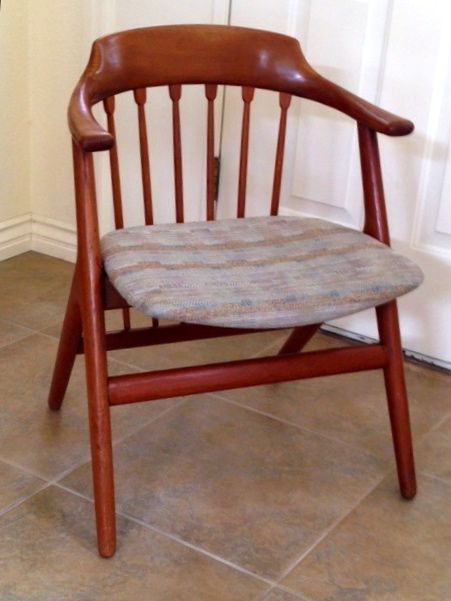
Teak Chair Repaired

Teak Chair Repaired

In the first write up about the repair work I’m doing on this chair, I mentioned how much I was learning and now that I’m done I’ve gotten more knowledge about; eh, let’s call it early mid-century furniture production.  Here is a picture of the chair now that it’s done.  Re-assembly was with Old Brown Glue, my favorite brand of liquid hide glue.  As I’ve mentioned in the past I like the fact that it’s made in America, allows a long open time, and; if the need arises the chair could be disassembled.  Hopefully that won’t happen but at least you won’t have the problem of trying to take apart something assembled with PVA glues or some other type of modern adhesive.

If you look closely at this chair you’ll notice that the stretchers and legs are obviously coped to fit together.  There are single dowels for the leg stretcher as well as the ones attaching the arms to the legs.  The formed spindles making up the back were all intact and appear to be mortised at the top and simply drilled for the bottoms.  Thankfully they were all intact!

Example of Joinery

Example of Joinery

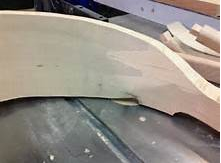
The large piece that supports the seat has three dowels at either side.  These reinforce the leg structure where the front and rear legs are joined.  Just like the back and armrest assembly, they are assembled with a tapered finger joint.  Here’s an example of how this joint is made.  Due to stresses, as I pointed out in the first blog, there is some cracking along this joint and the fingers are smaller; a few appear to be broken but …… they are holding now.  There’s really no fix for that other than remaking the entire piece.

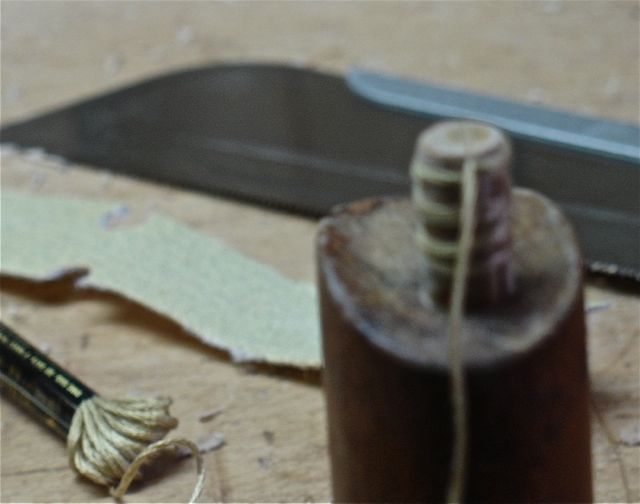
Cotton string on Dowels

Cotton string on Dowels

Another observation I made was that the stretcher holes appeared to have been distorted as people sat and moved about in the chair over the years.  My solution for that was to wrap them with some cotton thread to “fatten” them up.  Cotton will absorb the glue, expand, and tighten that up.  After cutting a shallow kerf in the end of the dowel to secure it, several turns of the string were wrapped around then brought back into the kerf to lock it in place.  I experimented with some 3/8″ dowel stock to see how many winds of string I could use and still be able to fit the dowel into the existing hole.

What's first?

What’s first?

Well, let’s get this project assembled!  You should always do a dry fit first but I really didn’t want to chance clamping things up and then breaking something else in the process of taking it apart again.  The desert climate isn’t kind to wood and things do tend to dry out and become brittle.  There are half a dozen pieces held together by a dozen dowels and another dozen mortise and tenon joints.  Some how or another they all need to be glued and assembled at the same time!  I would have loved seeing the jigs used for that in the factory where this chair was made.  It’s obvious that there was some misalignment during the process because of the way the coped joints on the legs and stretchers have uneven marks telling me they were forced into place and clamped up pretty tightly during construction.

Assembled!

Assembled!

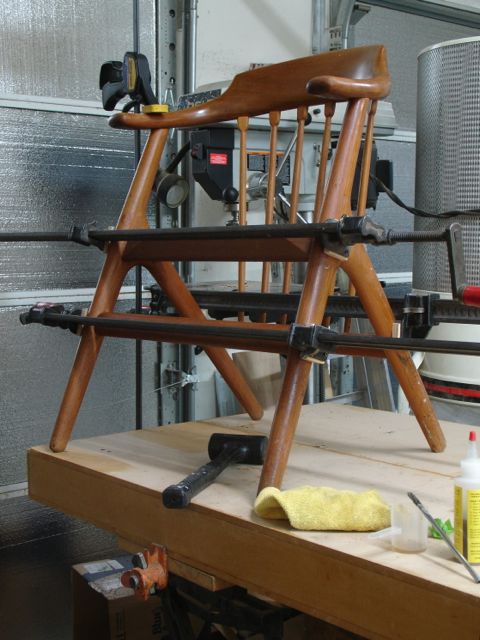
Well, I don’t have the jigs and lots of helping hands so once I came up with the game plan proceeded with it as quickly as possible and here are the results.  Not only is the chair clamped together I also clamped it to the assembly table to make sure all four legs are square to the floor.  One of the trickier parts was aligning the coped joints of the stretcher to the legs.  We’ll let it dry over-night and we’ll see what tomorrow brings.


As I removed the clamps I listened carefully to see if there was any cracking or other unwanted sounds as the clamps were released and the glue did its job, happy to say all went well.  I’ve found that by using BriWax and a white scotch pad the surface will clean up nicely without removing any of the patina that has developed over the years.  After that I wanted to bring it into the house.  Diane noticed what an interesting and un-chair like profile this chair has.  It’s very upright, the only support for the seat comes from the large crosspiece between the two leg assemblies.  For the sake of comparison I photographed it next to my original design dining chair.  This chair is one of set of six. I entered it into the Design in Wood competition in 2010 and was awarded an Honorable Mention.

Everything seems to be in good shape.  When you compare the two chairs you’ll notice how closely the legs are spaced on the Teak chair and also that the seat is a bit lower.  Mine is at just about the max height for a dining chair and works perfectly under our table.  Chair design can be challenging, the height had to fit my 6’2″ frame as well as Diane’s 5’4″ one.  My client has seen the pictures of the chair and is currently out of town but will pick it up Monday.  I hope it gives him many more years of service.

Posted in Uncategorized | Tagged , , , | Leave a comment

Chair Repair and the Things I’m Learning!

Just like restoring an old car, taking on a repair project of a classically constructed piece of furniture can be a real learning experience.  Although I generally shy away from repair work you may recall the work I blogged about restoring a set of Selig chairs and ottoman.  Here’s a link to the first BLOG about them which will link you to their completion.  Selig chairs are collectable items due to their Danish style and construction.  My Selig chair client referred a friend to me hoping that I could do something with their Teak chairs — they’re about 50-60 years old but unlike the furniture we find in stores today well worth the effort to keep them.  This is the hope I have for my furniture work, that wherever it may end up in 50-60 years someone will see the value of it rather than placing it out on the curb for pickup!

Here’s the chair, obviously it exceeded its weight limitations:

I don’t mean to get long winded but whenever I get into furniture construction it reinforces my thoughts regarding dowel joinery.  I recall (in the 60’s) my high school woodshop teacher, Ben Aiello discussing them.  This was a very common way to construct all types of furniture but when you add a secondary material the wood reaction to seasonal and structural changes will usually cause that joint to fail!  Over the years I’ve seen that time and time again and why I use traditional mortise and tenon joinery in my work.  Dowels have been supplemented with biscuits, pocket hole joinery,  and now the very expensive Festool Domino system which may be stronger than the dowels but; in my traditional mindset, nothing will replace the time consuming method of mortise and tenon joinery for framework.  Okay — off of my soapbox now, I know that adage about time being money and that’s what most are concerned with.

Let’s get on with the work on this chair.  As I began to carefully mark the pieces so it could be put back together properly I noticed this damage on the finger jointed back portion.  One that is impossible to repair:

Seat support, broken dowels and unfinished surface.

Seat support, broken dowels and unfinished surface.

I’m hoping that when everything is put back together it will relieve the stress at this point.  The main damage occurred on the main stretcher that connected the sides and supports the seat cushion.  These are 3/8″ dowels and someone before me has attempted a repair with some sort of adhesive.  One thing that surprised me was that the underside of this stretcher had a surface right off of the bandsaw with no attempts made to smooth it out.  As I continued to disassemble the chair it became apparent that many of the dowel holes have become oval due to the hardness of the dowel compressing the relatively softer, end grain of the wood as people sat and moved around in the chair.  Replacing the dowels with larger diameter ones isn’t an option since some stayed in one side of the joint but loosened from the other!  I recall a trick from way back, working at Silvera Lumber as a teen and young adult — I’ll wrap the exposed end of the dowels with cotton thread prior to glue up.  Another method would be similar to a fox wedged tenon but that’s too risky on a small diameter dowel such as this.  The cotton thread should absorb the glue and effectively increase the diameter to where it’ll fill the hole tightly.

Speaking of glue, I was hoping that the chair was assembled with hide glue and that seems to be the case.  Vinegar and warm water has removed most of the residue so that, hopefully, things will join back together once the joint has been cleaned.  Dowels that were broken were first removed or cut off flush.  The stretcher joinery is coped to join to the legs but the only real strength here comes from the dowels.  The previous repair had lots of glue here but gluing the end grain of the stretcher to the face grain of the legs doesn’t provide any strength at all.  These joints were cleaned being careful not to change the profile of the cope.  Once these were as clean as possible I used a round brush along with the water/vinegar solution to remove as much of the old glue as possible.

The main stretcher presented another problem.  None of these dowels survived so after cutting them flush the holes needed to be re-drilled.  I would have preferred using a drill press but as you can see, there isn’t a square surface to reference to.  After cleaning the first challenge was finding the center of the hole.  Here’s how I solved that dilemma with a circle template.  I “eyeballed” a 3/8″ hole then used a straight edge to extend the lines.  After center punching, a set up block was used to help me keep the hole as square as I could.

I’m left now with about a dozen dowel joints that needed to be assembled and clamped at one time!  Add to that the shape of their stylized chair, meaning no square corners to clamp up; and I’m in for a stressful morning.  Diane had some cotton thread (polyester wouldn’t absorb the glue) and as with all glue ups it’s a one shot deal.  Thankfully we have some cool weather right now and with a successful dry fit and the use of liquid hide glue I’m keeping my fingers crossed.  If all goes well the next post about this project will show a chair restored to its former glory!

Posted in Uncategorized | Tagged , , , , | 2 Comments

American Impressionist Show 2015

American Impressionist Show 2015 Honorable Mention

American Impressionist Show 2015 Honorable Mention

Sometimes you’ll hear someone say: “I don’t mean to brag but…….”; well, you’re not going to hear that from me because I do mean to brag!  Diane and I just returned from the 2015 American Impressionist Juried show that was hosted by the Trailside Gallery in Scottsdale, Arizona.  If you’re interested, here is a LINK to the catalog for the show, there are many outstanding paintings.  Also, if you’re interested in art in general, allow me to share these links to  Diane’s gallery website and her blog where she talks about her work and process.  The title of this painting is The Day Begins.  Diane had hired a model for this photo shot at the Heritage Museum in Henderson.  This is one of those occasions where I got to be the chauffeur, props manager, and photographers assistant for her.  It’s so much fun to work together on our passions.

The American Impressionist show is a juried one and of the 1449 entries that were submitted, only 180 were accepted and hung.  That means Diane was among the 12.5% of artists whose work was accepted.  This meant that the odds of having your work accepted was pretty slim.  Next, I’m estimating that there were about 30 awards given out and she was awarded one of 12 Honorable Mentions for her painting.  Crunching the numbers means that she was in the top 15% of those accepted — don’t you think I have a reason to be proud of her and her work?  The judge for the show was Carolyn Anderson, an artist that Diane admires and one she took a workshop from her quite a few years ago at the Scottsdale Artist School.

You may be wondering what all those numbers and percentages are about but that’s a carry over from my long running career.  The first race I ran back in 1978 was a half marathon and I happened to place 220 out of 440 which, I noticed was exactly 50%.  As my running progressed to marathons and eventually ultra mountain runs this was how I kept track of my progress.  I figured that my chances of winning a 50 or 100 miler were pretty slim but by calculating my percentage it gave me a way to assess my progress among the others that entered that particular race on that particular day.  I’ve gone from 50% to the upper teens on various races.  Unfortunately, two unsuccessful knee surgeries and contracting Valley Fever during a 24 hour track run have ended my running career but it’s still cool to Google my name and see race results from the past.  I ran the numbers for Diane to show her that it’s not just me that thinks she’s a fantastic artist —  numbers and averages don’t lie!

I admit to unabashedly being her number one fan and, having that distinction also lets me be her framer, p.r. guy, gallery contact, artist furniture maker, and  photographers helper, just to name a few.  The frame you see on this picture is one I designed and carved.  It’s gilded with 22 karat gold leaf.  Going to the show last week and having the opportunity to be at its opening is always a lot of fun — a great experience that we enjoy sharing together.

Posted in Uncategorized | Tagged , , , , , , | 3 Comments

Summerlin Festival of Arts 2015

Day 2: Sunday Oct. 11

Day 2: Sunday Oct. 11

After a good nights sleep, Sunday morning arrived with a clear blue sky, warm temps (even here for October) and saw Diane and I ready for another day of manning our booth. Let me share what we went through at first to get here!

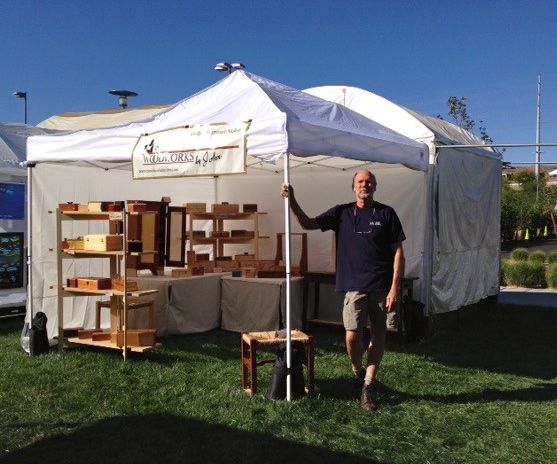
This is the twentieth time this event has taken place and the first time in its new venue of Downtown Summerlin.  Two years ago Diane and I made it our first craft fair where she featured her Rag Dolls and my boxes.  That year this event was held in a large park but many attendees complained about the parking which was across the street in a dirt lot!  This year those complaints are gone with literally hundreds of parking spaces and garages for them to park in.  Downtown Summerlin is a collection of stores and restaurants set up as an outdoor mall.  Only 100 artists and crafts people were juried into the show this year and I was fortunate enough to be one of them.  The show was held on Saturday and Sunday from 10am to 5pm.  Very well organized with lots of activities including a Farmer’s Market that was held on one of the streets within the Downtown Summerlin area.

Diane and I took our E-Z Up tent, shelves, and tables around 9am on Friday morning.  There was lots of activity as many others were setting up as well.  The area where the event was held was a dirt lot a month ago but now covered with grass.  As we put the tent sides on we noticed how humid it got inside the tent as the above record temperatures in the 90’s combined with the wet grass turned our tent into a sauna!  Thankfully, our open sides faced east and north so after 11am or so we were spared the direct sunlight.  Since it was so warm we decided to wait until the afternoon to bring our sales items to the tent.

This year we purchased zip down sides so when we left they were simply attached to the legs with Velcro and zipped closed.  The event is well run with security there all night.  So much for Friday set up, now at 9am on Saturday we were ready to make some sales and contacts.  First of all though, the inside of the tent was like a sauna and the first thing I noticed was that the boxes with sliding lids didn’t slide very well and the lift off lids were a bit sticky!  Thank goodness, after an hour or so the humidity levels came back to our customary single digits and all was well in the world of wood.

There are two main things I wanted to accomplish during this event.  First of all the obvious — sales which supply the needed funds to enter the fair and also buy more materials for future projects.  That goal was accomplished.  The other goal I had was to make contacts with potential local clients for custom furniture work.  I’ve lost track but I’m certain I talked to at least a dozen people who told me of a need they have for custom work in their homes and seemed to like the quality of the wine cabinet, hall table, and bench I brought to the fair.  Time will tell but after the last fair I received three custom furniture jobs and also some repair work.

Heavy Starch

Heavy Starch

The item that started the most conversations were my sculpted work shorts.  Here’s a LINK to the blog post about their history.  I have to admit that when we went home on Saturday I was convinced that one person in particular would be back the next day to buy them.  He was very enthusiastic about them and told me how he had collections of wooden items in his office.  Unfortunately, my intuition on that one was off!  No problem though, they started  many conversations and enticed more than one person to come into our booth.

Wall Hung Wine Cabinet

Wall Hung Wine Cabinet

The other item that seemed to draw people into our booth was the hanging wall cabinet I designed.  Diane suggested we put full bottles of wine and the glasses in it to really illustrate what the cabinet was for.  She was right, I may have a potential client for a similar unit in a lighter colored wood — keeping my fingers crossed for that to come to pass.


Diane and I have a habit of asking  each other what the highlights were of a trip, vacation, show, party, etc. after they are over and done with.  This was no exception.  Since we are both involved in creative activities and very supportive of each other; one highlight is hearing other peoples reactions to the work you create.  There’s never been an outright rude person making negative remarks.  Conversations usually included their own or relatives woodworking abilities.  It was encouraging to me to have quite a few folks in their late teens through twenties express an interest in the craftsmanship and methods of the work I had displayed.  I used it as an opportunity too, to let them know that I teach these skills out of my shop.

All in all, this was a worthwhile and interesting experience.  Admittedly, being out in the public, carrying on conversations, and answering many of the same questions numerous times can be tiring.  It’s time well spent as far as I’m concerned; the immediate feed back and potential for future clients is a great pay back.  Once things settle down and are back where they should be I have a picture frame to carve and gild and just accepted a job to repair a teak chair that met a person beyond its’ weight capacity!

Posted in Craft Fair | Tagged , , , , , | Leave a comment