Wenge + Spalted Maple = Dovetails and Pegs?

Wenge-SpaltedMaple-BoxSeries-WoodworksbyJohn

Wenge & Spalted Maple Boxes

I like the direction this box series has taken so I’ll share this photo first and then explain the “back story”.  On our recent visit to Spokane, my daughter wanted us to see a local lumberyard that had quite a selection of exotic woods.  I ended up buying a good sized chunk of Spalted Maple that measured about 3″ thick, 10″ wide, and 14″ long.  That piece is behind the unfinished box on the left.  I’d always wanted to see how Wenge is to work with so ordered about 3 bf of 6/4 material from Woodworkers Source.  That’s the piece behind the finished box on the right.  Wenge is one tough, dense wood — more on that later; let’s start with the Spalted Maple.

Planing Spalted Maple

Planing Spalted Maple

After planing one edge smooth and square the piece was resawn.  This process began with two pieces about 3/8″ thick for the sides and then another two 9/16″ or so for the lid.  I discovered that the spalting will change with every cut.


Spectacular Spalted Pattern

Spectacular Spalted Pattern


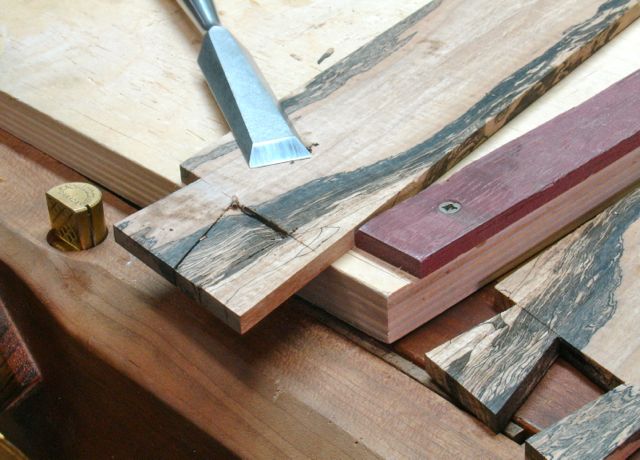
The process was the same, plane the slab, resaw, plane the slab again until I had enough for two boxes and their lids.  The wood is a bit “punky” and tends to chip off pretty easily so sharp tools, light cuts, and a prayer helped to get it the way I wanted.  It was pretty exciting watching each piece come off and expose the spalted pattern in that slab.  When looking at the end grain of this piece I’m guessing there will be a lot of spalting towards the center of the board.  Now comes the dovetailing and you know I’m a “tails first” kind of guy so naturally that’s where I began.  After some experimenting I found that since the wood  is “punky” a Japanese razor saw was the best choice even though I prefer using Lie-Nielsen dovetail saws.  I discovered on the second box though that the dovetail saw worked fine when both pieces were clamped together and clamped low in the vise.

Chisel Work on Spalted Maple

Chisel Work on Spalted Maple

Chisel work was another story!  Happy to say though that the technique I use where I cut ever deeper wedges out of the wood works well for this wood.  Started on the show side until about half way through then flipped the piece over and met in the middle.


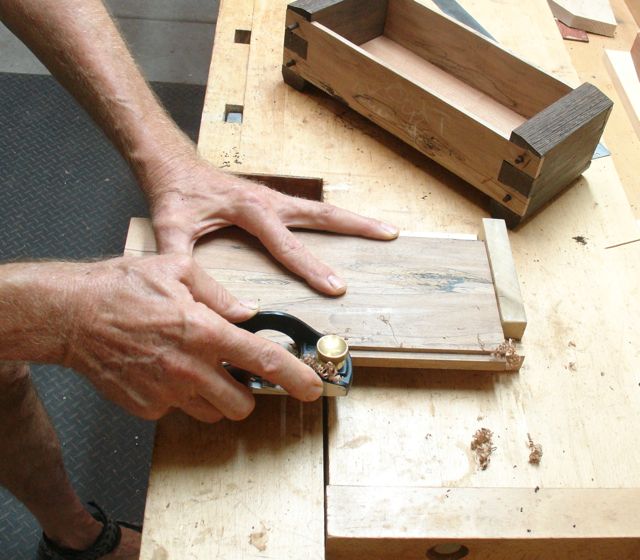
Whew — so far so good now let’s tackle that piece of Wenge!  The first box has angled cuts on the top and bottom which were made on the tablesaw.  I also was curious to see how this wood reacted to planing and/or scraping:

It was pretty tough going but the finish will be acceptable.  I’ve read that Wenge is pretty hard on your tools so there is a sharpening/honing in my future!  Again, the pin board, for lack of a better term, was cut first with a Japanese razor saw and finished with a 1/4″ carbide bit in a trim router and finally chiseled to fit.  Honestly, chiseling Wenge is pretty much like trying to chisel concrete!

Chalk in Scribed Line

Chalk in Scribed Line

In a previous post I talked about the Pica Dry Pencil that I found at this years AWFS show.  Having high hopes for this tool I really tried my best to like it but it just doesn’t work well.  For starters the lead is too soft to hold a good point so you’ll find yourself sharpening it every two or three lines!  Then, the colored leads they sell; which I thought would be great for working with dark woods like this, are equally soft and crumble like a kids crayon.  Back to the old tried and true method of chalk rubbed into the line to make it visible.

The completed box features my Slanted Dovetail design.  The second one has large lap joints which I wanted to pin — would the Wenge allow itself to become a peg?  Only one way to find out isn’t there?  In a previous post I did a YouTube video making dowels.  You can check that out but here’s a slide show of it as well:

This slideshow requires JavaScript.

The material I used was the small piece cut from the first boxes lid rabbets.  Pleasantly surprised that the Wenge cooperated and became pegs for me.

I like using Gorilla glue for laminating panels and oily woods, here’s how things looked prior to the assembly.  Cauls were made from some scrap Pine and covered with packing tape.  About the only time I’ll wear gloves is when using Gorilla glue, the bottom piece is signed and ready to be inserted into the dadoes of the side pieces.  It’ll be hidden by the finger joint.  Decided to glue and clamp first then insert the pegs after that was dry.

Ready for Assembly

Ready for Assembly

Final Touches

Final Touches

The final piece that needed to be finished was the lid.  It’s rabbeted to fit between the sides.  The initial cuts were done on the tablesaw and fine tuned by hand.  You can see the completed box in the background ready to have the pegs cut off and finished.  This will definitely be the last box before the Summerlin Craft Fair.  That happens October 10th. and 11th. at Downtown Summerlin.


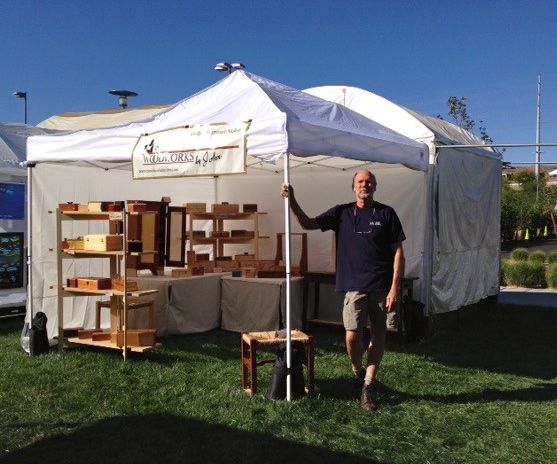
Here’s the Craft Fair announcement and a shot of the completed box.  Hope to see my local readers at the fair this year.


Posted in Slanted Dovetail Box | Tagged , , , , , , , | 4 Comments

Miter Cutting Sled for SawStop Tablesaw

Please Note:  Now that I’ve used this for making a frame need to point out one minor problem with this sled.  If your molding is long it can cause the front of the sled to raise up.  Shorter lengths are no problem,  will need to figure out a way to anchor the front of the sled in the miter gauge slot.

Ready for Picture Frames

Ready for Picture Frames

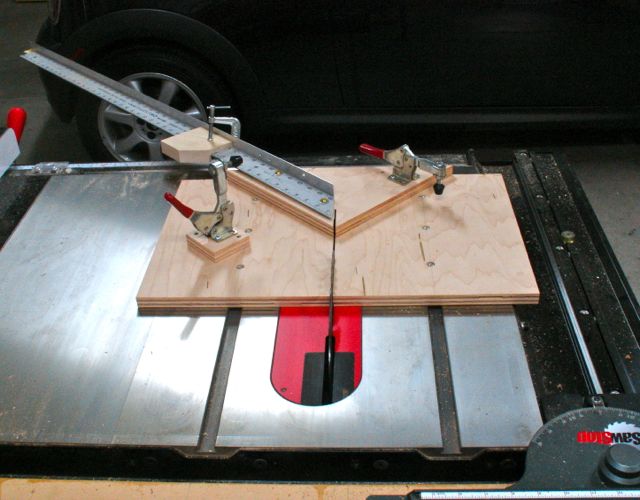
Here’s my set up for cutting picture frame molding on the SawStop.  Unfortunately, the sled I had for the Jet cabinet saw couldn’t be modified easily and needed replacing anyway so decided to start from scratch on this one.  In the past, my runners are made from UHMW polyethylene and I’ve had no complaints other than it can be tricky getting them to fit perfectly in the miter slots.  Decided to give the MicroJig Zero Play guide bars a shot on this project instead.  Haven’t made a frame yet but so far I like the action of them plus the ease of aligning everything for this sled.  I used two of their bars for this project and some 3/4″ Maple shop plywood I had on hand.

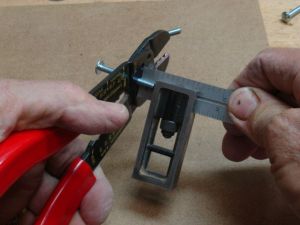
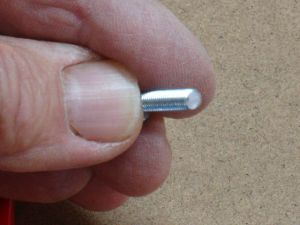
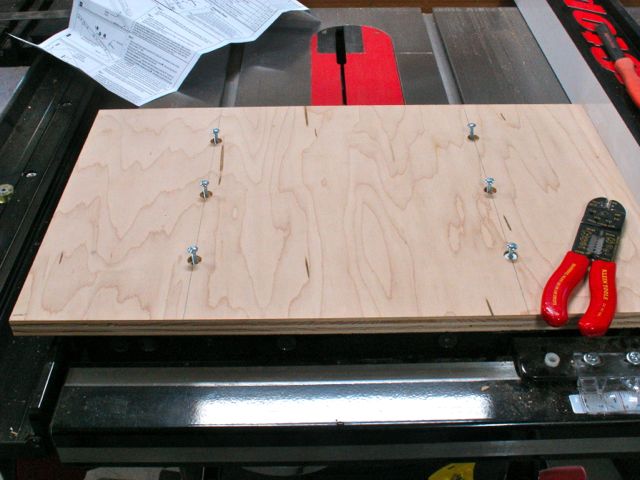
After the ZeroPlay bars are adjusted to fit the slots it’s time to mount the piece of plywood to them that will make up this sled.  It measures 14″ x 22″ and is centered on the blade.  According to MicroJigs instructions you should first drill a 1/2″ counterbore to a depth of half and inch into the ply.  I deviated from this because leaving only 1/4″ of material for the screw to bite into just didn’t seem sufficient.  I’m sure they do that so the screw supplied with the bars can be used for either a 1/2″ or 3/4″ thick base.  It’s easy enough to cut the 8-32 screws with a wire stripper; much easier than with a hacksaw for sure.  I have a box of 8-32 x 1 1/2″ truss head screws for mounting hardware so that’s what was used.

Base Aligned to Fence

Base Aligned to Fence

After drilling the counter bore and 1/4″ through hole the screws were started into the bars and tightened sequently using the fence for alignment.  Next comes the part of this sled that I feel makes it so accurate.  It begins with another piece of material that has an accurate, 90 degree corner.  This will be mounted to the base in line with the blade and is what your molding is held against as you cut.  The theory is that even if  the alignment is off a bit, because the guide point is 90 degrees your corner will come together more or less perfectly.  What you say, more or less!!; yes, I’ve learned that if it is off more than a degree or so one side will be ever so slightly longer than the other when joined even though the resulting corner is as square as can be.  If you’re doing outdoor window trim a tap with your hammer on the long point will be all that’s needed to correct that.   Picture frames require more accuracy so the  more accurately you can align this piece to the blade, the more accurate your mitered joint will be.  Seeing how I do mainly picture frames with this set up, that’s pretty crucial.  The widest molding my wife generally uses is 4″ so that’s how I determined the location of the guide piece.

I forgot to mention that once your base is secured to the runners you raise the blade so that it is just above the base and cut in to the approximate location of the guide piece.  I was able to jam a piece of 1/8″ masonite into the kerf for the initial lining up, attached it with one screw and then aligned it as accurately as I could.  Don’t glue this piece down, you may need to replace or re-align as time goes by.

To assemble an accurate frame it’s critical that opposing sides are the exact length, this is best achieved by having some kind of stop system on the sled.  The size of if will depend  on the length of materials you plan on cutting.  My setup is a 48″ aluminum straight edge (garage sale find) that is also supported with an aluminum angle.  The length of it makes it pretty awkward to store so it’s removable.  In this instance, 1/4-20 brass inserts were used.  These can be a hassle to install but here’s a trick I learned some time ago.  All you need is a 1/4-20 bolt and wing nut.  Since the brass seems to always tear out when you use a screwdriver this method locks the insert to the bolt which can then be installed into the plywood.

This slideshow requires JavaScript.

Place the wing nut onto the bolt then thread on the insert, locking the two together.  Once the insert is fully inserted you use a plier to back off the wing nut, unscrew the bolt from the insert, and it’s installed without tearing up the brass.

In practice, one side of each piece is mitered first.  You can probably tell in this slideshow that I’ve riveted the aluminum angle to the straight edge.  I’ve also made a stop that can be easily clamped to it.  Depending on how you attached the scale, it will need to be calibrated.  Picture frames are measured inside of the rabbet so that’s the way my scale is calibrated.

This slideshow requires JavaScript.

One thing not mentioned are the clamps.  I use De-Stay-Co clamps, they are quick and secure the wood well.  From time to time they may need to be repositioned depending on the profile of the wood I’m working with but I’d recommend using them so you can achieve the most accurate cut. I’ve found this type of sled to be very accurate and am looking forward to making a frame for Diane real soon!


Posted in SawStop Sliding Table | Tagged , , , , , | 7 Comments

Easel & Palette Box Complete

Easel and Palette Box

Easel and Palette Box

What better way to use some of the leftover pieces of Mahogany from the Armoire then to make a portable easel and palette box for Diane.  I mentioned in my first blog on this project that there were many challenges to overcome and things to learn — always a good thing!  This is not my original design but rather a modification of one made by an artist named James Coulter.  Besides the fact that I could make this for Diane and save money, the other reason was for specific size requirements.  The center area of the palette box will hold the 12″ x 16″ paper palettes she likes to use.  We followed Mr. Coulters advice and ordered a Slik F740 tripod which is extremely sturdy and light weight.

Wing Leveler

Wing Leveler

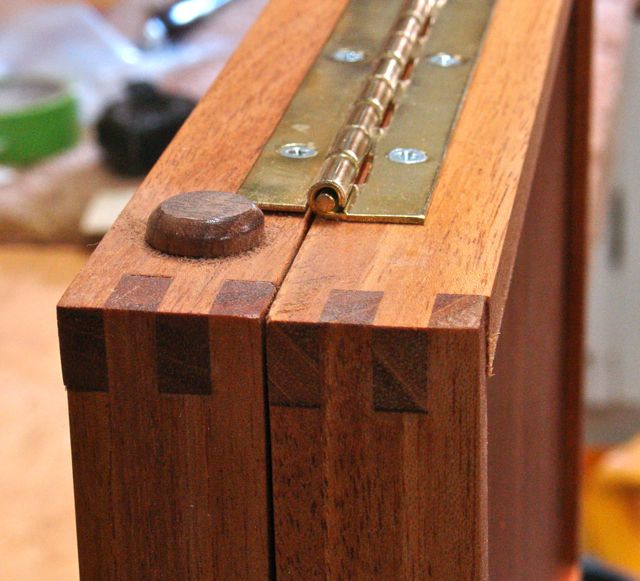
In the other post I mentioned the challenge of making these types of things and there were a couple of unforeseen ones for me too.  To keep things as light weight as possible I made the wood 7/16″ thick; good move right?  Yes, until you try to hinge it!  I wanted a piano hinge for strength but couldn’t find one narrow enough so needed to mount it on the outside of the box.  Thought that was a good solution until the wings were opened, the problem was that they tilted downward which wasn’t acceptable.  The wings will be used to hold turpentine which would spill and brushes that would roll off the side.  How to solve this dilemma!  In this photo you can see my solution, a button used to conceal screws.  After carefully drilling the required 7/16″ hole the button was glued in and allowed to dry.  There are two on either side which were then flattened down with a file until the wings were level with the palette portion of the box.  So, let’s see what this all looks like:

You may recall the dilemma of the handle.  Diane wanted an easy way to carry the palette box but if there was a briefcase style handle it would probably get in the way — besides, they’re ugly so here’s that solution:

Since Diane uses both panels and stretched canvas for her work she wanted one easel that could be used for both.  The solution was to insert some round headed wood screws that can be fine tuned if needed to hold panels.  For a stretched canvas, it’s simply held between the fixed bottom piece and movable top piece.

Camera Mounting Plate

Camera Mounting Plate

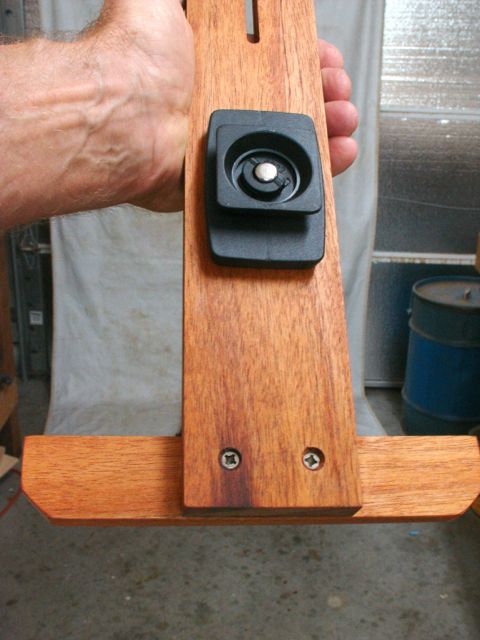
The tallest panel or canvas  that the easel can hold is a 20″ and can be adjusted down to 8″.  The canvas in the picture above is a 14″ x 18″.  The way the easel attaches to the tripod is with the camera mounting plate included with it.  In use there is no limit to how it can be angled or positioned.  It can be used when standing or sitting.


This was another interesting project to build.  I know that within a few sessions it will have its share of multicolored oil stains and finger prints on it but that won’t bother me — it’ll just add to the character and patina of this project!

Posted in Artist Furniture | Tagged , , , , , , | 5 Comments

Portable Easel and Woodworking Challenges

If there’s one thing that really intrigues me with woodwork it’s being approached with a challenge or project that needs to be solved.  The mental stimulation and trial and error process of actual hands on work to conquer that challenge “races my motor”!  Honestly, it doesn’t make too much difference whether it’s a large and complicated challenge like the recent Mechanical Cellarette or a simpler one like the hardware for this current easel project.

Most of you know that my wife, Diane, is an accomplished artist.  Here is her gallery site if you’d like to check it out.  I enjoy the opportunity to not only make, carve, and gild her frames but also assist her in photo shots and make art related furniture for her.  This includes a number of easels from a pochade box to a full sized studio easel.  The one currently in progress is more of a portable one that attaches to a camera tripod making it light and easy to transport.  It isn’t my original design but rather one “borrowed” from James Coulter and modified to suit Diane’s requirements — hey, when you’re married to a woodworker why spend money on something he can make?

Handle and Knob Complete

Handle and Knob Complete

I’ll show the completed easel in a few days, right now it’s in the finishing stages but here are the two “problems” that I enjoyed solving so thought I’d share them with you.  To carry this Diane asked for a handle.  The pieces that make up this part of it are only 7/16″ thick and 1″ wide so there’s not a lot of material to work with.  Let’s start with the carrying strap.  It’s a piece of leather from Tandy designed to be used for reins.  I use it to secure the pistol in my pistol cases.  The handle needs to lay flat when in use so the solution was to put a slot in it so it could be pulled out to carry and pushed flat when in use.  Here’s how I solved this problem:

This slideshow requires JavaScript.

Where I was stumped was how to make the insides of the slot smooth.  I finally hit upon the idea of using the drill press and carefully running a 3/16″ drill bit inside of it; probably not OSHA approved but …..!

The other challenge was to make a knob that didn’t look like the standard plastic ones available commercially.  The movable part of the easel has a 1/4 x 20 threaded brass insert.  I’ve learned that epoxy alone isn’t enough to secure a threaded rod into a hole — it’s going to work it’s way loose.  To solve that you can use either a thin brass rod or a thin screw (my choice) to secure your threaded rod into the wood.  After drilling the hole for your threaded rod, put it in place and then drill whatever size hole is needed to match the screw or rod you have.  In my experience, the threads not only pull their way through the wood and brass but also give your epoxy more grip — check this out:

This slideshow requires JavaScript.

Looking forward to completing this project and showing you the results.  In the meantime I’m also busy finishing the last couple of boxes and making price tags and info for the upcoming Summerlin Festival of the Arts.

Posted in Artist Furniture | Tagged , , , , , , | 1 Comment

How to Make a Finger Joint Jig for SawStops Sliding Table

After writing about the box/finger  joint I made for my SawStop sliding table, a few readers asked me how to go about it.  Since I needed to make one to cut 1/4″  joints, I decided to turn it into a tutorial.  If you make this jig I’d be interested to hear how it worked for you.

Parts Needed

Parts Needed

Here’s a listing of the parts needed for these jigs:

  • Plywood for back — 3/4″ x 4″ x 18″
  • 1/4″ MDF for bottom carrier —  2 1/2″ x 18″
  • 1/4″ MDF for backing piece —  1 1/4″ x 4
  • 2 Metric buttonhead capscrews M6-1.00 x 25mm with flat washers and nuts
Mounting Holes

Mounting Holes

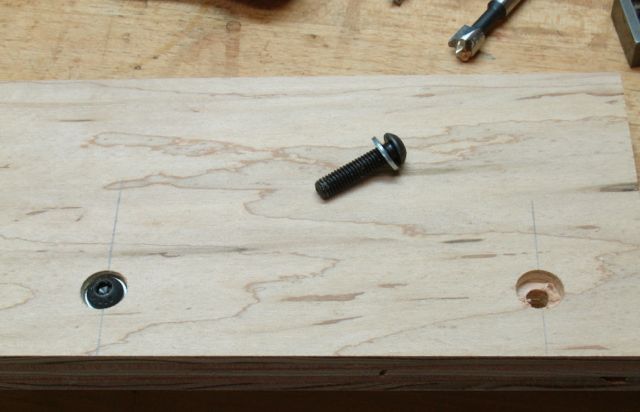
The first step is to locate and drill the holes used to mount the plywood piece to the sliding arm.  Including the 1/4″ MDF carrier they are 1 – 3/32″ from the bottom.  Use a 1/2″ forstner bit to  drill a counter bore so that the buttonhead capscrew and washer are flush with the surface.  Use a 1/4″ bit to complete the hole for the capscrew.  Not too critical of a measurement but I located them at 1″ and 6″ from the left of the board when viewing it from the back.

Backer Piece

Backer Piece

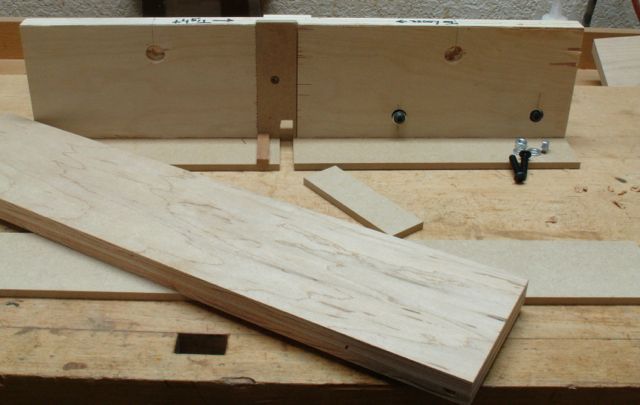
Before attaching the plywood you need to use your 1/4″ dado to cut a recess in it for the backer piece.  It’s located approximately 9 1/2″ from the left and centered on the dado.  This piece prevents blow-out on the back side of the joint.  It’s important to have the height of the dado match the height of the backer board.  Locate the center of this piece and drill and countersink for a screw to hold it in place.  I made the mistake once of cutting some finger joints in a 1/2″ thick board and then in a 3/8″ thick one.  Because the first cut was more, I had some blow-0ut on the 3/8″ pieces — lesson learned!

Carrier shifted 2X dado width

Carrier shifted 2X dado width

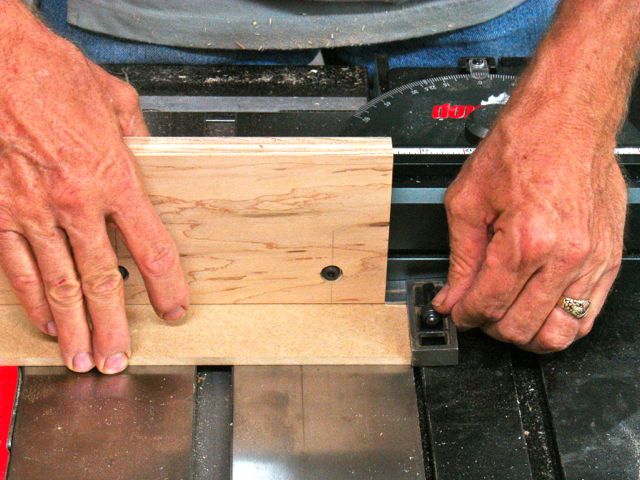
Now it’s time to put a very shallow, 1/4″ dado in the carrier piece.  Attach the plywood securely to the slider arm and move the carrier twice the thickness of the dado.  Since this is a 1/4″ dado it’s located 1/2″ from the left.  After that is cut, attach the carrier piece flush with some screws and glue but be sure not to put any screws in line with the blade.

Fitting the Key

Fitting the key onto the carrier piece


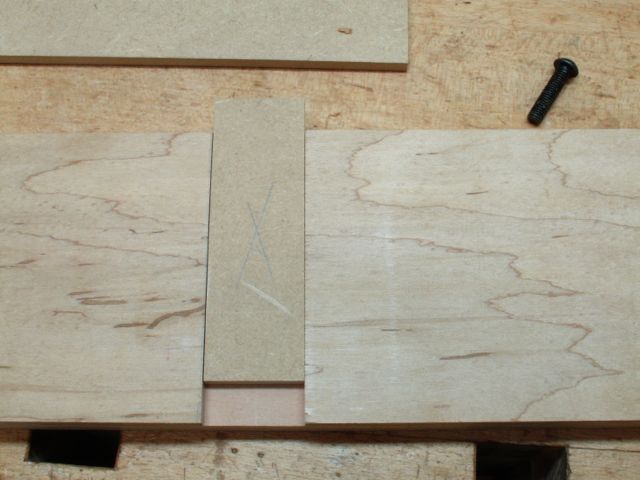
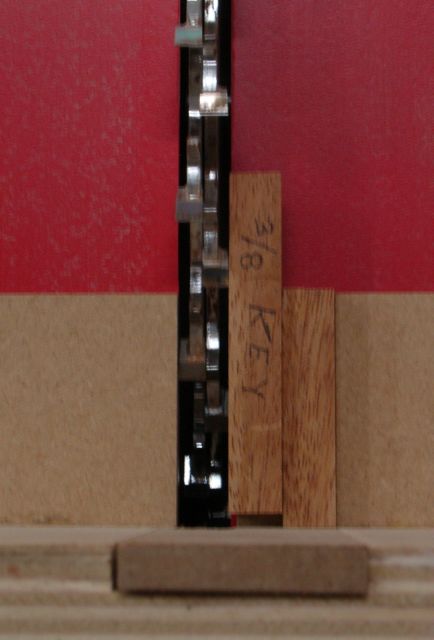
The next step is making a key that fits the dado exactly.  Make the key longer than what you need for the carrier piece, you’ll use it to set up the jig.  You can either cut some dados or use the MDF as a guide.  I think using a scrap piece and cutting dados 1/2″ deep will give you a more accurately sized key.  This is glued into the dado on the carrier piece.  At this time I like to glue a piece of wood on the back side of the jig where the blade comes through.  This acts as a “no go zone” for my fingers when cutting the joints.

Align dado to jig

Align dado to jig

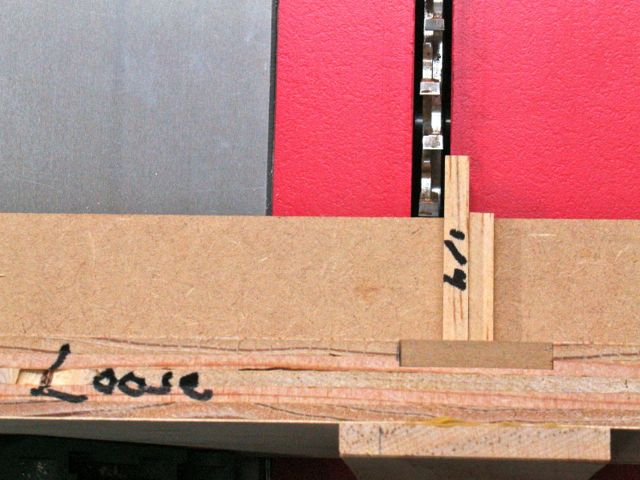
Attach the jig to the slider arm snugly.  Use the extra key piece to align the blade.  For testing I’ll use some 1/4″ MDF to make the initial cuts.  This process gets like Goldilocks and the Three Bears! First too tight, then too loose, and after a few more “tastes” it’ll be just right!  Took me about 7 tries to dial this one in to my satisfaction.  Too loose means you move the carrier to the right, too tight to the left.  I use a sharpie and write on the jig so I remember.  Doesn’t take much to throw everything off.  It’s also wise to use a test piece that is as wide as the pieces you plan on jointing.  A minor discrepancy is magnified if the board is 5-6 inches wide.

Movement gauging hint

Movement gauging hint

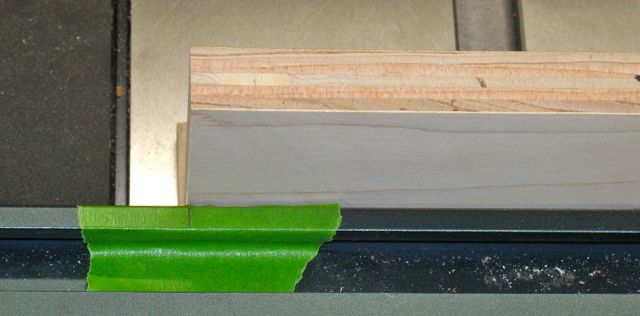
To gauge how much movement is going on as I tap the fence right or left I’ll place some tape on the fence and pencil in where I started.  This way you can actually see the very slight movements needed to get this just right.


End Result

End Result

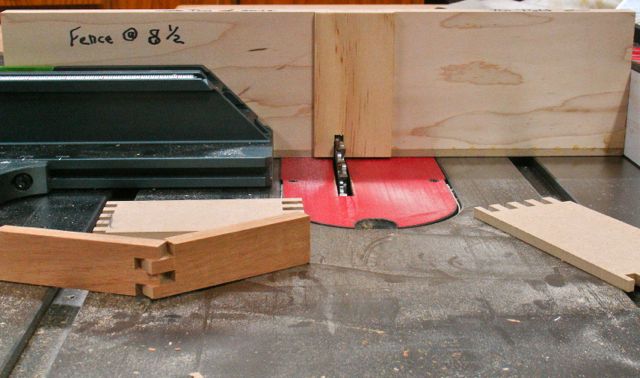
Here’s the end result of the jig making process.  Once everything was dialed in I slid the rip fence up against the right side of the jig.  It read 8 1/2″ so that will be my initial setting the next time I use this — write it on the jig with a sharpie.  See the piece of wood glued on in line with the blade?  That’s what I refer to as my “no go zone”; your fingers will feel that and as long as you don’t put your hand in that area the SawStop finger saving technology won’t be activated!

If this is your first time visiting my blog you can see a video of the jig in use on this previous POST.  It does take a little bit of time to construct it but if you make boxes or ?? that need a box/finger  joints it greatly simplifies the process.

Posted in SawStop Sliding Table, Tutorial | Tagged , , , , , , | 6 Comments

Finger Jointed Box Series

Now that I have the finger joint jig dialed in for the SawStop and the sliding table it’s time to make a series of boxes.  The only craft fair I’ve ever done was the Summerlin Craft Fair two years ago when Diane and I shared a booth.  It was an experience and although my passion is making furniture and carving frames, making one of a kind and custom boxes keeps me in the shop with some money in my pockets — there’s a combination that’s hard to beat!  Since I have quite a bit of the Radiata Pine from the last commission that’s what I’ll be using.  I’ve mentioned before about making more than one of a certain box series at a time, it’s much more time effective especially with finger joints that are cut by machine.

Sliding Table with Stops

Sliding Table with Stops

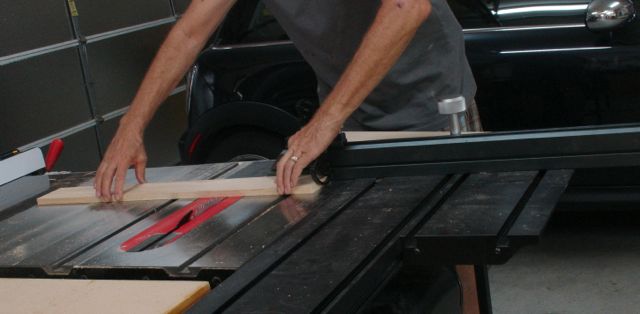
After deciding the sizes of the boxes, the first step was cutting the pieces.  I’m starting to get used to the sliding table for this operation although it still seems weird to me to have the shortest piece of a board supported by the “miter gauge” aka sliding table.  Unlike using that with a standard miter gauge there is absolutely no friction to overcome so the cutting action is extremely smooth.  I was able to use the stops which was easier than the method before where I used spacers.  As always, as the pieces are cut they are laid out in sequence and then marked so the grain flows around the box.

I had one of my woodworking friends give me the “thumbs up” for adding some YouTube video’s to my blog so I did this one showing the sliding table finger joint jig in action.  Don’t worry too much about hearing what I’m saying because the sound of the saw has taken all of that away!  The action of the sliding table on my SawStop is so much improved over other jigs I’ve made — love it!
You may notice that after cutting the two longer pieces of the box I use one as a spacer to cut the first joint on each side of the shorter piece.  Saves time that way in my opinion.  Also the boxes are all marked with the painter’s tape, numbers, and arrows to make sure they are assembled with the grain flowing continuously around the box.  Another note, if you read the first post about the jig I mentioned that the blade was cutting 1/64″ oversize well, guess what?  Today it was right on so just added a shim from a set of machinists shims so that solved that.

I generally cut the pieces a little bit wider than needed and trim them so they end right at the end of a finger (saw and plane).  Next I use this little box slot cutter bit that I love from Lee Valley.  I’ve mentioned it before but for a “mass-production” like this it’s so much simpler than making stopped dado’s for the top and bottom. Here’s a link to it from  Lee Valley.

It does create lots of chips so I’ll hold a vacuum inside, also make the cut in two passes; one without going to the bearing, followed by a full depth cut.  Keep in mind which way to feed the bit and if the joints are loose it’s wise to put a band clamp around the box.  The bit  leaves rounded corners so use a nickel, trace it on each corner, then file, sand, whatever works the radius.

All that remained was to rabbet the lids which are 3/4″ thick.  Rather than set up the dado head I made the rabbet in two passes on the table saw.  All that remained was to use the panel raising jig you see to chamfer the lid.  Luckily, all that was needed to modify this jig to fit the SawStop was to add a layer of laminate and it now rides snugly on the fence.

This slideshow requires JavaScript.

Lids 0iled, 2 in front are distressed.

Lids 0iled, 2 in front are distressed.


At the end of the day there were two of the lids that were distressed, which is a nice way to say “beaten up” with some nuts and bolts attached to a wire.  I think this gives the Pine and the box a bit of character.  All that remained was to oil them prior to assembly in the morning.

Posted in Uncategorized | Tagged , , , , , , , , | 2 Comments

SawStop SlidingTable Finger Joint Jig

First Practice Joint

First Practice Joint

This will be a very brief post to show how I modified the finger joint jig that I used on the Jet cabinet saw to now work on the SawStop equipped with the Sliding Table.  It took a number of hours to do it but I must admit that this is such a vast improvement over the technique of cutting finger joints (aka: box joints) before I just had to post and share it!


A bit of history first, ever notice how magazine titles always seem to shout out at us that the current issue has the best way to ………. for whatever?  I can think of many at the grocery check out line that have nothing to do with woodwork whatsoever!  Well, that seems to be the case with these jigs and through the years I’ve probably made a dozen of them with mixed results.

Woodsmith Jig

Woodsmith Jig

The one that seemed to work best was found in a ShopNotes publication titled Best Tips, Tools, & Techniques for the Tablesaw.  Mine is an older copy but I did find this LINK to the current edition you may want to check out.  The jig is pictured here and what made it one of my favorites is that it rides in both of the miter gauge slots of the tablesaw.  It allowed you to make interchangeable carriages for different size finger joints.  Also the insert behind the blade is replaceable which helps prevent tear out.  The only drawback was feeding the wood through the blade, difficult to get the right angle and keep the jig firm in the slots.

What I did for the SawStop was to only use the carriage from this jig.  In this blog I went into detail explaining how to make an auxiliary fence/jig that will slide into the slots of the sliding table.  Briefly, you drill a 1/4″ hole 1  3/32″ up from the bottom of the jig after making a 1/2″ counter bore that will accommodate a M6-1.00 x 25 mm button head cap screw and washer.  This can now slide into the arm as shown below:

Jig attached to sliding arm

Jig attached to sliding arm

Fine Tuning Location

Fine Tuning Location

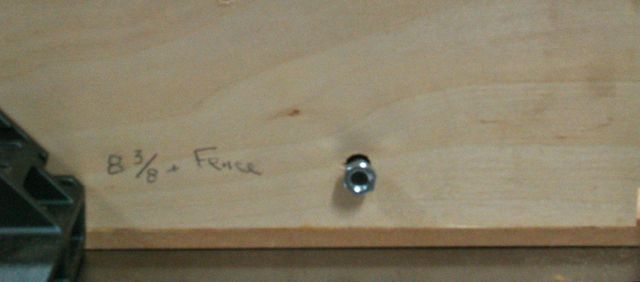
Notice I penciled in 8 3/8″ fence?  After putting both of the nuts into the slot the fence was slid to the right against the jig which was tightened when the indicator read 8 3/8″.  This located it “in the ballpark”, fine tuning was done with a spacer the exact size of the slot made by the Freud box cutter set.  Actually, this set cuts 1/64″ oversize.  The first thing I did was run a set with some 1/4″ MDF and surprisingly enough — they seemed to be right on!  Next up was some pieces of Pine and the fit was perfect — my lucky day!

The bottom line is that the action of cutting these finger joints with the sliding arm is so smooth and controlled there is no comparison with any other method I’ve used over the years.  For the upcoming craft show in October I need to build up my inventory of boxes and this should make that process go smoothly.  For safety there is a block of wood glued to the back of the jig directly above the blade.  Not sure where I learned about that but it’s a good way to tell your hands not to go below it!  After making the slight adjustment the fence indicator reads 8  7/16″ so when I’m ready to cut the joints I’ll just need to slide the jig into the arm, push it and the fence to that measurement, and tighten it in place.  Small adjustments may be needed but that’ll be easy enough to accomplish.  If you have the sliding table for your SawStop you just may want to give this a try.

Posted in Finger Joint, SawStop Sliding Table, Tutorial | Tagged , , , | 1 Comment

Custom Pine Box Complete & Delivered

I’m  a bit behind because this latest Etsy order is already packed up, shipped, and delivered.  Matter of fact, the client gave me a great review which is really what it’s all about.  When I taught I would tell my students that the money for a project was really secondary because that is soon spent on bills, tools, going out, etc.  On the other hand, the satisfaction of knowing you did a good job will last forever.  As you may imagine, that was a hard sell to teenaged students!

Here is a picture of the three boxes.  It’s always interesting to see the differences in the same species of wood, these are all Radiata Pine.  The one on the right is the original box that was sold.  My client wanted another similar one and that’s the one on the left.  As is my habit, I made another one of a similar size for the store and that’s in the center.  Really illustrates why I prefer to buy all of the lumber for a furniture piece at the same time and try to get related pieces out of the same board.

Three Dovetailed Boxes

Three Dovetailed Boxes

Both of the boxes that went out had a sliding tray for added storage.  These have mitered corners with a bottom set in a groove.  I recently upgraded my saw to a SawStop with a sliding table so here’s how that is set up for making a mitered box:

This slideshow requires JavaScript.

I went into more details about making this jig to fit the sliding table arm.  If you’re interested you can find that information on this BLOG.  The next jig I plan to make for the SawStop is one to do finger joints.  That should be coming up soon as I need to increase my inventory for the upcoming Summerlin Craft Fair this October.

The final details for these boxes had to do with attaching the handles to the lid.  Since I recently gave a demonstration for our Sin City Woodworkers group on hand cutting mortise and tenon joints I thought I’d try to make a video of it for the blog.  It came out okay but I’ll apologize for the quality in advance — like to think I’m a better woodworker than videographer!

Since I’m not sure how to splice two video’s together, the first part is only about laying the joint out using a two pin mortising gauge:

This part shows the actual cutting of the joint.  To gauge the depth of the mortise I’ll put a piece of tape on the mortise chisel, 3/8″ in this case.  Many woodworkers would be tempted to use a plunge router and fence but honestly the hand process took about 5 minutes and, in my opinion; is much more enjoyable.  No loud, screaming router and flying dust that needed to be cleaned up afterwards either.

There you have it, the work is done and the boxes have been sent to their new owner.  I think it must just about be wine time!

Posted in Hand Cut Dovetails, Mitered Box, Mortise and Tenon Joint, SawStop Sliding Table, Uncategorized, YouTubeVideo | Tagged , , , , , | Leave a comment

Custom Order: Dovetailed Pine Box

In a previous post I mentioned that I have a custom order request from the Etsy store and the client was very understanding about my vacation and Armoire plans.  It’s now coming to the final stages and my goal for today was to finish the handle and have it glued in place so the first coat of finish can be applied tomorrow — I made that goal!

It’s always interesting to have a conversation about how to price your work with other woodworkers.  This came up at the meeting of Sin City Woodworkers last Wednesday.  Calculating the price of materials is pretty straight forward.  Calculating a final price is a tough call; do you charge time and materials only, do you go over your past sales and try to calculate the amount of time it may take, what’s the best approach?  What works for me is to make multiple of the same project in maybe different sizes and/or materials whenever I get a custom order.

Handle Profile

Handle Profile

For example, let’s look at the handle I came up with for this box.  It took almost an hour to create the profile out of a piece of Australian Lacewood.  It involved some tablesaw work to create the tongue and then some router work for the profile. I made enough for 5-6 boxes so now it’s essentially free the next time I use it.  Sometimes the pricing game I play is to decide how much would I enjoy the challenge of a requested project?  If it’s one that really intrigues me I may make a lower bid.  On the other hand, one place I used to work part time told me if he had a custom request for something he really didn’t want to do he’d make a high bid thinking that if they accepted it at least it’d be worth his while!  Not sure I want to follow that philosophy, rather just be honest with the client.

Process for Cutting Tails part of the Joint

I’m a tails first dovetailer so this is my method.  I like to utilize the Stanley 140 trick even though I don’t own a pair of skewed, rabbet block planes.  Instead I cut a rabbet on the insides of the tail boards on the tablesaw.  After deciding on the layout it’s time to begin the process, I cut both sides of the box at the same time with a rip-cut dovetail saw.

This slideshow requires JavaScript.

What works well for me is to take an initial chip out, laying the chisel right into the scribed line.  The next cuts are made slightly proud of the scribed line which I then pare to after the material is removed. You can see the rabbet created on the tablesaw in picture #4.

Scribing and Cutting the Pins part of the Joint

I use a fixture to help line up the pieces which you’ll see in the first picture of the slide show.  When taking out the waste between tails I again start on the show side of the board.  I found that this Radiata Pine is what I refer to as punky — in other words it doesn’t cut very cleanly.  Rather than trying to remove chips during this process, a wedge cut was made to the shoulder line (picture #5).  This left a bit of wood for support when the board was turned over.  You’ll notice in the last picture how the shoulder is rough due to the punkiness of the wood.

This slideshow requires JavaScript.

Flushing the Dovetail

Flushing the Dovetail

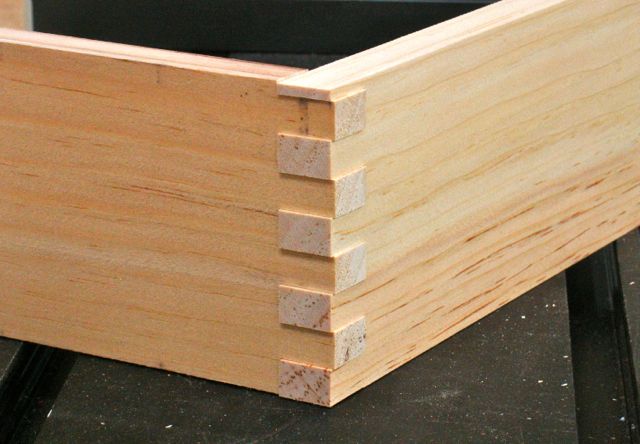
After the box was assembled and allowed to dry overnight the joint was planed smooth.  Always a good idea to leave them slightly proud.  I use a block plane for this, you can see the difference in this picture, the corner near the bottom has been planed.  I feel that planing leaves a cleaner finish on end grain than sanding does.  In the next post I’ll be showing how to make the small, mitered tray the will fit inside of this box.  I played around trying to make a YouTube video of  the mortising process which is uploading as we speak — probably put in on the next post as well.


Posted in Etsy custom order, Hand Cut Dovetails, Hand Tool Woodworking, Tutorial | Tagged , , , | 5 Comments

John’s Armoire: It is Finished!

Today was the first day I worked in the shop without the Armoire in it and to be honest, it felt kind of empty.  It’s been in the shop for such a long time but I’m glad that it’s now upstairs, waiting for me to figure out how to organize and fill the drawers.  Last Wednesday, the Sin City Woodworkers group held our monthly meeting in my garage/shop.  Partially as a one of our field trips to visit other members shops but also to share the designing and building of this piece.  Must admit I’m pretty proud of it!  Over-all it measures 74″ tall by 19″ deep and 48.5″ wide.  I really wanted to take some good photographs of it before bringing it into the house.  After checking it out Diane decided she could sew together the drop clothes we used for our craft fair to create a backdrop.  Since it had grommets already it was a matter of suspending it from a rope through the hooks in the ceiling that used to hold my kayak.  Here are the results, Diane took the pictures with the same camera she uses for her art work and they came out great!

Now, getting this thing up the stairs was a totally different experience.  Luckily, Adam and Kim were coming over for dinner last night and Adam agreed to give me a hand.  After taking out all of the drawers and shelves we began the journey up the spiral staircase.  As you can see by the pictures Diane took with her phone, it was pretty exciting — her and Kim both thought we’d have it crashing down over the railing but Adam and I had the situation well under control!

This slideshow requires JavaScript.

Now to concentrate on the upcoming Summerlin Craft show (October) and two smaller commissions in progress.


Posted in Johns Armoire | 9 Comments