Flower Nouveau Complete

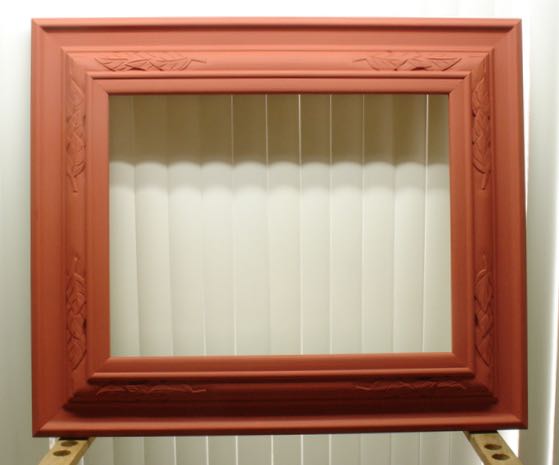
It always feels good to complete a frame and this 16″ x 20″ is no exception, it’s titled Flower Nouveau because it just seems like a different way of looking at a flower carved into the corner of a frame.

The previous post about this frame found me wrestling with how to transfer the somewhat complicated design to each corner.  Using a half template that can be flipped so each side is the same is great for the outside shape, it’s getting the inner details the same that gave me fits.  After posting my concerns on the Picture Framers Grumble I was happy to get a response that helped me solve the problem.  Something I knew and had showed students in years past but totally forgot!  After first drawing or copying a design on a piece of transparent paper you trace 1/2 of the design on one side of the frame. Then you can flip it to do the other side which gives a reversed image.  The graphite (use soft pencil) used for the first tracing will transfer to the second side.  Anyway, very nice to get a response and also a link to a YouTube video from someone else on the Grumble.

Toning the frame after all of the carving and gilding is complete can be a challenge.  Like so many of the other “crafts” people do you can screw up all of the work with one mistake! After sealing the composition leaf with shellac my preference is to use casein paints as a wash.  The flat finish and ability to reverse the process is its appeal.  A light grey to replicate years of dust and patina is my preference.  Here’s a side by side comparison of how things changed:

Notice how the frame progressed from the bright, brassy finish to a mellower look.  I couldn’t help but put one of Diane’s recent paintings in it to see how it would look.  The title is Ticket to Ride and I’m proud to say I was her photographers assistant, carry the props guy for this one.  It’s taken at the Heritage Museum in Henderson, NV.  This is the old Boulder City train station that was moved there and restored.

Ticket to Ride

Ticket to Ride

Posted in Uncategorized | Tagged , , , , , , , | 1 Comment

Scottsdale Frame #4: Flower Nouveau

Now that this frame has reached the burnisher/sealer stage I feel as if I can show it on the blog.  I’ve decided to call it Flower Nouveau since there is some of that style incorporated into the design.  The inspiration for this came from Chris Pye’s project on his workshop site called Victorian Lintel.  It’s about 7″ long so it needed to be reduced in both size and complexity:

Lay-out was quite a challenge.  The profile of this molding has a deep cove so using a compass was out of the question.  Thank goodness for printer/scanners that allow you to size a picture to whatever you need.  I ended up making 4 different templates that were attached to my ever popular salad container plastic.  Love these, they are reversible and flexible.  Won’t bore you with all of the details but here’s a brief slideshow of what I went through.

This slideshow requires JavaScript.

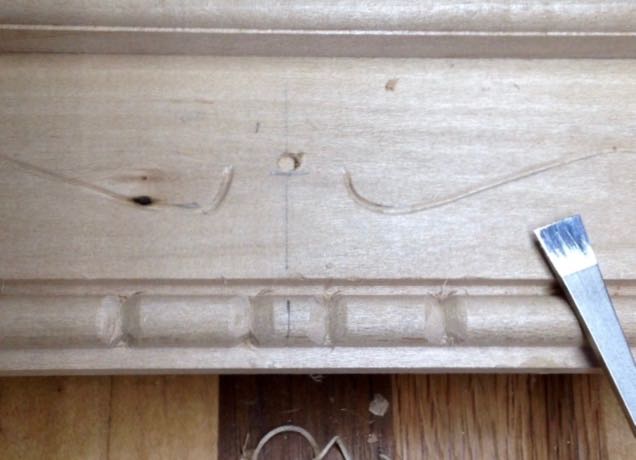
Briefly the process was to scribe the outer edge of the ribbon with a marking gauge after determining its position with the template (slide 1). After drawing in the ribbon across the miter everything was scribed which made it easier to follow with the v-tool.  The long bent chisels were the best choice for this application.  Since a compass wouldn’t work in this space I resorted to using templates to draw the circle then set off the petal locations with a divider.  The center of the boss was drawn in first then outlined with a #8/13mm followed up with the long bent #5.  Very challenging but I think it’ll read just fine when the frame is complete.

The entire boss was first outlined with a v-tool then eventually scooped out after locating the very center of it with the #8/13.  All work is hand pressure only so as not to go so deeply that the gilding will fault and crack over it.  The next challenge was to get the design in the areas just outlined.  The templates came in handy once again to compensate for my drawing skills; or lack thereof!  In the slideshow you can see how I punched holes in the template where the leaves should be, the notches were easy enough to locate.  For me, I find it difficult to work upside down plus trying to draw a  mirror image on each leg of the frame.  I finally resorted to getting inside of the frame to get the drawing as close as possible (slide 5).  Thankfully it’s a 16″x20″ and I’m small enough fit!

This slideshow requires JavaScript.

As with everything, life is a work in progress and the goal is to make all eight of the sides look as close to being the same as humanly possible.  That will only improve as I continue doing this work.  There’s always a balance between looking rough and too primitive and the extreme likeness only a CNC machine can produce — I’ll err towards the side that shows the human hand!  An assortment of fishtail chisels were used to do the edges.  The long bent gouges and v-tools were an invaluable addition to being able to carve in the coves.  Next up — gilding.

Posted in Carving, Picture Frames, Scottsdale Adventure | Tagged , , , , , , , | 2 Comments

Waterleaf Frame Complete — Next!!

Before I get into the work on the next frame, allow me to share the final result of the Waterleaf one just completed.  Toning and giving the finish a sense of age without making it look like it’s been through the war is the final goal in the picture frame process.  The burnisher/sealer used for this frame is the deep, traditional red color which I knew would show in the faulting between the leaves.  Once the frame was completely gilded the next step is to use 4/0 steel wool to cut the brassy appearance of the composition gold.  I recommend using an oil free product from Liberon for that.  You need a deft hand when removing the gold — it is so easy to go one wipe too many and have poor results!  Trying to replicate where the gold would probably be worn off over the years is what you’re after.  Tried to remove small, random sections on the higher portions of the frame where this would probably occur.  Once I’m satisfied with that I applied 3 coats of platinum blond shellac to seal the surface and prevent tarnishing.  Again, casein paints were used to add some character and tone the gold down even further.  The first mix was with Payne’s Grey and Titanium White only but that was too blue so a bit of Ivory Black was added to simulate what years of dust may look like.  After allowing that to dry thoroughly the entire frame was rubbed down with Liberon Black Bison Wax plus some Rottenstone brushed into the crevices.  I’m happy with this 16″ x 20″ frame:

I did spend the bulk of the shop time today working on the next frame design.  Seems as if things took a lot longer than I expected them to but anytime working, thinking, planning, and practicing is time well spent in my opinion.  Chris Pye has a project on his woodcarving school which appealed to me so thought I’d work to adapt it to a frame.  Well, easier said than done!  It’s called a Victorian Lintel and there are a number of problems I needed to overcome.  Here’s the way things looked when I finally called it quits:

End of the Day

End of the Day

Problems to overcome were that not only is his project three times larger than the area available on the frame corner it’s also done on a flat board.  The leaves on either side of the boss were unequal length which doesn’t work well for a picture frame. His drawing is on the right side and you can see there is way too much detail for the small area I have to work in.  There are three separate templates made from plastic which I’ll discuss once I get into actually doing the frame.  The first step will be to lay out the 3/8″ wide border completely around the perimeter.  The pronounced cove in this profile will have to be tapered down before the design can be transferred to the frame.  If you compare the practice carving on the left and my final template in the center to Chris Pye’s original design at the upper right you’ll see it’s much simplified.  The outside edges of the center boss need to be dimensioned a bit too but I’ll work that out tomorrow.

One thing I’m finding, there is very little information out there dealing with the carving of picture frames.  I know the majority of them come from “off-shore” or are mass produced by some chip and dust throwing CNC facility.  I went to the Desert Woodcarving show in Mesa this weekend and there was absolutely no information or books out there that dealt with carving quality picture frames.

Posted in Carving, Picture Frames, Scottsdale Adventure | Tagged , , , , , , , | 2 Comments

As Others Saw Me!

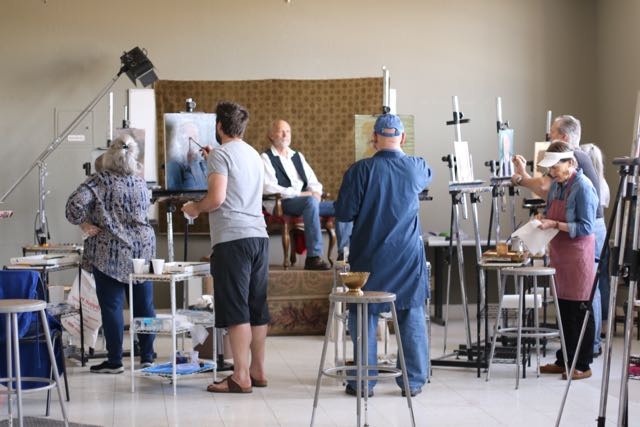
This blog is totally unrelated to my woodworking so maybe somewhat difficult to write.  You’re probably aware that Diane and I are spending 6 months in Scottsdale as our 20th. anniversary trip/celebration.  The goal and purpose is to really immerse ourselves in the vibrant art scene found here.  The Scottsdale Artists School is one of the finest in the country and features workshops taught by well known artists from virtually everywhere.  Diane has enrolled in many workshops over the years and always came home inspired with a new perspective of her own art journey.  My goal during this time is to concentrate on carving and gilding frames — that has been written about in previous blogs.  So, to get to the point; Diane suggested that I apply to become a model at the school so I interviewed and was placed on the roster.  Here I am, on my first “modeling gig”

Michael Siegel Workshop

Michael Siegel Workshop

I was put on the schedule to pose for Michael Siegel’s workshop.  If you click on the link to see his website you’ll agree with Diane that this was a good fit for me.  His style is impressionist and based on that of the old Dutch Masters.  Let’s see, I’m Dutch but no master but do have the type of face he’s done in other work.  I was scheduled for two days; 8:30 – 4:00 with an hour for lunch plus breaks, roughly 5 minutes every 20 minutes or so.

Michael Siegels Demo

Michael Siegels Demo

The first day, Michael spent the morning demonstrating to the class by doing the portrait shown here.  Now, three hours isn’t a lot of time for this work.  For as long as I can remember, I’ve always been fascinated by the process of doing “stuff”.  Doesn’t matter if it’s making an oatmeal cookie or putting together a giant skyscraper — the planning and process of doing things is exciting!  It also doesn’t matter that I’m not likely to accomplish them, just knowing how is what I like.  As he worked on the painting he was explaining the why’s and wherefore’s of the process.  Some of it he related to sculpting so I took away some information for wood carving.  Other things were those that Diane has shared with me when we talk about our own studio work at the end of the day.  Just cool stuff!

After lunch the first day, the students in the class drew numbers to see which easel position they would have.  I taped my foot location to help me return to the same position after each break, found an object across the room to focus on and prepared for sitting still — not as easy as you might imagine!  Having done this before for groups in Las Vegas I knew what to expect but a 6 hour posing day was a bit more challenging than the 2 hour ones there.  You just don’t move or scratch an itch instead plan stuff in your head, sing songs (silently), and enjoy the process.  And enjoy it I did!  Michael was constantly answering questions from the students and doing impromptu demonstrations on their canvases.  I suppose you really had to be there to get a full appreciation of it.

In any case, this 5 day workshop was geared towards painters of all levels.  If you’ve never observed an artist as they create their work it’s not an easy, slap the paint on the canvas process.  Every stroke of the brush has a purpose, they need to capture the light and shadow plus every nuance between.  Michael was telling me that some academic schools will have the same model sit for 50-60 hours so that the artist can really capture all there is — whew!  Here is a slide show of the work they completed.  Many of them took photographs of me and will no doubt spend time in their home studios if they intend to finish this work.  Great experience and I’m looking forward to more of them.  Just a note, Michael would do those impromptu demonstrations on the students canvas — those aren’t aliens coming out of my chest!  Every artist had a different view of me as you can tell.  These paintings are not intended to be portraits per se but rather a study of what the artists wanted to express based on what they saw in front of them.  Much preferable to a photo realistic painting in my estimation.

This slideshow requires JavaScript.

Posted in Scottsdale Adventure, Uncategorized | Tagged , , , | Leave a comment

Waterleaf Molding — Gilded

Freshly Gilded Frame: Waterleaf Carved

Freshly Gilded Frame: Waterleaf Carved

The question in my mind was would I be able to lay the composition gold into the carvings on this waterleaf carved frame and thankfully, the answer turned out to be yes!  The previous blog about this frame had to do with the layout and carving.  Now I’ll talk about the gilding of it.  First off, this is composition gold leaf, not precious gold that is applied through water gilding.  As previously mentioned, although I’ve done some water gilding I have a problem with being too electrified and full of static so the process becomes really aggravating.  Throw the cost of the material and the increased labor of applying many coats of gesso and clay and the composition gold becomes much more attractive.

I only use oil based size, I don’t have much confidence in water borne products.  This is the slow-set variety so the frame was sized last night around 8:00 pm, gilding began about 12 hours later.  This molding is 4-3/4″ wide so a full sheet of leaf wasn’t quite enough to go over in one pass.

Leaf Layer

Leaf Layer

Watching the video may be as exciting as watching grass grow or paint dry but a number of followers have asked about the process I use to apply composition gold to frames.  Since I really can’t talk during the process let me summarize it first.  Laying a full sheet of leaf (5″ square) takes some practice but if you use what I refer to as a “leaf layer” it’ll help the process.  This is nothing more then a piece of 1/4″ MDF measuring 7″ square with a circular opening to make it easier to hold on to.  The corners are rounded over and it’s waxed to reduce any friction.  You’ll see it in use during the video.

Enjoy, let me know if you have a question.  Not showcasing any videographer skills here, just the method used for laying composition gold leaf on a picture frame.

Just some thoughts on my method:

  • Once the leaf is on the layer, no more breathing!
  • The first step is to anchor the leaf on the inside edge, it then becomes a dance of pressing the leaf to the frame while at the same time sliding the leaf layer back.  As a rule, begin on the right side of the leaf, not the left where it overlaps the previous one — you need to stick it to the frame before gently pressing it onto the size
  • Control the angle of the leaf layer so you’re gently pulling the leaf down onto the frame, don’t let gravity do that for you
  • It helps to have a method, mine is to start at the left side so the overlap is consistent all the way around the frame.  After the entire frame is covered I now press the leaf down into the size working from the right to the left — this way you won’t lift at the overlap
  • Resist the urge to press more leaf or remnants of the leaf into carved areas, you’ll find it results in an ugly build up of “scraps”.
  • Corners are tricky, sometimes I’ll cut a leaf diagonally and follow  the miter of the frame
  • Faulting (cracks) are inevitable, pieces of leaf can be laid over larger ones and blended in with your fingers afterwards
Removing skewings with blush brush

Removing skewings with blush brush

There are two main things I do after pressing the leaf down with my fingers.  The first is using a blush brush donated from Diane’s make up table!  By the way, these remnants of gold leaf are called skewings.  If you don’t brush them off prior to the next step they can scratch your frame.

Final Pressing of the Leaf

Final Pressing of the Leaf

Once those are removed my next step is using a microfibre cloth to press the leaf firmly.  At the same time, any over-lapping pieces are removed as well.  Now’s when I have to give my “oh too critical eye a rest!”  There will be areas that faulted, areas that may have missing leaf, specks of dust, and maybe even a stray hair from the size brush.  Frames are meant to look as though they’ve been around for a hundred years.  There are entire books written about how to authentically age picture frames.  Just pleased with the final results and after thoroughly drying it’ll be time to begin the toning process.


Posted in Gilding, Picture Frames, Scottsdale Adventure, Tutorial, YouTubeVideo | Tagged , , , , , , , , | 2 Comments

Waterleaf Molding — Exercise in Repetition!


Sample Piece and Frame to Be

Sample Piece and Frame to Be

Foster Planing Mill No. 95

Foster Planing Mill No. 95

A very classic design for moldings is the waterleaf motif.  Although they appear quite complicated its form comes from a series of cuts made with specific chisels in a given sequence.  Whew, all that being said as an ultra runner I seem to like repetition; you know the process — left foot, right foot, etc., etc. Start that pattern and in 10 hours or so you’ve conquered whatever 50 mile mountain race you happen to be doing at the time.  One of the molding profiles we found at Foster Planing Mill seconds area is the one pictured here.  It currently lists for $6.85 per foot and I know we paid a lot less than that for it!  The waterleaf will fit nicely on the Ovolo section.

For reference I’m using the water leaf molding series on Chris Pye’s website as well as his book:  Wood Carving, Projects & Techniques.  Another book used for reference is by Frederick Wilbur:  Carving Architectural Detail in Wood.  These are books that have been around for quite some time so you can probably find them bargain priced on eBay.  I also use Pinterest and image searches on the internet.  All that being said, the most difficult thing to find is detailed images of how to treat the corners of the molding — thankfully Diane has a pretty good eye for that, mine is still developing!

The frame I’ll be doing has a sight size of 16″ x 20″ and can handle a stretched canvas.  After doing a practice section and gilding it to see how difficult that may be I was ready to begin work.  I’ll break this up into a couple of slide shows to give you the basis of how I went about it — no substitute for Chris Pye’s video and practice but hopefully it’ll break the process into simpler steps.  First was to make a plastic template that fit in the Ovolo section of the molding.  The eye (place where two leaves meet) is generally 1/3 of the distance but your gouge size determines it as well, I had a #5/23mm.

This slideshow requires JavaScript.

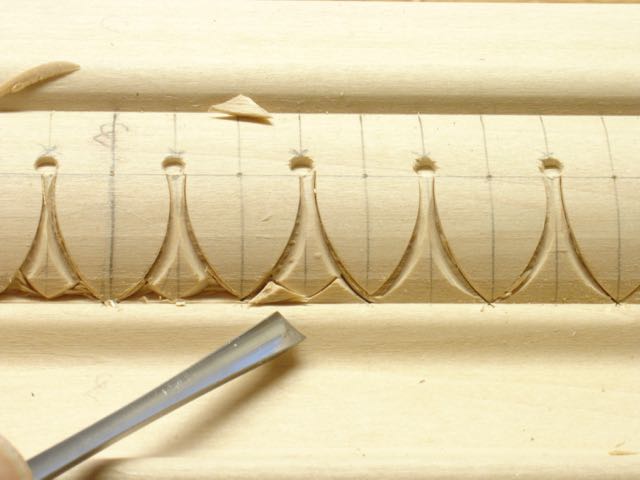
The spacing of the units was trial and error but main focus was matching the gouge size to create a nice pattern.  To draw the straight lines the pencil point is put into the divider mark, slide the square edge of the pattern to it, and draw your line, just be sure your pattern in 90 degrees and square.  A #9/3mm is used to make the eyes followed by a punch to flatten the torn fibers at the bottom.

Now it’s time to shape the leaves themselves.  I began by using hand pressure to lightly set the line from the lower corner to the eye.  This was followed by what I hoped were uniform taping with a light mallet to set them in to a consistent depth.  All cuts were made in one direction then the other.  Now to remove a crescent shaped sliver using the same #5/23mm gouge — difficult to get consistent cuts as you can see so practice is required!  I keep reminding myself though about that saying of the beauty of handcrafted items being their imperfections.  Also, it’s the painting that should be the star while the frame has the supporting role.

This slideshow requires JavaScript.

Secondary Leaves

Secondary Leaves

When the frame is gilded the variations shouldn’t be so obvious. Now that the main leaves are complete the secondary ones between them need to be formed.  The #5/6mm fishtail is just right for this step.  By cutting all from one direction, then the other, then both sides of the main leaf I hoped to achieve a uniform rhythm.  Once all four sides were cut, they were popped out using either the fishtail or a small, skewed gouge.

All that remains is to form the tops of the leaves.  The line between the eyes was first stabbed with a double beveled, fishtail chisel (#1F/16mm) making it deeper at the top and shallow on the eye line.  The tops of the leaves were then formed with a #5/12mm fishtail.

So there you have it, a short tutorial on cutting waterleaf molding.  The question that always comes up is: “how long did it take?”  The first one didn’t count because I took all of these pictures to share the process but the second, 16″ leg took right at 45 minutes.  I recently had a conversation with a fellow woodworker and her and I seem to be on the same page.  Doing things like this is all about the process, the reward is mainly your own self-satisfaction.  Can’t ask for anything better than that as far as I’m concerned!

Posted in Carving, Hand Tool Woodworking, Picture Frames, Scottsdale Adventure, Tutorial | Tagged , , , , | 2 Comments

Share the Completed Frames

Finding a good location to photograph these frames has proven difficult!  At home I’ll use the side of the house in the mornings before the sun hits and the lighting is really quite nice.  These are the best I can get here in Scottsdale — a corner of Diane’s studio which is lit up nicely now that she too has an LED shop style light from Rockler.

Not sure why I’ve started calling the 8″x10″ a Corner Leaf Motif — it’s really a flower!  Just to recap, the Celtic Knot one was made from molding we got when we went to Foster Planing Mill from their “second’s pile”.  The other is modified from the molding they made based on Diane’s design.  In my last post about this frame it was ready for  the gilding  process.  Due to the depth of the molding there was some concern on my part about how this would turn out.  Here’s a look at the gilding process for the corners:

This slideshow requires JavaScript.

Still working on the carving, it can certainly be frustrating being the student!  Watch video’s, read books, read blogs, and then for some reason my chisel doesn’t seem to do what I think it should.  Like Diane and I both say: ” if it was easy, everybody would do it”.  This is really all about the process of trying to accomplish as much as possible in life and keep on keeping on — next frame is going to be an exercise in perseverance for sure.

Posted in Carving, Gilding, Picture Frames, Scottsdale Adventure | Tagged , , , , , , , , | 2 Comments

New Picture Frame – Celtic Knot

Celtic Knot Practice

Celtic Knot Practice

Frame designs are chosen for a couple of reasons but one major one is so that I can develop different carving skills.  A fairly common theme would include interlaced patterns like those found in Celtic designs.  I have a friend, Mike Cook, who does some of the most intricate and beautiful Celtic designs I’ve ever seen so to “be like Mike” I set out to find one to use for a future frame.  Mary May has one in a lesson so that seemed to be the right one to choose for my first.  Fairly straight forward and after completing the pile of sample ones you see in this picture decided it was time to stick it on a frame.  Now the complication I had seems obvious but until actually putting the design on the actual frame it never entered my mind!  Mary May carves this knot onto a flat, solid board.  After doing it on some flat stock I also practiced on a cut off from the molding which proved to more of a challenge.

Profile

Profile

The frame I chose has this profile and is about  3 -1/2″  wide tapering from almost nothing to  1- 3/4″ in height.  Now add the miter to it and you end up with an odd shaped design at the frame corners that resembles two thirds of a pyramid.  For patterns  I like to use the plastic container material used for salads.  It’s easy to cut, flexible enough to press into the coves of a picture frame, they’re thick enough so a pencil traces the edge, and they’re easily flipped over when the sides of a design aren’t exactly the same which is the case here.  To make the pattern is easy, use double stick tape and cut it out.

Ready to start

Ready to start

Due to the strange angles at the miter the border around the knot was no longer parallel to the edges of the frame when the pattern is bent over the miter.  That problem was overcome by drawing parallel lines for the border.  This meant that even though the border is parallel, the knot is angled upwards.  In her video, Mary said to treat the outlining of the knot more like a chip carving.  Rather than using a gouge to form the radius, an 8mm straight chisel was used to carve around the outline.  This was an interesting process, I needed to constantly keep in mind the angle of the cuts in relation to the angle of the molding profile.  You can see how the initial drawing looked in this picture.  The challenge was to keep the sides straight and correctly angled — that was challenge one!

Next was forming the over/under look and removing the three areas between the loops.  Challenging enough on my flat, practice piece but even more so on these mitered and beveled corners.  The process was accomplished using the small, straight chisel, a #7 fishtail and a pair of #2, skewed spoons purchased a long time ago and rarely needed — until now!  They require kind of a strange angle to cut, made even stranger by the profile of this molding.

This slideshow requires JavaScript.

I’m pleased with the results.  The grain goes in so many different directions it was time to look at it and say “enough is enough!”  The real star will be the painting that will eventually find a home in this 14″ x 18″ frame, I just want to add something pleasing to set that painting off in its own little world.

Next challenge — gilding!


Posted in Carving, Picture Frames, Scottsdale Adventure | Tagged , , , , | 1 Comment

Short Follow-Up on Leaf Motif Frame

They say a picture is worth a thousand words and I know the quality of that picture will have a lot to do with that!  That being said I’d like to have a photographic history of the frames made during our Scottsdale adventure.  Seems as if the best place available is on top of the carving bench with the LED light on and the shade closed.  Not ideal but the best possibility here in Scottsdale.    These two pictures of the frame have very subtle differences:

Can you spot the difference?  On the left is how the composition gold looks when it’s first applied — notice how shiny and almost brassy it appears?  Compare that to the image on the right.  Here the panels (coved section on inside) and the outer band have been very lightly scuffed with 4/0 steel wool to knock down that shininess.  A traditional method of treating gold leafed frames is to alternate burnished and mat finish sections.  Since composition gold can’t be burnished I’ll leave alternating sections (carved corners and inner ribbon) un-scuffed by the steel wool to hopefully achieve that traditional effect.   After that the entire frame was sealed with two coats of platinum blonde shellac applied with an air brush.  The last step is to tone it down somewhat, I’m working up a few samples before I commit to that process.

In the meantime I’ve started on another frame based on a design by Mary May.  It features a Celtic Knot.  Here’s a picture of the almost completed frame as a teaser:

Celtic Knot Frame 14" x 18"

Celtic Knot Frame 14″ x 18″

This is actually the bottom of the frame in my photo set up which shows the depth of this particular carving.  I will tell you this, when Mary May demonstrated this knot it’s on a solid, flat piece of Oak.  Doing this carving on a mitered corner with a radiused profile really added a degree of difficulty to it.  I’ll share the process and complications in my next blog about it but it was a great learning experience, one that I think turned out successfully.

Posted in Carving, Picture Frames, Scottsdale Adventure | Tagged , , , | 2 Comments

Gold on the Leaf Motif Frame

If you read my last post the first carved frame of the Scottsdale adventure was ready for the gilding step.  I use composition gold which I like to refer to as Dutch Gold because of my heritage.  However; Diane feels this term is somewhat derogative and gives a cheap connotation to the process.  Since I want to market frames I’ll try to add the term, composition gold to my vocabulary instead.  Although I’ve done 22 karat gold leaf using the traditional water gilding method it gives me a lot of trouble!  I seem to have more than the normal amount of static electricity so the gold leaf just wraps around the gilders tip most of the time!  I’ve tried all the tricks, anti-static mats, anti-static gloves, standing on wet newspapers, humidifiers, etc. to no avail.  Add the cost of the materials and the additional labor of mixing and applying multiple coats of gesso and clay and I’m somewhat resigned to using only the composition gold.  All that being said, I’d love to take a traditional water gilding class from Charles Douglas up in Seattle to see if the humidity there would be beneficial to eliminate some of the static problems I have — maybe my next adventure!


Sizing Studio?

Sizing Studio?

The mailman brought  the slow set size from LA Gold Leaf Thursday so I applied a thin coat last night.  Needless to say, the conditions were less than ideal as this photo shows.  This is the  balcony of our apartment so wanting to have adequate ventilation decided this is where the process should take place. Winds were calm so not overly concerned about the dust, I moved the box and frame into the storage area you see behind the box.  I had lights on in there, the balcony light, plus the two rooms that face the balcony as well.  Just hoped I had adequate coverage of the size — always hard to tell in poor light.  Since the oil size needs about 10-12 hours to reach the proper tack, early morning laying of the leaf was on the schedule.

On the Way!

On the Way!

The workbench proved to be just the right height for gilding, I like the work to be slightly above my waist for this task.  It usually takes me a few sheets of gold to “get into the zone”.  Since this molding is modified from Diane’s custom design a full sheet of the composition gold covers all but the last half inch of the side.  I was more than pleased with how the leaf went into the carving.  This was the unknown, how deep could I carve and get the leaf down into it without cracking.

Molding Profile

Molding Profile


The profile of the molding looked like this before carving.  That very pronounced ridge going into the cove needed to be tapered down before the leaf motif was carved.


Close Up of Gilded Corner

Close Up of Gilded Corner

In this close up, you can probably see how that was accomplished.  Next up is toning the frame and knocking down the glare of the composition gold — it just doesn’t compare to 22kt. gold but we’ve already discussed that!  Since you really can’t burnish composition materials, that was done first on the yellow burnisher/sealer. After at least 24 hours to ensure that the oil size is completely dry it’ll be time to knock down the brightness of the leaf.  For that I use 4/0, oil-free Liberon steel wool only.  I’m going to experiment a bit on this frame and knock down the panel, outer edge, and sides only leaving the ribbon and the carving as is.  This is followed by a couple of coats of clear shellac that is sprayed on.  I’ll wait until Monday morning to do that, not too sure how the other tenants near me will like the smell of shellac in the morning.  Waiting till Monday rather than tomorrow (Sunday) gives me a better chance of not having too many folks around that may complain about the smell!  I purchased a small, quiet compressor just for this purpose so anxious to see how it’ll perform.  My shop Porter Cable pancake is way too noisy for apartment living.   My plan is to make a series of pictures of the frame showing its progression from the bright gold it is now to (hopefully) a toned down version ready for someones painting.

Posted in Gilding, Picture Frames, Scottsdale Adventure | Tagged , , , , , , | 1 Comment