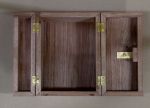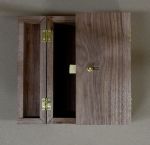
Computer Monitor Completed

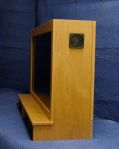
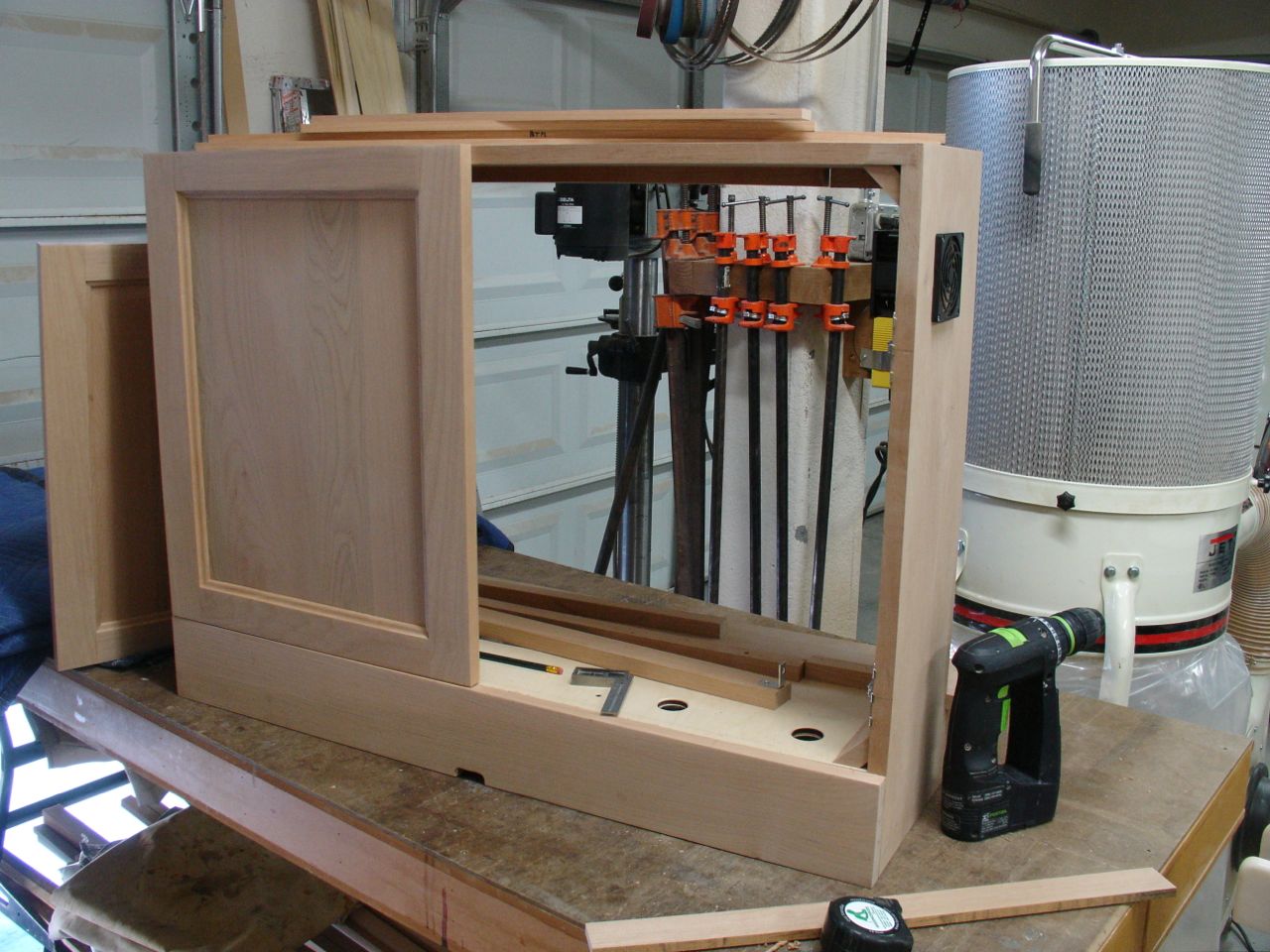
WoodworksbyJohn-CustomFurniture-LasVegas-ComputerMonitorCabinet-3:4 viewHere is the completed cabinet for the 31″ computer monitor I’ve been working on.  You’ve heard me refer to this project as my “head scratcher” because of the requirements my client had.  He knew it would be somewhat tricky but I believe I’ve given him what he wants.  That’s always my goal, to give the client more than he thought he’d get.  Delivery is next week and I’m anxious to get his reaction to the real thing, not just blog photographs!
The size of this ended up being 27″ tall by 36 1/2″ wide and 14″ deep.  He requested storage space below and that has a depth of 13″and has about 4″ of space.  In the picture above you can see the glow of the power button which controls the monitor power as well as the 3″ diameter fans located at either end.  The wood used for this piece is Alder with an Alder plywood used for the panels in the doors.  The monitor was inserted from the front so the trim is only applied with brads in case it ever needs to be removed.  The back allows full access to whatever may be needed.  This piece is finished with General Finishes EnduroVar.  This is a water borne polyurethane and 3 coats were applied with a HLVP sprayer.

Here are a few additional shots of this project:

Posted in Current Commission | Tagged , , , | 3 Comments

Mr. Melvin Wilson, Metal Shop Antioch High School

When I was in high school, back in the 60’s at Antioch, California I was a shop rat.  Partly because I’d managed to get kicked out of many other classes but mostly because those (and band) were the types of class I really enjoyed and applied myself in.  Back in the day we had a full compliment of Industrial Arts and our metal shop teacher was Mr. Wilson.  Now you may wonder what that may have to do with my present day woodworking so let me explain.  Mr. Wilson’s’ method of checking the integrity of our welds would be to take us out behind the shop and heave our project up in the air.  If it stayed in one piece after bouncing on the ground your weld was considered sound.  If not, it was back to the bench to re-weld all that had come undone.  By the way, the welding bench was a good place to sneak a smoke — an acetylene torch would make quick work of a Marlboro if Mr. Wilson came around!

You may recall that the mystery box had issues with the strength of the mitered joints.  I’ve discussed that with my client and they really like the clean look of that so my next plan was to try a splined miter to see how it would work.  What better way to test it then with Mr. Wilson’s time honored method?

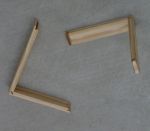
I managed to capture it in mid-air after tossing it up and finding it in the view finder and as you can see, it broke!

Wilson-3Breaking wasn’t necessarily a bad thing.  Hopefully no one would throw a box up in the air to check it’s integrity but if you’ll notice it was mostly the wood itself that broke.  The joint is stronger now because we’ve increased the glue surface and the addition of the spline gives a better grain direction for a bit more strength.  Notice how much of the box side held on to the spline.

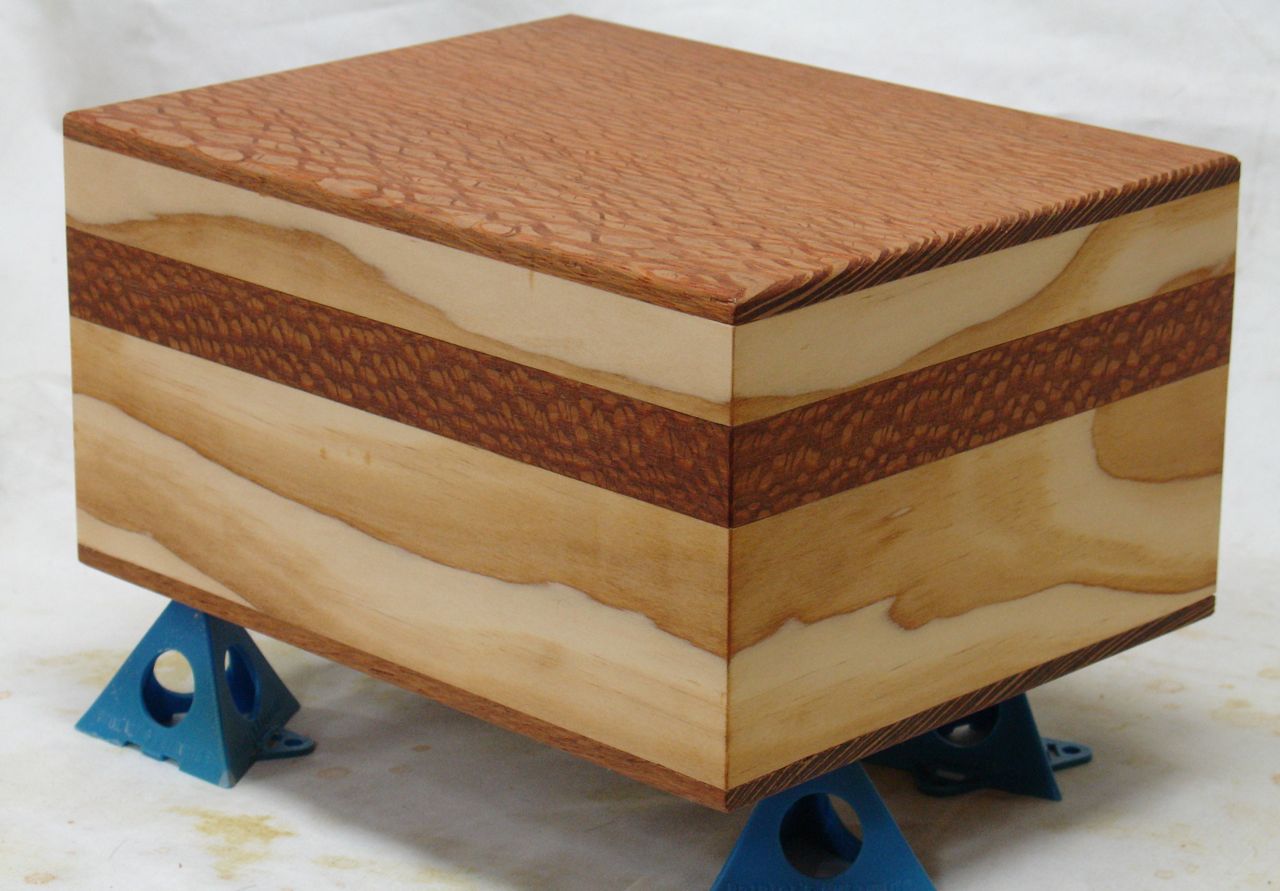
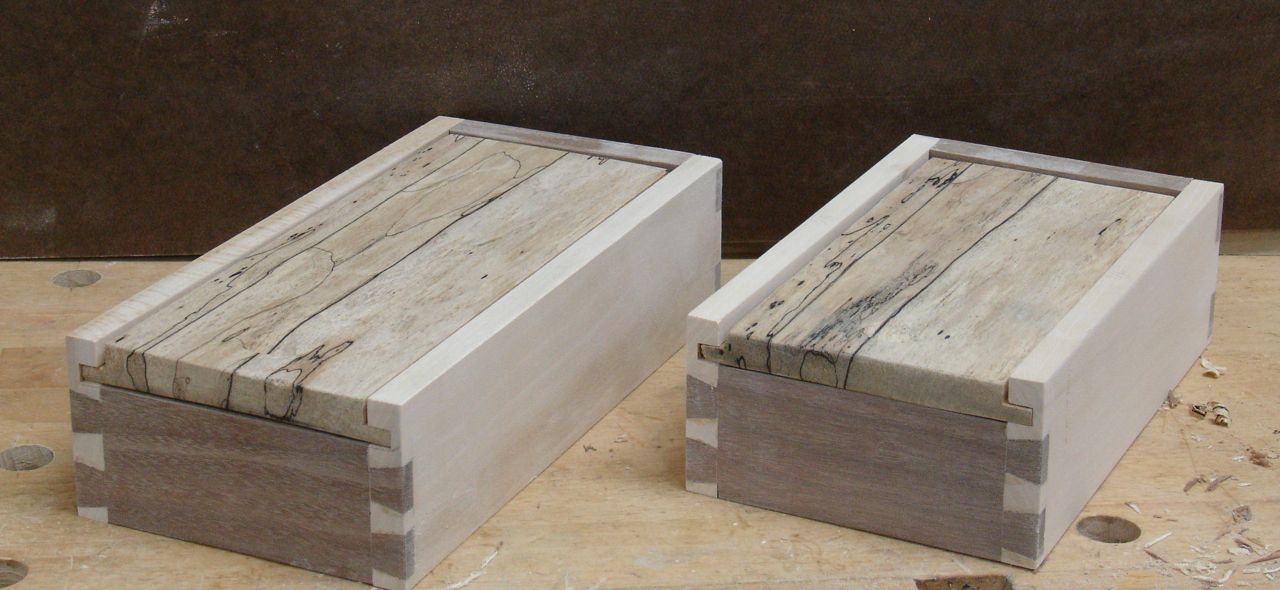
The next step is making yet another prototype but this time using a splined miter.  I’m using a piece of clear Pine and will use some Lacewood for the tops and bottoms.  This sample will hopefully turn out much better and it’ll be placed on my Etsy store when it’s complete.  We’re going to make the real McCoy out of the Wenge and the Brusso hardware will be ordered soon.  Their hardware is probably the finest you can buy.  The prices reflect that but the quality is first rate.  No sense creating a $500.00 presentation box and adorning it with China’s finest crap hardware!

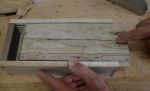
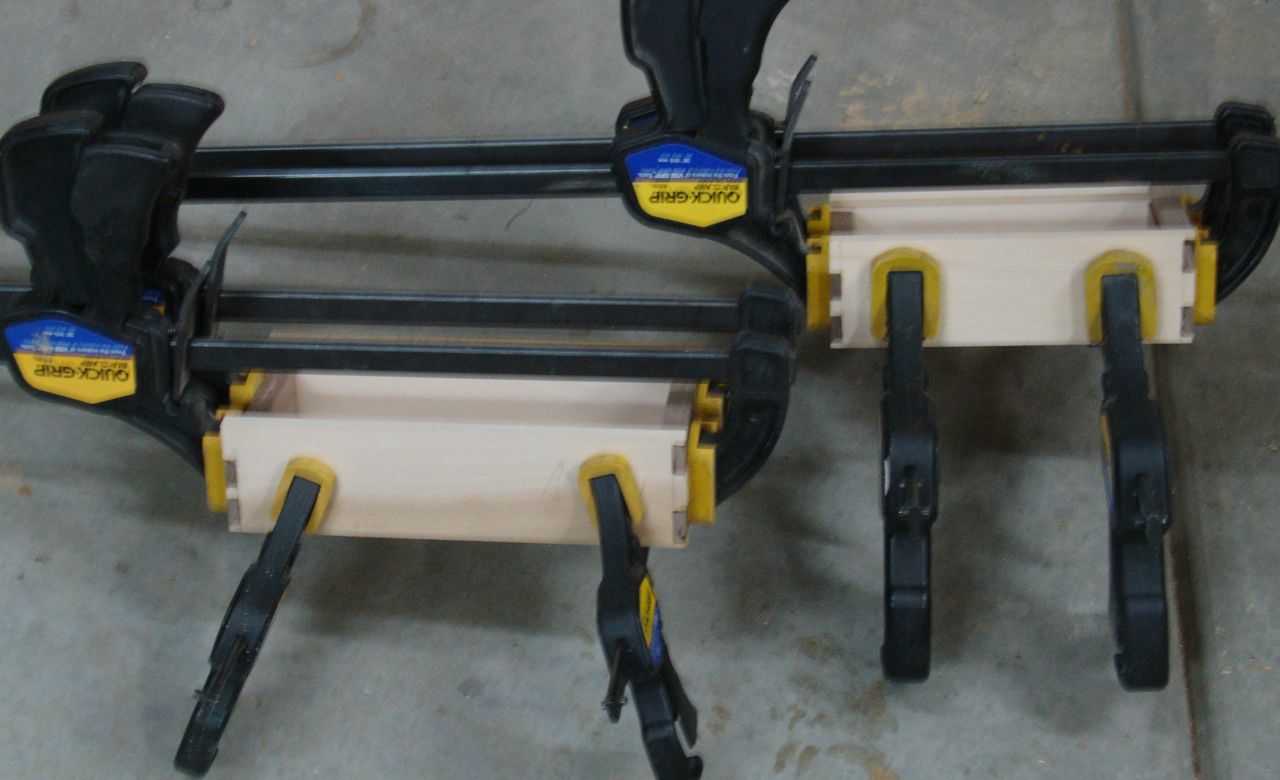
Here’s a photo of the assembled Pine box, the height of it makes it a bit stressful to get the glue and clamps positioned but I believe it’s going to be just fine.Wilson4

Posted in Current Commission | Tagged , , , , , | 2 Comments

Mystery Box, First Prototype

Hard to believe that I have close to 8 hours of actual working time into this project!  That doesn’t include the times spent with my client to get to this point or the time this consumed my thoughts as I tried to work out the design and execution of it.  Here’s a recap of the requirements:

  • Had to meet certain interior dimensions so the items that were to be presented would fit
  • The lid is of a deep design and split 1/3 – 2/3 similar to what I’d call a clamshell
  • The latch system needed to secure both sides and be somewhat unobtrusive
  • Needs to have an access port on the back to insert a cable (not done yet)

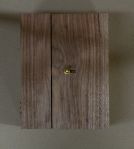
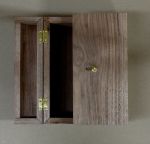
Here’s a gallery of what the unit looks like at this time (sorry for the poor quality, should have used a better background piece).

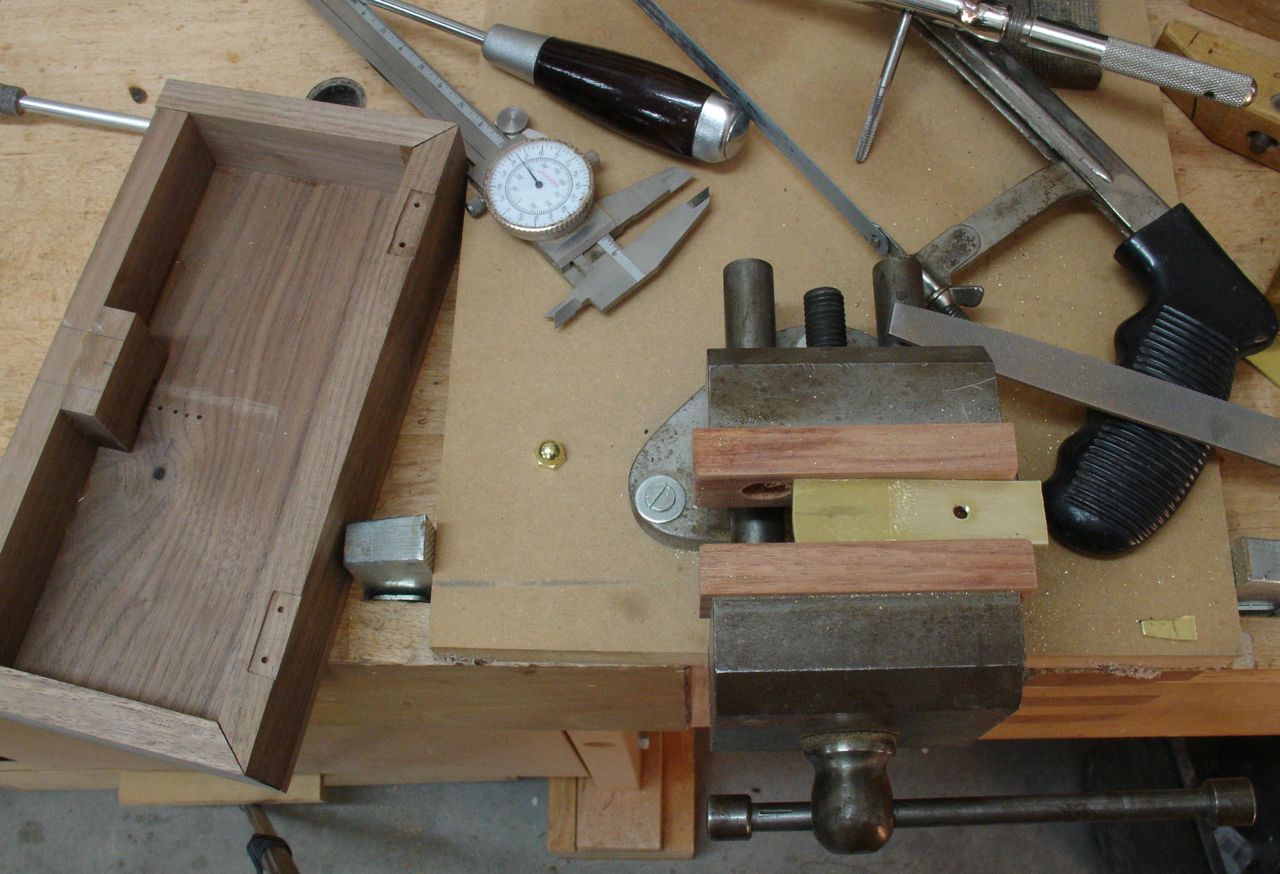
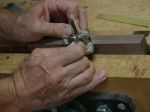
WoodworksbyJohn-MysteryBox-Prototype-1One big question we had was coming up with a way to make the latch.  The three of us looked through catalogs and on the internet but nothing seemed to fit the bill.  This was fun, gave me a chance to do a little bit of metal work and combine it with the woods.  Workbench looked a little different for that, a piece of .064 thick brass was cut and tapped to accommodate a 10/24 screw. You can see in the photograph the piece of brass in the vise.  The assembled “latch holder” is at the left side of the box lid, notice the line of scratch awl marks — that’s where I needed to create a slot for the screw to travel in.

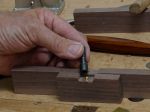
Creating the mechanism was pretty interesting too!  It began by taking the pieces of Walnut that were destined to be the inside of the lids and cutting a mortise out of them sized for the brass latch piece.  There has to be a way to hold some tension on that latch and a ball catch for a cabinet door was the answer for that.  I happen to have a couple leftover from a long ago project.  Oddly enough it was the lady from the couple who saw one of them in a catalog when we were doing our brain storming.  She asked me what it was and I’m sure that’s what jarred my memory and made me think of using it for this application.

It’s time to email this blog to the client and see if we can get together to discuss our next move.  As I pointed out in the first blog on this project the corner construction needs to be stronger.  Need to add a spline to it to gain some strength so that will be part of our discussion.

Posted in Current Commission | Tagged , , | Leave a comment

The Mystery Box — Prototype #1

What the Heck ??

What the Heck ??

Jamie, from Wooditis where I occasionally teach classes, referred a couple to me who were looking for someone to make a presentation box for an item they are marketing.  We had the usual email correspondence and then met twice to explore the possibilities of bringing what they have in mind to an actual piece.  What adds to the intrigue of this is that things must be kept somewhat secretive!  It’s an item that they have developed and successfully marketed overseas and now they want to get themselves into the high end retail areas of our Las Vegas Strip.  They came prepared with drawings and measurements of what they require and also some photographs of the types of presentation boxes that could be comparable to what they’d like to have.  After working out the details the best we could an agreement was reached and I told them I’d start work on their idea.   On paper everything seemed to be okay although I did have some concerns once I really plotted out the overall size of the box.  Seeing the over-all size scaled out in a drawing showed me that this box is larger in scale than I though it would be.   We had decided to use Wenge but at around $20.00 a board foot I thought it may be wise to make a prototype utilizing some other material first.

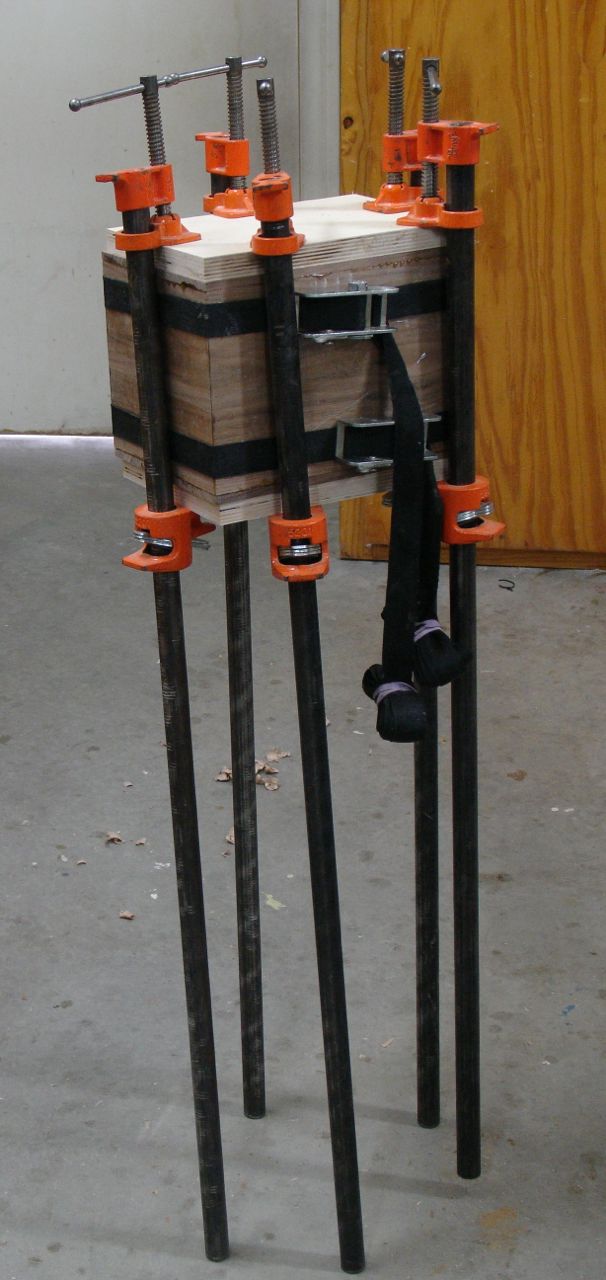
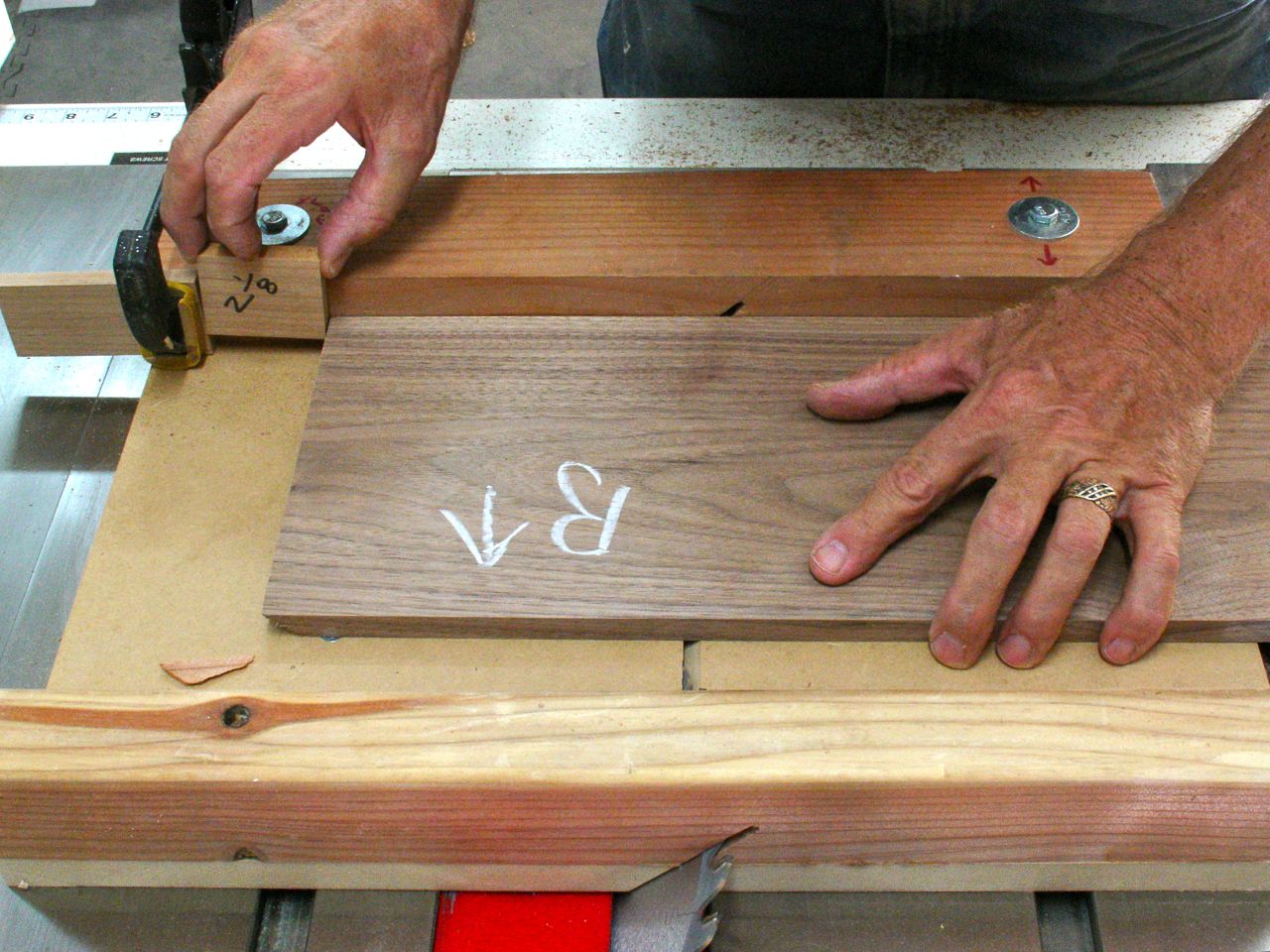
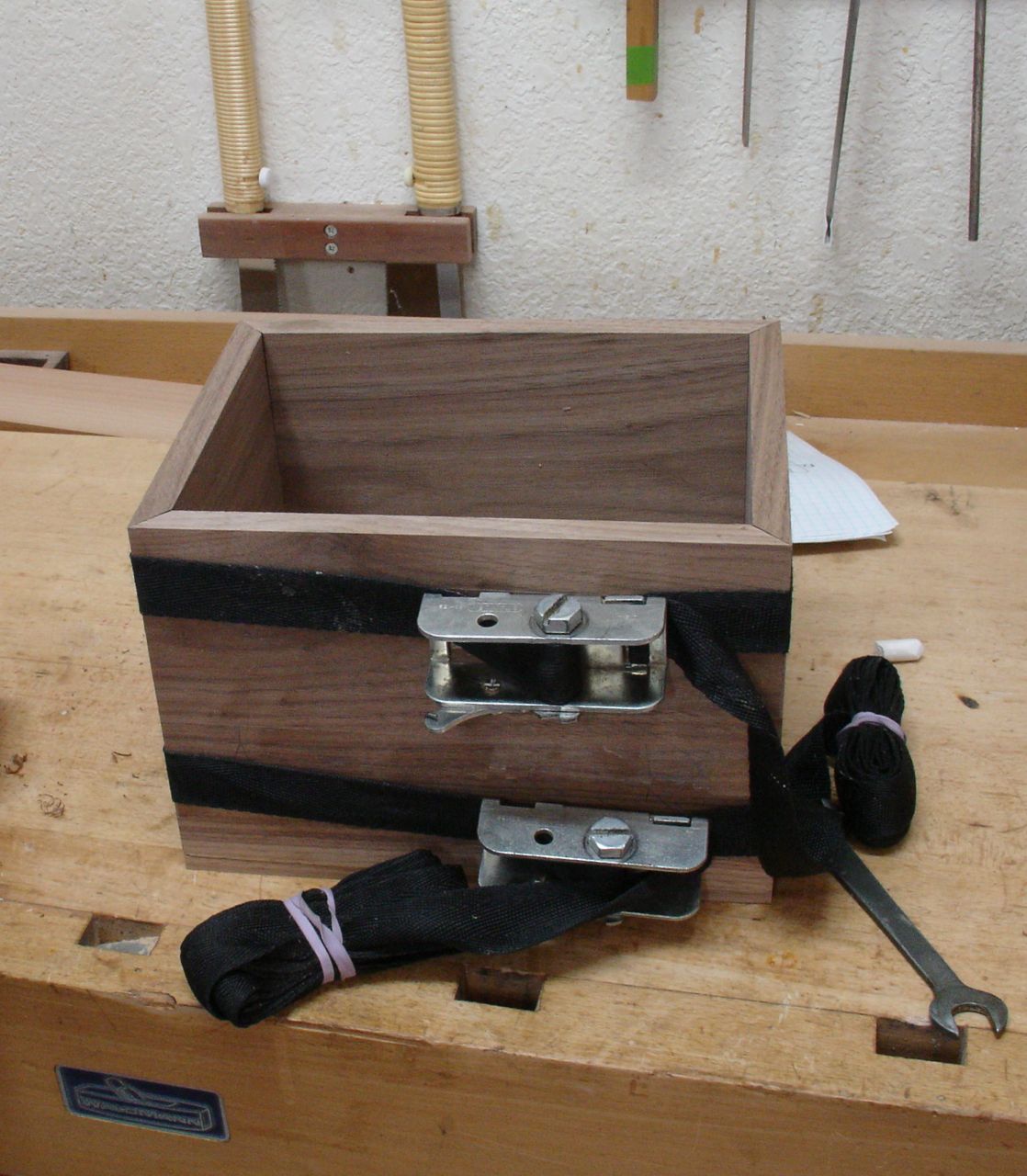
Looking through my lumber, I discovered a piece of Walnut that was just about the correct size so I went ahead and worked the prototype out with it.  That’s what the picture is; two band clamps plus cauls top and bottom to make a cube that will be cut apart to form a deep box with a shallow, clamshell style lid.  The design for the lid has it unevenly split to provide storage space for items needed.  Things started conventionally enough.  After setting the tablesaw to 45 degrees the pieces for the sides were cut to length. My method is to set a stop block for the longest piece, then use a spacer to cut the shorter one. The size of the spacer is the difference in the length of the two pieces, in this case the spacer measured  2 1/8″.

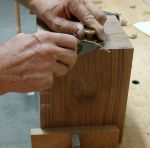
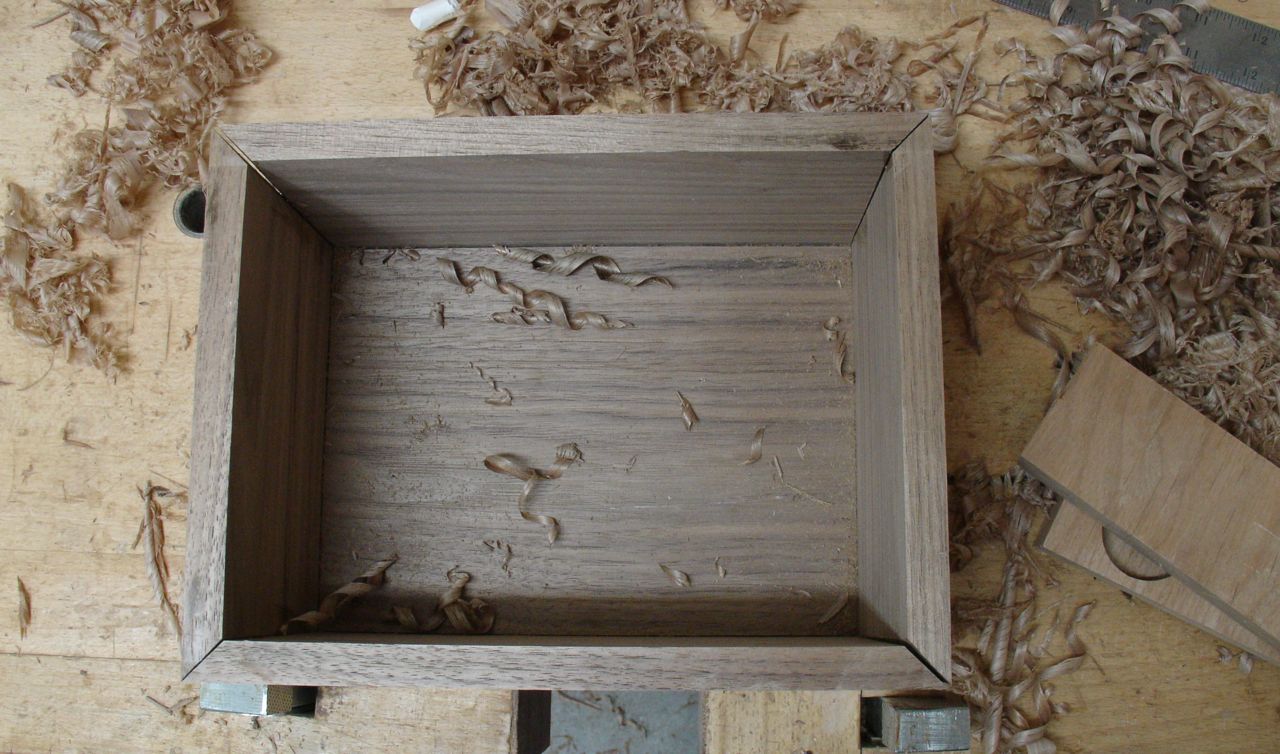
WoodworksbyJohn-CustomFurniture-LasVegas-MysteryBox-Prototype-1The purpose of following this procedure is so the grain on the box is continuous all the way around.  You can’t simply cut both long pieces, reset your stop block and then cut the two shorter pieces.  The grain won’t continue, that’s why there is the chalk marking to indicate the order of the piece and also the direction it should be oriented during glue up.  Next up was to make the lid.  The design calls for a seamless lid that is solidly glued to the entire box — I know what you’re thinking; what about wood movement?  There is a man on Lumberjocks who uses the name of Boxguy who uses this method.  I’ve had some correspondence with him and he assures me he’s been doing this for 10 years and never had a problem, he thinks it’s because the small size of his work doesn’t have enough wood movement to affect it.  This possibility was discussed and we decided to go ahead with  this for the Mystery Box.  To create the 1/2″ rabbet all around the top and bottom pieces I used the table saw as shown below to rough it out which was followed by accurately sizing it with a rabbet block plane.

WoodworksbyJohn-CustomFurniture-LasVegas-MysteryBox-Prototype-3

Assembly was started by applying two rows of packaging tape to hold it together initially followed by two band clamps.  Once that was together the top and bottom were attached and clamped like the picture at the top of this blog.  Kind of looks like a modern art sculpture in that photo doesn’t it?

Entire piece was allowed to dry overnight and then began the process of making this look like the examples they had shown me.  The inspiration for them was some leather bound ledgers and had something to do with the bottle of liquor it held.  The inside depth specified for the lid was 1 1/4″ and this lid was to be a 1/3  —  2/3’s split.  Before separating them though I used planes to smooth out the surfaces and edges.

My first cut was to divide the lid part way down with the tablesaw and then complete it by hand.  Next would be to separate the lid from the rest of the box.  This is commonly done with the tablesaw and my technique is to cut the two long sides completely through, then lower the blade to leave a sixteenth of an inch or so that can be cut by hand.  This eliminates the problem of having the lid bind as the cut is complete.

This is where the problem began!  As I was making these cuts I could hear some cracking — never a good sound when working wood!  Sure enough, when I finished the cut here’s what I found:

WoodworksbyJohn-CustomFurniture-LasVegas-MysteryBox-Prototype-8

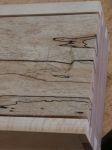
You can see that when the piece was separated the stresses that were inherent to the wood let go.  In the photo, the upper left and lower right corners have separated.  This confirms my concerns that for a box of this size the mitered joint is not a good solution.  Possibly adding a spline to reinforce it will be an option.  Miter joints are not a strong joint at all because you’re attempting to create an end grain to end grain glue joint.  It’s okay to use for light duty applications like moldings or picture frames and a display type of box that wouldn’t exceed 3″ or so in height but this won’t be the best joint for this application.  I suspect that the example my clients is looking at is probably some type of quality plywood covered with leather.  Finger joints would be among the best choice to give the corners the strength needed.

In the meantime, I’ll continue to use this prototype to work out a latch system.  If you can picture how the two clamshell lids will close you can imagine the unique situation we’re facing.  A perfect solution would be an antique type drawer lock but since these two close on to each other that may not work.  I’m partially done designing a drawbar system from brass.  As for now, the box with the separated corners has been glued and clamped as a temporary fix to work on the hinge and latching system for the Mystery Box.

Posted in Uncategorized | Tagged , , | Leave a comment

Computer Monitor Cabinet Ready for Finish

My client for the computer monitor has a real hectic work schedule as he’s supervising a total remodeling job at a local Toyota dealership.  Because of that we’ve had a difficult time getting together to select the finish for his project.  Yesterday I decided that what the heck, nobody is going to steal a couple of pieces of Alder and Alder plywood if I laid them in front of his construction trailers’ door so left them there with a note.  That worked!  he sent me an email and we’re going to go with the General Finishes, EnduroVar which is the same finish I used on a recent bar stool project.

This time of year it’s best to do my finishing work in the mornings, especially spray work.  The whole world is my spray booth but direct sunlight is not my friend.  The area I spray is on the west side of the house and I have until 10:30 or so before the sunlight comes over the ridge of the house.  Our humidity has been pretty high for us but it should be okay.

To prep for this job I’m trying a tip from The Wood Whisperer.  He has many video’s on line and covers a myriad of subjects dealing with woodwork.  He’s pretty informative and easy to listen to, here’s a LINK to his website.  Anyway, his tip had to do with pre-raising the grain which is something I’ll do with Oak even when using an oil finish.  His suggestion was to use your sprayer; I have an Earlex 6900, to apply a light mist of water to the entire project.  This way you can make your adjustments to the gun and be ready to shot the finish on without too many additional work.  I went ahead and did that and once that dried everything was block sanded with 240 grit paper.  All that remains is to blow off all the dust, set up the tarps to protect the concrete and shed, and apply the finish first thing in the morning.

I should be able to get the first two coats on, block sanding between with 400 grit paper.  If the finish sets up as quickly as I suspect it may I’ll be able to apply the third coat as well.  I’ll keep you updated.

Posted in Current Commission | Tagged , , | Leave a comment

Computer Monitor Cabinet: Final Details

WoodworksbyJohn-CustomFurniture-LasVegas-ComputerMonitor-FinalDetails-4It’s taken quite some time to day to get to this point but I think all of the final details have been addressed and we’re ready for final sanding and applying the finish.  I’m waiting for word from my client as to what type of finish we’ll go with.  Initially my plan called for Watco oil with hand rubbed top coats but the more I worked on this and thought about where it will be I’m now leaning towards the EnduroVar which is a water borne polyurethane finish.  I’m certain that there will be coffee cups and other drinks placed on the shelf and the poly would be a better finish for that.  Hope to hear from him soon so I can do the finish in the mornings, too hot once we get past 10:00 am or so.

WoodworksbyJohn-CustomFurniture-LasVegas-ComputerMonitor-FinalDetails-1Lots and lots of final details for any project and this was no exception.  As I mentioned in an earlier post the hinges will need to be off-set so they don’t interfere with the two cooling fans.  In this photo you can see why, that’s the fan at the top of the cabinet and the hinge mounting bracket is too long so had to be placed lower.  The lower hinge is installed into a scrap piece.  I’ve learned from experience that whenever I use European style hinges to always make a test piece first.  This way you can check that the set up on the drill press is correct for drilling the 35mm holes required by the hinge.  Here you can see the glue blocks too that are placed in the corners to add rigidity to the case.  The way I do the hinge holes is on the drill press.  I have a piece of Oak that I use as a guide.  By bringing the bit into the hole and then clamping a fence behind it I get the required setback.  Everything references to the center line.  For this case, the hinges mounted 7″ from the top and then an additional 12 3/4″.  These measurements were located on the door edge and the cabinet.  Once everything is set up it’s a simple matter of lining up the markings and drilling the holes.

Here is a brief listing of the final details checked off today:

  1. Cut trim pieces to go around monitor screen after it installed.  The sides were one width while the top and bottom were each different.  This means mitered corners aren’t possible.  These will be applied with some 23 gauge pins only in case the unit ever has to be removed.  I’m not a huge fan of 23 ga. pins — you can see them!
  2. Add spacers to both sides of the screen mount to attach trim pieces to
  3. Come up with a more elegant electrical plan.  My client gave me a power strip but it was too large and just looked ugly!  Looked all over to find one that had the rocker switch opposite the side where the power cord runs in but no luck.  The power strip will be in the center section so I fashioned a cover that will conceal much of the wiring yet still allow easy access to the switch.  That one rocker switch will turn on the monitor and both ventilation fans.  Also found some cable clamps that will screw into the underside of the unit and corral the cords — hate messy cords!
  4. The span of this unit is close to 36″ so that created two minor problems.  First off, the bottom trim piece had to be scribed to the shelf to get a close fit.  Also, I needed to add a brace in the center of the back.  At first I thought my doors were out of square but it was the top bowing down a little.  That is solved with a center brace that will be screwed in place so that removal will be easy should the back of the monitor need to be serviced.
  5. Experimented with the door adjustments and found I needed to plane a little bit from both inner edges.  A full overlay hinge will just barely cover a 3/4″ thick frame, learned that you can push the adjustment but it tends to push the inner edge of the door outward — better to have a slight reveal on the side.

So, I’m at the end of this particular project.  In my previous blog I mentioned a possible commission designing a presentation box for a electronic device.  Well, after a 2 hour plus meeting yesterday I got the job.  This will be a very interesting project and it’s a bit secretive too.  Maybe I’ll have to give it a code name like they used to do at Area 51 here in Las Vegas!

Posted in Current Commission | Tagged , , , , | Leave a comment

Coped Doors with an Antique (almost) Rockwell Shaper

WoodworksbyJohn-Rockwell 43-120 Shaper-Doors-1Here’s a photo of my almost antique, Rockwell Woodshaper Model 43-120.  Rockwell became Delta/Rockwell but now the Delta name is the one most know it by.  I bartered some work for this shaper back in the late 70’s and it’s served me well.  You can still find parts for it and there’s an interesting site that is dedicated to all sorts of  old woodworking tools.  Here’s a LINK to it if I’ve piqued your interest.

There are a variety of ways I use to make doors ranging from hand cut mortised and tenoned ones that I prefer or in this case, a coped frame made with the help of a wood shaper.  Shortly after getting the shaper I purchased this set of cutters made by Freeborn.  I’m not sure why but many woodworkers shy away from shapers in their work but when I had the opportunity to barter for this used one I couldn’t pass it up.  Granted, this one is only 1 hp and runs on 110 volts but it has been more than adequate for the work I do.  When faced with making a number of doors this is a great way to go about it.  Once you have the machine set up it becomes a matter of planning your work sequence out and then cutting what you need.  Doors made this way are the industry standard and the type of door most of you probably have in your kitchen and bathroom cabinets.  Personally, I prefer using this shaper over the current practice of using a table mounted router to spin a monster bit at high rpm’s.

For the computer monitor I need a set of doors for the back which will blend into the cabinet yet give full access should it ever be needed.  Here they are, dry-fit and laid on the frame to make sure my calculations were correct.   It’s always a good feeling to see that your calculations were accurate.  In this photo they are just laying on the case to make sure the fit is what I need.  I tend to make them 1/16″ to 1/8″ oversize to allow room for hand planing to exact size.  This also allows me to compensate for any irregularity of the cabinet.

WoodworksbyJohn-Rockwell 43-120 Shaper-Doors-4After selecting the order of these pieces the panels will be sanded and the entire assembly glued up.  A good technique to use when selecting the wood for a set of doors is to have the top and bottom horizontal pieces come from the same piece of wood.  You should lay them out so the grain is continuous.  Same goes for the center vertical piece.  I will select one piece to make both of them and rip it in half.  Again, it’s marked for re-assembly so that when the doors are closed it will appear as a single board again with the grain pattern matched up.  These are the things you should expect when you order custom furniture.  Even if the client doesn’t realize these extra steps you take it’s always worth the effort.  When the grain of the wood has a continuous flow it’s pleasing to the eye.

Calculations, here’s a quick breakdown of how to go about making a door like this.  After selecting the wood for the doors you plane them all to a uniform thickness.  The first shaper operation is cutting the ends of the horizontal pieces which are called the rails.  You need to measure the width of the opening that needs to be covered.  In this case that measurement was 36 1/2″.  Now the width of the vertical pieces, referred to as stiles; needs to be subtracted.  For this project each stile is 2 1/2″ wide and since there are 4 of them it meant I needed to subtract 10″ from the overall width leaving a total of 26 1/2″ required.  Still with me?  Since there are two doors this measurement is divided by 2 to give a total of 13 1/4″ needed for each rail.  Don’t forget this, you need to add 3/4″ to each rail to allow for the stub tenon joinery.  Neglect that step and your door will be 3/4″ of an inch too small to cover the opening and yes, I know that from experience!  Here’s a LINK that will explain the process of panel and frame doors.

Coping the Rail

Coping the Rail

As I mentioned, the first piece to cut is the joinery at the end of each rail.  A feature of shapers is that the rotation can be reversed.  This allows you to cut with the profile on the bottom of the piece which is safer.  I don’t use a sled but rather have modified a miter gauge by adding a clamp to it which securely holds the piece being cut.  There is a piece of scrap behind it to avoid blow out.  You’re looking at the front of the machine and the piece has already been through the cutter.

Shaping the Inside

Shaping the Inside

The next step is cutting the stiles and the inside of the rails with the other three cutters.  The reason I prefer not using a coping sled is that the height of the cutters remains the same when making this cut.  If you use a sled you must re-adjust it to compensate for the thickness of it.  It is safer to use the sled when the piece being shaped is wide.  The inside of each rail is cut along with the inside of each stile.  In this picture I’m using a push block on the rails which makes for a safer operation.

After selecting and cutting the material for the panels the doors can now be glued together.  Looks like I’m making good progress on this project.  So far the weather has cooperated and my timing to glue up in the mornings has worked out.  By noontime it’s well into the mid-90’s in the shop and that’s just too hot to glue up.  Hinges, surface prep, and finishing is left on the project.  I’ll also need to design a molding to go around the monitor once it’s installed.  That’s on the work schedule for today.  I’m also meeting with a client that has a very interesting project designing a presentation box for a very high end Apple iPhone, tablet, and laptop his company is producing.  Fingers crossed we are able to come together on that one!

Posted in Current Commission, Tutorial, Uncategorized | Tagged , , , , , | 1 Comment

Computer Monitor Casework — The Saga Continues!

WoodworksbyJohn-ComputerMonitor-Assembled-1So, this is where I’ve stopped at around 11am today and it’s good to see this project start to take shape.  My client knew that this would be; as I’ve termed it, a real head scratcher and he was right on the mark with that assessment!  I always enjoy the challenge of taking on the unknown project but it’s difficult to estimate how much time it may take to produce when you challenge yourself with one of a kind work.  Sometimes you’re pleasantly surprised and find that what you thought might take 15 hours was successfully accomplished in half that time, other times it’s the opposite — afraid that’s the case on this one but it’s definitely keeping me on my toes.  Boy, there’s a lot of things to keep in mind.

WoodworksbyJohn-ComputerMonitor-Assembled-2This was the first success after many hours of preliminary work, being able to clamp the unit together and place the monitor in it and see it fit.  It’s sitting on top of the table saw so the angle is a little weird but everything is correct.  Now I could figure out the placement of the ventilation fans.  They need to be placed near the top and back far enough to clear the monitor.  This meant they couldn’t be centered which affects the hinge placement.

WoodworksbyJohn-ComputerMonitor-Assembled-3The fans require a hole about 3 inches in diameter.  A circle cutter made that task easy and all that remained was to locate and drill the four holes used to mount the fan.  At the same time, holes were also cut into the bottom piece for ventilation and for a cable chase.

The case will be joined using screws which will be concealed with plugs.  Although this isn’t the fine, hand cut joinery I would use for building a dining set it seems to be the best choice for this project.  The inside bottom is made of Baltic Birch plywood which is laminated between the Alder for the back and front shelf.  Biscuit joinery was used here to help keep all in alignment.  As usual, glue up was a bit hectic and I debated whether or not the temperature was too warm in the shop but the bottom line is that I wanted to get things over and done with so went ahead and put this project together.

WoodworksbyJohn-ComputerMonitor-Assembled-4One concern I had was keeping everything square, the opening for the monitor itself measures 22″ tall by 35″  wide and you can’t put a brace of some sort down the center of the monitor — don’t think my client would appreciate that!  Screwing the monitor to the case (6 screws) will stiffen it somewhat but I decided to use a furniture technique of putting glue blocks in the corners to strengthen  the entire case.  They are generally applied with a rub joint which I further reinforced with a couple of 23 gauge pins.  These glue blocks are attached at both the top and bottom of the case and essentially increase the glue area and over-all rigidity of the case.

All that remains for the main portion of the case is to attach the dividers that support the bottom and also provide the storage space beneath the unit.  I’ll do that after lunch plus glue in all of the plugs to conceal the screws.  For that I’ll use liquid hide glue since it cleans up better than cabinet makers glue.  Then it’s on to the doors which is a pretty straight forward operation.

In spite of my complaining at the beginning of this blog about the challenges of this particular project I truly enjoy it.  Just like when I’d compete in my 50 mile mountain races there are smooth stretches and some you’re not so sure you’ll be able to overcome.  A lot can happen during the 9-13 hours it would take me to finish one of them.  The majority of the time though you finish and feel much better about yourself and ability to cope with life.  Completing a challenging project gives me the same sense of satisfaction.  Diane and I recently came back from a vacation in Kentucky and  I purchased a dulcimer.  There is a very well known mountain dulcimer maker there by the name of Warren May.  He and I have traveled somewhat similar paths in that we were both Industrial Arts teachers.  He stopped many years ago to pursue making his dulcimers.  He has numbered and signed each and every one of them — mine is #16,831.  It’s a beautiful piece of work but I’m not so sure I would enjoy making that many of anything no matter how beautiful or satisfying it may be.  I think I’ll stick to being the one of kind project guy like I am.

Posted in Current Commission | Tagged , , | Leave a comment

Monitor Cabinet Continued

WoodworksbyJohn-CustomFurniture-LasVegas-MonitorCabinet-This shows the progress on the case for the 31″ monitor job I accepted recently.  It’s always good to finally take the parts you’ve been working on and fit them together.  If you read the first post on this project you’ll recall I termed it my “head scratcher” since it looked to be a real puzzle on how to construct it.  Now that I see what I have (picture on left) I can tell that the plans in my mind and roughly drawn on paper have me on the right track.  This will be big!  My initial plan was to divide the space below the cabinet into 3, equal areas and use that to store binders, papers, and other job related items.  Now that I see how the cables may have to be routed that may change to 2 divisions.

This job is a good example of what I refer to as hybrid woodworking.  When you combine machine process with hand work I believe you’re following an efficient work flow without only preferring one or the other.  Work started with machinery to rough cut the stock to size.  Next, a hand plane joints the edges for lamination followed by first a power planer and finally a hand plane to get that furniture quality finish I put in all of my work.  After the sides were sized they were cut to the L-shape you see with the bandsaw.  Bandsaws leave a fairly rough surface so here is the power tool, hand tool process utilized to finish that process.

I know, and after going to the AWFS fair here in Las Vegas last month it’s obvious; that this could have been completed on a CNC machine in a fraction of the time.  To me, that takes the hands on woodworking out of the equation.  I’ll always prefer to have my hands on the materials forming and shaping it to produce my work.

We’ve only begun the work on this piece but it’s good to see it come together.  On the schedule for today is determining the over-all height to give an acceptable viewing level while seated at the desk, location and drilling 3″ holes for the ventilation fans, figuring out where the bottom panel needs to be drilled for not only air flow but also running the cables.  It would be nice to assemble this today but the temperature may get too warm, then the glue sets up too quickly.

In case you’re wondering, the back of the cabinet will have doors on it so that it can be accessed easily.  These will be of a flat panel design and use a rustic Alder ply for the panels.  I can see that there needs to be internal bracing to keep everything square and in alignment but the monitor will need to be in place so I can tell how it will fit.

Any wonder I’m calling this my Head Scratcher project?

Posted in Current Commission | Tagged , , , | Leave a comment

Head Scratcher Project

Some time early in July I received an email from someone who had found my through the Custom Made website.  I’ve been part of this website which is supposed to help others on the net find you but haven’t had any success securing commissions with it.  He used it to locate me and then did a search to contact me directly — maybe that’s why Custom Made isn’t the successful site that they’d like to be.   It’s free so I’ll keep with it.  In any case, I received an email stating he needed me to build a cabinet for a 31″ monitor.  To be honest, I wasn’t real sure what this would entail but since I’m always up for the challenge I met with him.

I met with him at his construction office at Auto Nation Toyota.  They’re doing a huge remodel and he’s the contractor for the job.  First impression was that he was a very friendly and busy guy.  During our meeting the phone rang constantly and workers would be in and out asking him questions.  The way he reacted to my “head scratching” told me that he realized this would be an interesting challenge/job to say the least!  I collected my design fee, he agreed to get the required ventilation fans and I left to work out some sort of plan.  The plans were tentatively set, a price was quoted but then I didn’t hear from him for a while.  I sent an email asking him to let me know when he had the fans and was ready to move forward.  That happened a couple of days before our Kentucky trip so we got together after our return.  We got together, I picked up the monitor, fans, and molding he had to trim it out.  After figuring a materials list I bought some Alder.

WoodworksbyJohn-CustomFurniture-LasVegas-ComputerMonitor-1I decided that to do this project in 4/4 stock it would look too puny.  Besides, I needed to laminate the wood for the sides which will be 13″ wide.  When you laminate you always need to plane the board smooth so it would have ended up being more like 5/8″ thick and that wouldn’t have looked good.  I found these two pieces of 5/4 Alder and decided to buy both of them for the entire project.  Even though the doors, top, and shelf only need to be 3/4″ thick and I’ll be planing off a lot of material the color of these two boards is a good match.  The 4/4 stock they had was considerably lighter.  Matching the natural coloration of the wood is worth the extra cost for the material as far as I’m concerned.

MonitorTemplateThe approach I took once the monitor was in my shop was to make a pattern of it.  There are a number of ins and outs on the back side that I’ll need to build around.  There will be a space below the monitor where he can put binders and papers he may need.  It’s not the best picture but it gives the information and dimensions I need to build this project.  He also gave me the required cables and cords for the monitor which I’m glad he did.  That allowed me to space out the holes needed at the bottom; not only for ventilation but also to figure out how to run the cords.  Like I said, this is a “head scratcher” project!


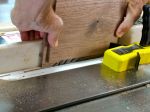
The first step was to laminate two pieces for each side.  That begins with the tablesaw and ends by jointing the edges that need to be joined with a jointer plane.

WoodworksbyJohn-CustomFurniture-LasVegas-ComputerMonitor-2

WoodworksbyJohn-CustomFurniture-LasVegas-ComputerMonitor-3After jointing the edges they were laminated together, Gorilla Glue is my choice of adhesive for this process, never have had a failure with it.  That was yesterday and now that both panels are ready to go I’ll be doing the joinery work on them.  It’s hit 98 degrees in the shop this afternoon so decided to tackle the rest of it after church tomorrow.


Posted in Current Commission | Tagged , , , , | Leave a comment