A Tricky, Half-Blind Carcass Dovetail

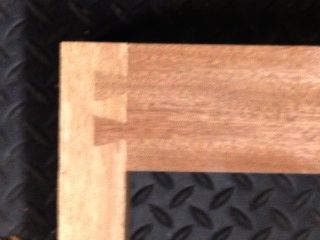
Poor picture but joints are visible

Poor picture but joints are visible

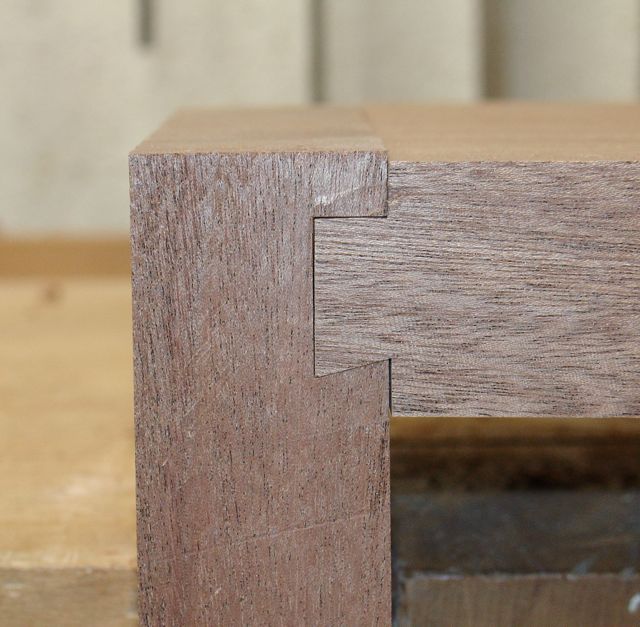
I’ll admit it, like so many other woodworkers I’m enthralled with the dovetail joint.  Yes, it’s probably been romanticized but the truth remains that it is a joint that works because of it’s mechanical design and angles.  Whenever I teach a student about the dovetail I’ll mention that this joint has been found in ancient wooden items and is still sound!  So, here’s the one that is tricky but will work well for the top of the carcass.

Trick from Tage Frid

Trick from Tage Frid

The reason I find this joint somewhat tricky is that you’re cutting down into end grain.  Too hard of a blow with your mallet and could split the entire piece!  Add to that the hardness of this ribbon grain Sapele and the fun and stress just continues to multiply!  I used a couple of techniques here that I found in my research so will pass them along.  First of all, this dovetail is about 3/8″ thick and 5/8″ long which means there isn’t a lot of cutting to be done with your dovetail saw but; you need to cut the wood at the bottom.  Tage Frid had a technique in his book where he used  a piece of cabinet scraper to complete that cut.  I had a very thin piece of card scraper that I used.  In his book the joinery is cut with a bow saw which has a pretty wide kerf so he showed a thicker card scraper.  According to the text, you don’t want this to be a sharpened piece of metal since that could split the wood!  I was very careful and gentle with the small hammer I’m using!

The other trick I used on this project is one I found on a Lonnie Bird video.  On it he showed removing the waste from a half blind dovetail by using a smaller chisel and cutting down on the end grain.  Usually the wood you remove is split along the grain and worked back to the shoulder line.  The Sapele has a tendency to split along the grain so I experimented with Lonnie Birds technique and found that it worked well.

DovetailCarcass-WoodworksbyJohn-CustomFurniture-LasVegas-6

Small router plane and fishtail chisel

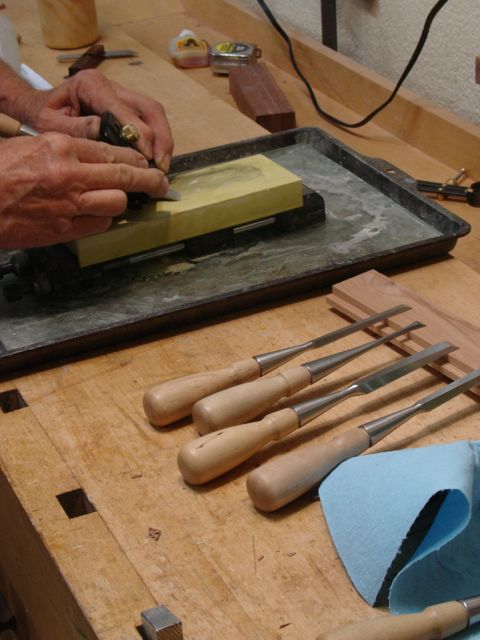
Once the bulk of the material was chopped out this way it became a matter of paring to the lines like you normally do.  What was awkward about this as compared to smaller work like a drawer is how to secure it in the vise.  That’s always a challenge because if you can’t hold what you’re working on securely your work will be sloppy.  There are a couple of things that make cutting this joint easier for me.  One is to use the Stanley small router plane to help maintain the proper depth of the socket and the other is using a Lie-Nielsen fishtail chisel to work into those corners.  You see both of them in this picture.

Practice twin, 14 degree dovetail for bottom stretcher

Practice twin, 14 degree dovetail for bottom stretcher

The twin dovetails that will be used for the front, bottom stretcher will have their own challenges but at least I won’t be cutting down into end grain on the ones just completed. My practice one turned out quite nicely so hopefully the real ones will go as well tomorrow.  This is what the practice one looks like, the angle is 14 degrees to match the machine cut one on the shelf above.

Posted in HDTV Stand | Tagged , , , , , | Leave a comment

Woods Cut, Joinery Started, TV Stand Progress

In my last blog I talked about the bare faced dovetail joint I will be using for this project. I also mentioned how I’m calling this my “challenge project” because I want to try a number of techniques I haven’t done on this scale.  The main thing is to use solid wood for the entire cabinet along with a lot of hand cut, dovetail joinery.  Makes me a bit leery of posting this for all the world to see (well, at least my blog readers) but what the heck, the byline on my blog says that I’m “sharing my thoughts and decisions” so I suppose I’m committed!

WoodworksbyJohn-LasVegas-CustomFurniture-HDTVStand-Joinery-1The first thing to do was to cut those bare faced dovetails that will connect the two sides together with the main shelf.  Yes, router work is quicker than hand work but it’s also quicker to mess things up!  Before routing the socket for this joint, the inside surface of the cabinet was finished with a smooth plane.  Really can’t do that later as it would change the fit.

Next step is cutting the socket. This is definitely a case of measure twice and cut once.  The initial cuts were made in two passes with a 1/2″ cutter to a depth of 3/8″.  That bit was swapped out for the dovetail bit, the fence moved 1/4″, and the cut made.  Amazingly enough, even though I used a tape measure to make these settings the groove itself is only 1/64 wider on one side than the other.


Now, here’s the somewhat ironic part of this joinery story!  When I was at San Francisco State University it was important to not only cut your joints but get them glued up the same day.  Why?, well when the fog rolled in the next morning the increase in humidity would cause the wood fibers to swell and what was a good fitting joint became difficult to assemble.  Here in the desert, I’m experiencing the opposite of this.  Two days ago the fit on this joint was as close to perfect as I could get after fine tuning the flat side with a rabbet block plane.  Now, there is a very slight space and I think it’s because the wood dried a bit after being exposed.  Not a huge concern though, it may reach an equilibrium but if not a small Dutchman will conceal it.

HDTV Stand

Sketch of HDTV Stand

The bottom piece of the cabinet will be 3″ wide with twin dovetails into the side for the front.  The top piece is dovetailed into the sides and serves as the upper track for the sliding doors as well.  The back of the cabinet will be a panel and frame piece to create a square and solid case.  After cutting these pieces to the inside dimension of the cabinets plus 5/8″ for the dovetails I used the tablesaw to rabbet the ends, the rest of the joinery will be hand cut.

L-Shaped Fence for tablesaw

L-Shaped Fence for tablesaw

The workday ended by cutting another rabbet on the inner, back  side of the cabinet.  Here’s where using an L-shaped fence in addition to the rip fence comes in handy.  You don’t need to add a sacrificial piece and can see exactly where the cut will be made with your dado head.


Sliding Door Track

Sliding Door Track

The final thing accomplished is beginning the work for the sliding doors.  Here’s where I have to go out on faith.  I’ve mentioned my design considerations for them and the commercially available plastic track is just plain hideous! I found an article in Fine Woodworking magazine by Seth Janofsky showing how he makes his own track for sliding doors.  This was in the September/October 2004 edition.  The first part is to cut the track in the shelf and also the top, cabinet case member.  I followed all of his directions including drawing it out to visualize it.  The work was done with a 1/2″ wide dado blade in the tablesaw and what you see is the final result.  Definitely have to pay attention to what surface — ah yes, I love the challenge!

Posted in HDTV Stand | Tagged , , , , , , , | 1 Comment

Bare Faced Dovetail: Critique Requested

WoodworksbyJohn-BarefacedDovetail-Exp-9In my last blog I talked about the joinery considerations for the TV stand project.  After lots of research and some inquiries on the Woodweb forums I’ve decided that the joint you see pictured here is the way to go but I would be interested in hearing thoughts from other woodworkers.  This is my sample joint and the real one will be about 7″ down from the top of the board.  In Ernest Joyce’s Furniture book a sliding dovetail like this is referred to as a barefaced dovetail (pg.178).  With the size and weight of these pieces a tapered, sliding dovetail seemed to be tricky at best.  Also, the case will need to be assembled and disassembled many times to check how the sliding doors fit and the drawer web construction.  With only the bottom of the joint having the dovetail angle, that will establish the shelf location.  The top, being flat can be fine tuned with a rabbet block plane to fine tune the fit.

Here’s how I went about cutting this joint:

At this point I now have the female side of the joint cut into the cabinet side.  Next up is cutting the corresponding joint on the shelf.  It begins with leaving the depth set as it was and cutting half the dovetail on the end of the shelf.  Then, the 3/8″ rabbet bit is used on the opposite side:

Now it became a matter of fine tuning the joint to where it will slide together without too much problem — router plane and rabbet block plane are used to achieve that:

The joint slid together fairly easily so my thoughts are that even when it’s twice this long, my success should be the same!  To fit the bottom and top members of the cabinet I’ll be able to flip the shelf over to the rabbeted side and clamp the sides temporarily as I fit the top and bottom case members.  These will be hand dovetailed in the usual manner.  I won’t need to fully insert the shelf until the final assembly.  My plan is to use liquid hide glue on the final 2″ or so which will secure the shelf in front (and keep it flush) but still allow it to move in the socket with temperature changes.

So, how does this sound to you fellow woodworkers who’ve taken the time to read through all of this?  I really would appreciate any thoughts you may have because you know once the glue is on it darn well better work!


Posted in HDTV Stand | Tagged , , , | Leave a comment

The Challenge: TV Stand Project

Well, I’ve been holding off beginning to blog on this latest project because of the complexity of the piece.  Since doing the family room remodel it’s obvious that the table we now use to hold the television isn’t adequate so — what better excuse to design and build something new!  I’ve made many pieces of furniture using panel and frame construction or hardwood plywood for the sides with solid, mortise and tenon face frames but never attempted a large cabinet like this made completely with solid material.  I’m basing much of the sizing from Thos. Moser shaker designs, most of his drawings show 1 1/8″ thick material.  Here is my initial design sketch:
HDTV StandOver-all it’s approximately 26″ tall, 16″ deep, and 50″ long.  Since I dislike open shelves or glass doors to house the media components that are operated by remote control the two doors at the top are sliding.  Here’s one challenge, I’m making my own track which will be routed directly into the shelf at the bottom and into the top frame member.  I’ll be using a piece of Big Leaf Maple mail ordered from Woodworkers Source in Arizona.

My next challenge will be all of the dovetailed construction the design calls for.  This has caused many sleepless nights and lots of research not only in my reference books but also on the web.  The size of the shelf is what is tricky, a tapered sliding dovetail seems like the best way to go but the process of making this complicated joint is daunting!  I’ve used sliding dovetails in small, solid lumber cabinets but never in one of this size.  I will also need to take this shelf in and out several times during the construction of it which isn’t recommended for dovetails.  After some experimentation I’ve come up with a bare-faced dovetail combined with a dado that I think will do the trick.  Look for a separate blog on that coming soon — the joinery work has been done.  Below the sliding doors will be three, dovetailed drawers and the entire unit will sit on a pedestal as shown.

Last of all, here’s a “shout out” to Woodworker’s Source in Phoenix.  I put a link to them above but after a discussion we had at the latest Sin City Woodworkers meeting about customer service from our local lumber suppliers feel this is warranted.  First of all, I’ve done mail order with them for probably 10 years or so.  When my wife was in galleries in Scottsdale I would stop there too whenever I delivered paintings to her galleries.  The piece of Big Leaf Maple I mentioned was one of their “one of a kind” boards and delivered to me here in Las Vegas.  I needed about 50 board feet of 6/4 Sapele and wanted to pick out my own lumber so it was time for a road trip.  Before going there I called and they had about 700 bf in stock.

It’s about a 5 hour drive and when I arrived the boards in the bin were pretty well picked over so decided to check out the warehouse.  One of the guys asked me what I was looking for — 6/4 Sapele in as wide of board available.  He pulled down a unit of 10 footers that were anywhere from 5-9″ wide and beautiful.  He set them down in a corner and I selected what I needed.  I took my time and marked them with chalk to coincide with my cutting list.  I re-stacked the pile, having worked in a lumber yard in my younger days I always do that and suggest you do too.  They cut the boards to the sizes marked and also straight line ripped them for me.  My jointer is a #7 Stanley so this is well worth the .25 per board foot to me.  Also picked out some 6/4 Maple to be resawn for the drawer sides.  The point I want to make is that the people at Woodworkers Source are really great to work with.  Their customer service is top notch and that’s the same whether you shop there in person or go through mail order.  In all the years I’ve bought wood from them I’ve never been disappointed.


Posted in HDTV Stand | Tagged , , , , , , | Leave a comment

Roman Shades = Custom Pull

FamilyRoom-Remodel-Drapes-1

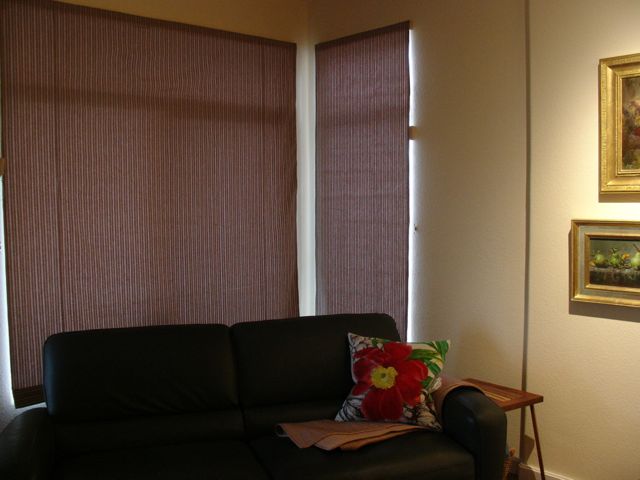
New Roman Shades

Well, I did say a post or two ago that it was the last of the blogs about our recent family room remodel but —- guess what?  Here’s another!  If you work around your own home does it ever feel like there’s no end to it all?  Happily, my wife has a great sense of style and design so our house stays up to date and a wonderful place to spend our time together.  A high school friend of mine who I’ve re-connected with through Facebook has a design blog which is always inspiring, it’s called The Good Life of Design and is a good source of inspiration.  Her style is coastal beach and even if that’s not your focus, her blog is a good read.

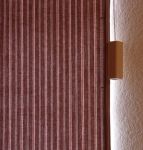
When we took down the original Roman Shades that Diane made for the house her first thought was to simply replace the cords and the numerous plastic rings that the sun had eaten up — well, not so easy!  The desert sun was brutal, as a result the lining was so bad it was impossible to sew or repair.  Our first instinct was to go the quick and easy route and contact one of the many companies that specialize in blinds.  Kind of had the thought going in that we wouldn’t be satisfied with their offerings or pricing so Diane was off to the various fabric stores to find just the right material and she succeeded!  Just as she was about to give up on her quest she came across this fabric and bought 15 yards to do the job.  She didn’t know until checking out that it was all on sale, ironically the lining ended up costing more than the face fabric!  Next on the agenda was to find rings and cord which she ended up buying on line.  The rings are brass so will never deteriorate from the sun, unfortunately the storms back east delayed the shipment so Diane was “chomping at the bit” to get the job complete.

There were a total of 6 shades, two for the doors (25″ or so), two for narrow windows (36″ or so), and then two more for the large windows (75″ or so).  That’s a lot of fabric and sewing to say the least!  Ended up taking the assembly table from the shop and putting it on her sewing table to have enough room and support for the fabric.  That was a lot of sewing for her to complete but the final results are beautiful.   For my contribution to this job I only needed to re-size the mounting boards and change the eye-screws for the cords to run through.  The shades are attached to the mounting boards with velcro which makes it easy to align them as needed.  Believe it or not, the windows aren’t all square or level to the world so being able to adjust them is crucial.

Check out that shaving!

Check out that shaving!

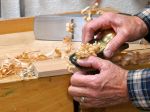
New pulls were made from a piece of 1″ square Poplar.  This began by first planing the surfaces.  I felt a bit like Rob Cosman as I planed this wood.  The shaving came out just like it does for him in a YouTube video on planes.  I’ve given you a link to it in case you’re wondering what I’m talking about.  Once the piece was squared and smooth the edges needed to be chamfered which was done with a block plane.  So much nicer doing this type of work with hand tools as compared to a router, shaper, or table saw.  Quicker and better finish too:

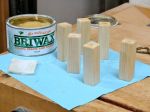
After the piece was shaped and felt good to the touch the individual pulls were cut, they’re about 3″ long.  Here’s a sequence of the finishing steps to this project.  We’re happy with the results of the entire job but I’d bet there will be subtle changes moving forward!

Posted in Home Remodel | Tagged , , , , , | Leave a comment

Repair Job on a Custom Stool

WoodworksbyJohn-StoolRepair-1

Ouch!!

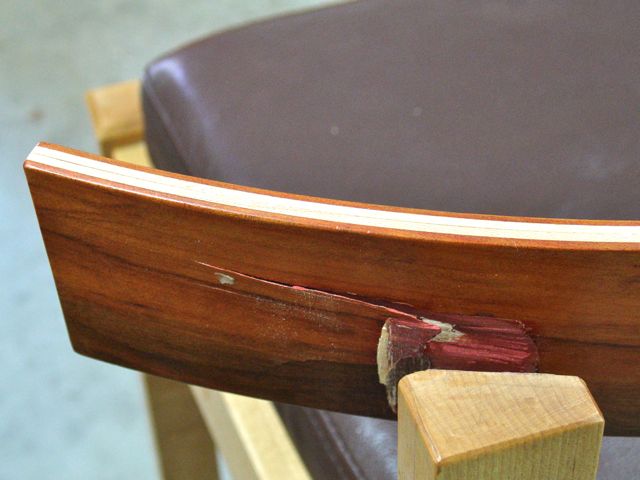
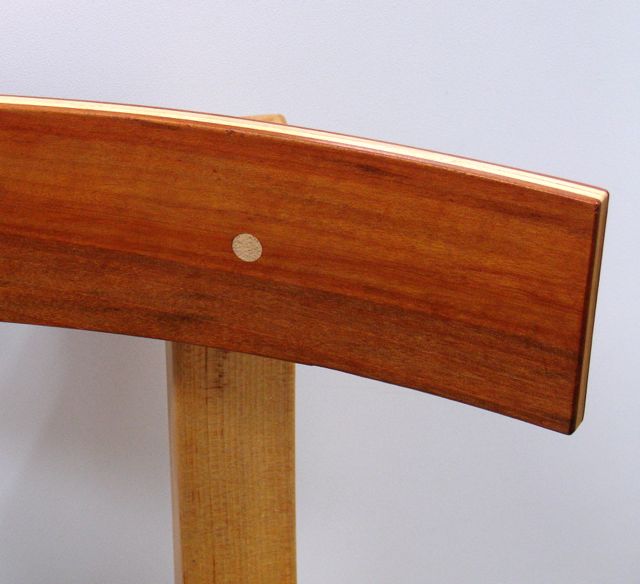
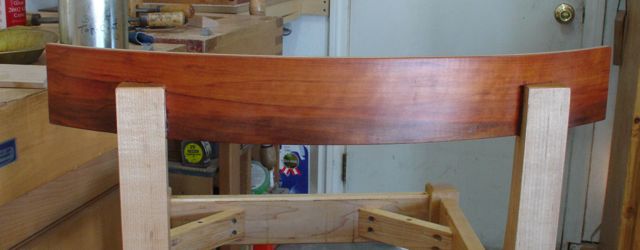
In my last blog I mentioned that a previous client of mine called me with the news that one of the stools I made for him had an accident.  He told me the stool has survived many parties and grandkids but just couldn’t take being toppled onto the floor. This is how things looked when he brought it by.  Apparently the back got tangled in something which brought the stool down.  Just a side note, you always hear that the glued section of a piece of furniture is stronger than the original wood.  This was proven here, it’s the wood that failed, not the glued up joint.

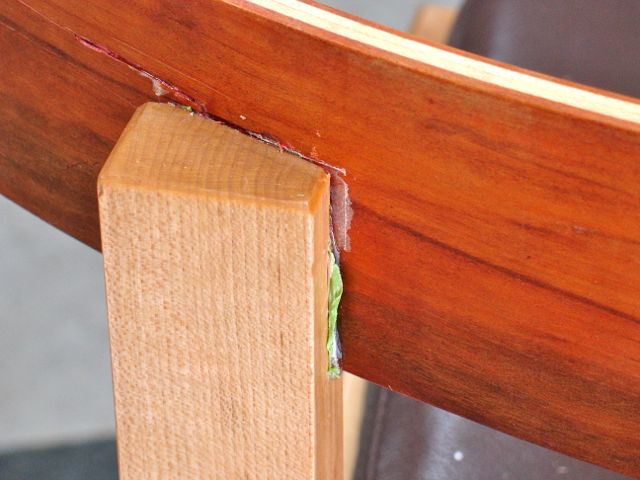
WoodworksbyJohn-StoolRepair-2The back of the stool is a curved, laminated piece that consists of 2 pieces of Chakte Kok sandwiched around two pieces of Maple.  Each piece is about 1/8″ thick, they were laminated together with plastic resin glue.  The way they are attached is with epoxy and a single screw that has been concealed with a Maple plug.  There was very little room to countersink the screw and then apply the plug.  As you can see, the screw ripped out of the one side so it needed to be removed.  The other side was still attached but the top of the leg has some cracks in it.  I decided against trying to drill out the plug to remove the screw, there just isn’t enough meat to firmly re-attach everything.  Epoxy and clamping over-night seemed to be my only option.

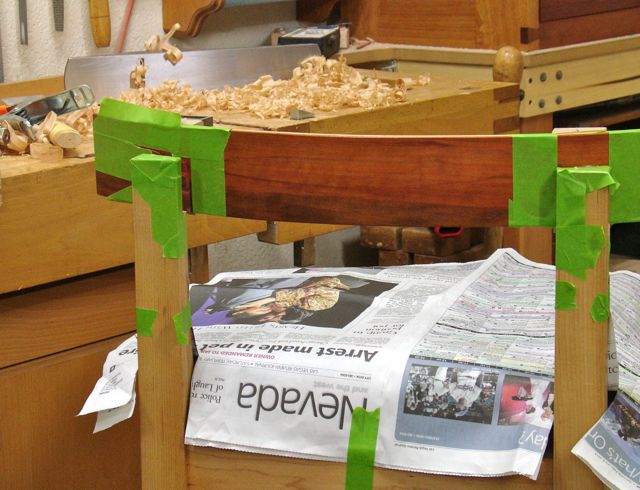
Trying to put parallel clamps on a curved surface like this stool back wasn’t going to happen!  My first step was to create a caul with the same curvature as the back of the chair for clamping.  A short piece of Alder fit the bill:

WoodworksbyJohn-StoolRepair-10Once the fit on the caul was acceptable it was cut in half, one for each side.  To protect the surrounding wood everything was taped off and the leather seat covered.  The cauls were attached to the front of the back with double stick tape.  After a dry fit it was time to do it!  I’ve mentioned before and most woodworkers will agree that glue ups are always stressful.  All of your work can be ruined by one mishap — now add the fact that this is 5 minute epoxy and there is a definite time frame.  Suffice to say, I was pumped up!  Forgot to take a photo of all the clamps used but there were enough to do the job.  Although the directions for the epoxy said you only need 30 minutes of clamp time I allowed overnight time before removing the clamps.  Kind of held my breath and crossed my fingers that I wouldn’t hear any popping or cracking noises as the clamps released the pressure — all was silent!

Clamps removed

Clamps removed

After removing all of the tape there was still a bit of residue from the epoxy which was removed with a sharp chisel and X-acto knife.  The large split was smoothed down as well.  Really glad that the finish I use is so simple to rejuvenate and hide minor imperfections.  It’s a 3 part mix of turpentine, boiled linseed oil, and poly urethane that is wet sanded into the wood.  I did an initial application with 400 grit paper and then additional coats rubbed in with denim.  These were buffed out, since the front of the back had a few scratches on it it too was re-coated.  Here’s what it looks like now, much better if I do say so myself.

WoodworksbyJohn-StoolRepair-9

Posted in Uncategorized | Tagged , , , , | 3 Comments

From the Bar to the Desk!

No, that’s not what I did last night — I work with a local interior designer from time to time.  She owns and operates Urban Ranch General Store here in Las Vegas.  Durette has hosted my work in one of her featured artists shows and also has a few of my pieces in her studio.  Well, she called me and asked if I could modify a chair for one of her recent design jobs.  Her client wanted to take one of the bar stools and convert it to a desk height chair instead.  Here’s the original bar stool on the left and the modified desk chair on the right:

The current seat height was 24″ which is too tall for a desk.  The client asked for casters as well.  The limiting factor with this project was the foot rest.  Even though it’s screwed into position (rather than tenoned) moving it wasn’t feasible.  I knew there were many different styles of casters but was somewhat surprised by the pricing.  Seems as if the readily available ones were all 2″ in size and roughly $5.00 a pair.  Then they make a huge jump to $30.00 – $60.00 for a set of 4.  After consulting with my client, we chose the lesser priced ones for this project.  Fairly straight forward job, the only complications was having to deal with the screws which were centered in the leg.  Because of that the stem mount for the casters is off center.  Here’s a photo essay of the process:

By the way, stools seem to be the current trend.  If you’ve followed my blog for a while you may recall the Dovetail Chair I designed back in 2010.  From the publicity I received after being an awarded an Honorable Mention at the Design in Wood competition I made a set of bar stools for a local client.  He called me a week or so ago, heart broken because he knocked one of them over and split the back!  Even though this commission was 4 years ago I want to see if I can fix it some way.  You can see that stool in the last picture, here’s a LINK to the final blog of that project.

Posted in Uncategorized | Leave a comment

Last Word on the Re-Model

My guess is that most of us that work with our hands get a lot of satisfaction from it.  Seeing my students reactions during my teaching career to the projects they were able to make showed that sense of pride and satisfaction.  Now that the wall work is over and the house is slowly but surely being rid of the dust and tools laying around it’s time to reflect on the change.  Here’s  a quick look at the over-all change:

As you can see in the after picture the fireplace is gone along with all of the nineties arches and radiused edges.  This was the first arrangement of art work that Diane chose to display.  I came in from the shop this afternoon and noticed the lights were on and she was standing there studying the wall and figured a change was in the air!  Diane has a wonderful sense of style and the various “happenings” around our house reflect that.  I think they’re actually called vignettes but to me it’s a happening.  Here’s the new lay-out, I can see that it is much more lively and not as static as the initial plan.


The first thing she said is that it needed some of the 22 kt. gold frames I’d done plus she wanted to show some of my work.  She chose the acanthus leaf carved in a week long class from Ian Agrell back in 2012.  I’m sure the wall will change from time to time but we’re enjoying it now.  Gives a lot more warmth than that unused fireplace ever did.  I must admit it also gives me a lot of personal satisfaction!

Posted in Home Remodel | Leave a comment

All over ‘cept the Clean-up

If you’ve been following our latest home remodel you can be sure that I’m glad it’s almost over.  Diane has already started to do the clean up and is going through her paintings to see which will be the first to be featured on this new wall of ours.  As with most remodeling endeavors, they never seem to go seamlessly — always a minor glitch or two to keep us on our toes!

Let there be Light!

Let There be Light!

Let There be Light!

The saga of relocating the electrical box in the ceiling didn’t end without a bit more drama.  Somewhere along the line, one of the tiny little set screws that are used to connect the two light bars disappeared.  It could have been any time within the last couple of days but it was no where to be found.  Probably in the bottom of the vacuum cleaner!  After shopping three different stores to try and find a match I decided it was time to take matters into my own hands.  Lamps Plus didn’t have the setscrew which surprised me since the unit was from them.  In any case, the closest I could find was a 6/32 x 1/4″ so I tapped the hole for that and it works.  We replaced the halogen bulbs with dimmable,  MR-16 base LED bulb and are pleased with the results.

Let there be Cable!

Let There be Cable

Let There be Cable

Since the cable outlet has changed from the west wall to the north wall a custom baseboard molding was made.  As you can see, the corner of the drywall needed to be chiseled out to allow that coaxial cable enough room to bend without kinking.  Pretty much a hatchet job, i.e. drywall knife and a screwdriver!  It was a little tricky making sure the cable fit agains the wall and stayed inside of the channel while nailing the baseboard on.  I located the studs to make sure I have a good connection.  The wall isn’t the truest and since I’m not a fan of caulking I wanted to make sure I have good nailing.  I’m hoping that none of the nails decided to bend and penetrate the cable — antenna guys are coming tomorrow to do their installation so then I’ll know for sure.

Let there be Molding!

Let There be Molding

Let There be Molding

The baseboard currently in the house is 7/16″ MDF  from Home Depot which is flexible and kind of crappy.  I made my own from 4/4 Poplar to conceal the cable.  Going around the bull-nosed corner was tricky but Garrison (the drywall guy) mentioned that it could be done by cutting pieces at  22 1/2″ degrees and they would be approximately 5/8″ wide at the back.  He was right on the money, I did need to adjust the width a little so it took some time to dial it in.  The other end piece is cut at 45 degrees.  To assemble those small pieces I used glue and a 23 gauge pinner.

The moldings were over 10′ long so I needed to move the chop saw from it’s usual place and clamp it temporarily on the work bench.  The molding was coped, not only where they were the same size and my custom profile but also where they went to the existing, MDF that was there before.

Let there be Wine!

Yep, that’s the best part.  Actually we’re going out for Italian at Pasta Cucina because after all of this work, who wants to mess up the kitchen with dishes, pots, and pans?

let there be wine

Bare Footin’

I’m now looking forward to getting back to furniture work.  The project will be a unit to hold the TV plus the DVD player and our Roku box.  My initial plan is for it to be made of Sapele like the table in the picture above and have sliding doors to conceal the electronics.  They will be made of the Big Leaf Maple I purchased from Woodworkers Source, matter of fact I may do a road trip to Phoenix to select the lumber for this unit.  I’d like to make it using very traditional joinery and methods.

Posted in Home Remodel | Leave a comment

Nineties no More!

First light, Friday

First light, Friday

In my last blog I discussed how I went about creating the baseboard to conceal the coaxial cable.  A lot has happened since then and the end is in sight.  Started out with having the drywall guys coming earlier.  The original schedule was to come today (Saturday) but he called and asked if they could start Thursday instead.  Not a problem so the wallboard was installed and taped up Thursday night.  This picture is what things looked like when daylight hit the room Friday morning.  Notice though that there are some wires hanging from the ceiling.  There’s a story to all of that!  Traditionally home builders will put an outlet in the center of a ceiling if they put one in at all.  This house came with one which is also wired for a fan.  Prior to the remodel we had installed a halogen track light system that extended to the north wall and then curved to highlight that wall.  That’s where the art work used to be displayed.  After looking through the internet and visiting Lamps Plus we decided to go ahead and re-use that fixture but retrofit it with LED lamps.  However,  centering the fixture in the room makes it too far from the new wall to really be effective.  No problem said I, I’ll just re-locate the box.

Nineties no more-2Easier said than done, no matter how I tried to maneuver the fish tape I was unable to get it over the joist to the new location.  After trying to work it for over an hour I called my drywall guy and asked if he’d have any problem fixing the hole I needed to put in the ceiling to get the wire where it needed to be.  No problem he said and within 5 minutes of cutting that hole I had the wire where I wanted it to be!  You can see where I patched the ceiling half way between the old and new box location.  That problem solved meant waiting for them to come and texture the new wall.  I felt bad for him because he had some problems with his texture gun.  Made for a longer day then he had counted on plus a trip to Home Depot to replace his gun.  Seems to be the way these things go sometimes though, you get a side job but end up using some of the profits to replace your tools!

Painting isn’t one of my favorite activities but has to be done.  Early start, around 7:30 with the most time consuming part — edging, taping, etc.  That part was completed by 9:30 or so.  Next up was painting on the first coat.  We had decided to paint the ceiling the same color as the walls as part of it was damaged when we removed the radiused and added on, nineties detail.  Also, after cutting that hole to relocate the wire it was needed too.

The way this room is situated, the afternoon sun really showed how badly a second coat was needed.  The existing walls were painted a peanut butter color so I knew two coats would be required even though they claim that this Behr paint is a primer and paint in one and “should” cover in one coat.  The more I thought about it I just couldn’t face trying to paint that second coat Sunday.  Trying to fit it between church and the neighborhood super bowl party was not appealing in the slightest!  I pushed back my desire to relax and enjoy some wine and grabbed the roller instead.  The room is now ready to go with two coats of paint.

In the meantime, Diane has been working like a mad seamstress to replace the curtains.  The first plan was to simply replace the rings on the backs.  They’re Roman Shades that she made 18 years ago!  Well, the desert sun has not only eaten up most of the rings but also rotted the fabric to the point where she can’t even sew anything to it.  She found some really cool looking, tailored pin stripe material that will look fantastic.  I’ve been hearing the sounds of the serger from her studio all the while that I’m painting the room.

Besides a thorough cleaning the room needs the baseboard installed and the wiring for the light needs to be completed so it can be re-installed in the new location.  Hopefully it’ll be another 18 years before another change is needed.

Posted in Home Remodel | 1 Comment