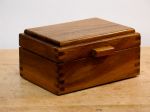
Dyed Plywood Box — Cutting the Sides

The last custom order I received from my Etsy store was one that involved primarily hand tool work.   The only power tools on it was preparing the rough stock for the dovetail joinery.  This latest order is almost a direct opposite as it will be primarily power tool work.  Each type of work has its own set of technicalities and procedures.  Whereas the success of the hand tool work relies, to a large extent, on my ability to control the tool being used machine tool work relies on how well I’m able to set the tool up to perform the work.

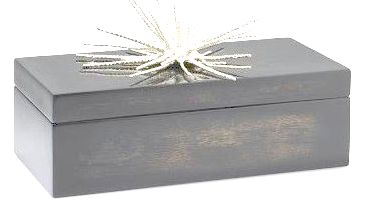
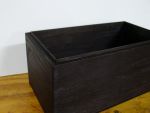
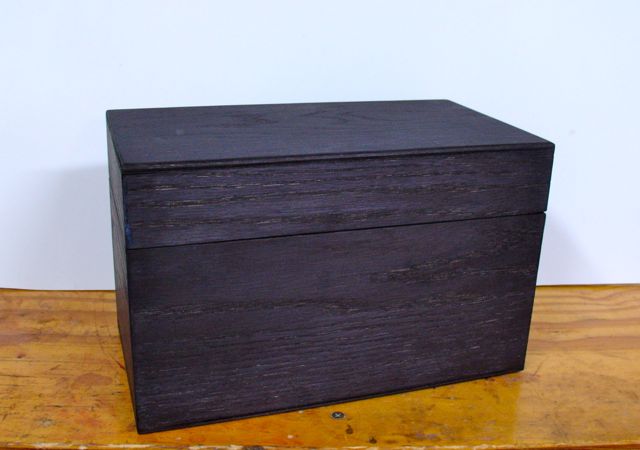
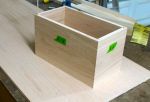
I mentioned this project briefly in a previous post, it’s a request for a black dyed box that will open similar to a shoe box.  Lucky for me, this client hasn’t been in a rush for it because I wanted to experiment a little to make sure I could produce what she wanted.  She had sent me a picture of what the box should look like along with the dimensions required.  I had some black dye that I used on one of Diane’s picture frames but wasn’t sure how it would work on the ply.  Well, to shorten up a long story I built an example, sent her the pictures, she approved of it and ordered the box.  Like I tend to do whenever I receive a custom order is to make several of them of various sizes to add to the stock on my store.  I’ve experimented with using Mixol universal tints with clear shellac and some of these boxes will be finished that way.  But first, all of the pieces needed to be cut to size.

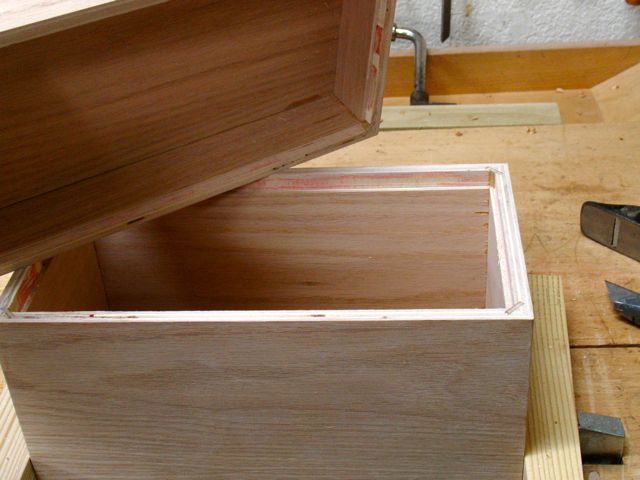
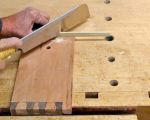
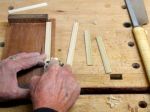
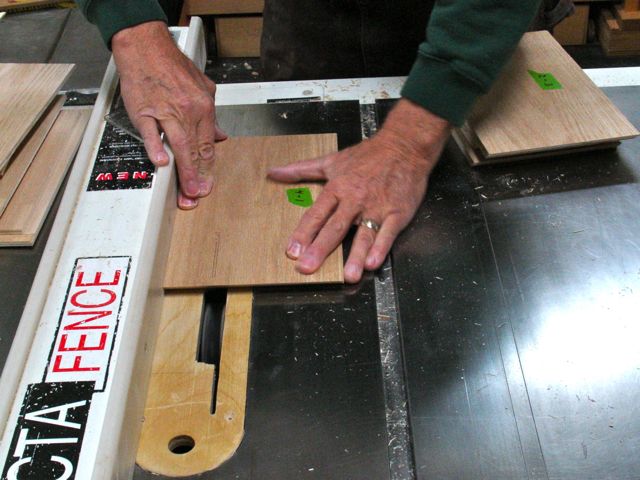
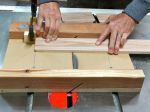
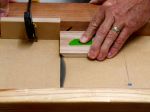
I’m using 1/2″ thick Oak plywood that is good both sides and has a plywood core.  I’ll be making an additional, six boxes besides the custom order one.  The process begins by cutting the plywood to the required width.  Next, a sled is used on the tablesaw with the blade tilted at exactly 45 degrees for cutting the pieces.  I’ve been using one of those electronic angle cubes to set the tilt on the blade and find it’s easier than using a combination square.  Here’s a tutorial set of photographs to illustrate my process:

There are a couple of things I’d like to point out.  First of all, as each piece is cut I lay it out in order so that when the box is assembled the grain direction of the face veneer will be continuous around the box.  After experimenting with various ways to mark them I’m finding that painters tape and a sharpie work best for me.  Pencil is okay but sometimes it’ll stay in the grain of the wood only to show up when the final finish is applied.  Grain will be an almost perfect match on three of the four corners with the last one being very close.  This sled set-up is one I’ve shown before but if you haven’t seen it the spacer block is the difference of the length between the long and short sides of the box.  As an example, if you were making a box measuring  5″ x 8″, the stop block would be set at 8″ and your spacer block would be 3″.  Works very well for me!

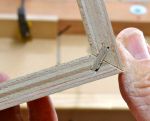
After all of the pieces are cut to length they need to have a kerf cut on the mitered edge to accept a spline.  I have some mahogany plywood that just happens to be the same thickness as the kerf made by a Tenryu blade — lucky me!  The stop block locates the position of the spline and the blade is adjusted so that it cuts about 1/4″ into the edge.  The splines measure 7/16″ wide which allows just enough room for glue and some adjustments if needed.

Next step will be cutting the pieces for the top and bottom of the boxes.  Here we’ll be using that L-Shaped fence on the tablesaw to cut rabbets all the way around them so you’ll be able to see how that works out.

Posted in Splined Miter Plywood, Tutorial, Types of Boxes | Tagged , , , , | 2 Comments

Applying Felt on Box Sides — not just the Bottom!

Applying Felt on Box Sides — not just the Bottom!.

Posted in Uncategorized | Leave a comment

Always Something to Learn!

One of the greatest things about working with your hands is that you can always find some new techniques to increase your skill set.  In the annual issue of Fine Woodworking’s Tools and Shops (the one that published my scrub plane, shameless plug!) there is an article by Bob Van Dyke featuring the L-Shaped fence for the table saw. Although I’ve seen these in use on rare occasion it wasn’t something I thought I’d need until now.  Here is a LINK to the article although you have to be a member of Fine Woodworking on-line to access it.  You could buy the Tool and Shop issue or check it out from your local library.

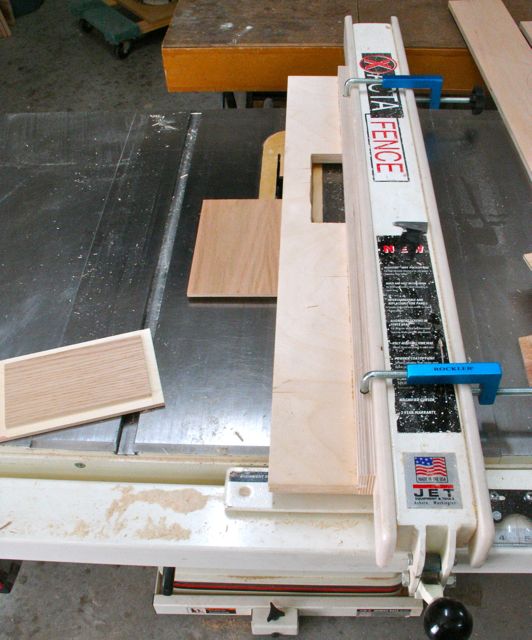
WooodworksbyJohn-L Fence- 1There are a number of things you can do with this, easy to make fence.  You’ve more than likely used a sacrificial piece on your rip fence when rabbeting a board — this is a way to have a permanent fence that won’t get destroyed.  Other uses are for tenons, squaring up a rough edge on a piece of raw stock by using a guide, and template work.  I just started a custom Etsy order that needs rabbets cut on the top and bottom pieces so I thought I’d give it a try.  This one is made of 3/4″ Baltic Birch plywood.  He used F-Clamps that fit into large holes drilled into the fence.  Since I have these Rockler fence clamps it was easier to simply drill 3/8″ holes and use them.  I cut a slight rabbet on the piece that is clamped to the fence to aid in registering the fence during glue up.  Five screws and glue is all that was needed.

The area cut over the blade is there so you can safely clear scraps as needed.  WoodworksbyJohn-L Fence-2I found that it also serves as a hand hold when you attach the pieces together. You can see there is a dado head installed which is set for a height of 1/4″.  In this photo you can see the underside of the piece that was rabbeted all the way around.  It was very easy to cut the rabbets using this L-Fence.  The custom order I have is for a plywood box that will be dyed black.  My client sent a photo of one from a catalog which is no longer available and asked if I could make it.  After some experimentation I think I can and will blog about it as work progresses.  It’s an opportunity too for me.  There is a series of boxes I’d like to try using tinted shellac on, an experiment that’s been on the back burner until now.

I truly wish I could share a project I recently completed but can’t!  Here in Las Vegas we have a group called the Sin City Woodworkers.  You can click that link to our latest newsletter from Novembers’ meeting.  We’ve been in existence for 5 years now so I’d say we’re well established.  We meet every third Wednesday of the month and for our annual Christmas party we have a contest.  The challenge is to see what you can make with a construction grade 2″ x 4″ x 8′ piece of material purchased from any “big box” store.  I just completed my project for the contest  but since the projects will be brought in anonymously for voting I can’t share what I’ve made with you at this time.  Wish I could though, pretty amazing that it started out as a $3.00 stick of wood!

Posted in Uncategorized | Tagged , , , , , | 2 Comments

Applying Felt on Box Sides — not just the Bottom!

Silver Arm Cuff Presentation Box Completed 11-20-2013

Silver Arm Cuff Presentation Box Completed 11-20-2013

Here is the completed presentation box I was commissioned to build through my Etsy store.  The wood is Monkeypod, dimensions are approximately 3 1/2″ deep and tall by 4 1/2″ long.  The finish is multiple coats of Platinum shellac rubbed out with wax.  The box is lined with 100% wool felt and is hinged with concealed brass pins.  Joinery is all hand cut and the project took about eight hours of actual work time.  I’m not considering all of the time developing this project and the many conversations I had with my client — all in all; a very satisfying experience.  Isn’t that what woodworking is all about?

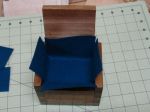
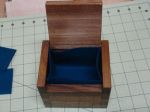
One of the requirements for this project was for every interior surface to be lined with felt.  This box is for a custom made, silver arm cuff which is under construction now.  This  arm cuff will slide down into the box and have minimal clearance all around creating a secure containment.  Lining the bottoms of boxes is pretty straight forward, simply cut a piece of mat board to fit and wrap with the fabric of your choice.  Usually this will be secured with some sort of adhesive (I prefer a spray) and then you’re done.  Bringing the material up to the sides was a different challenge and very little was found on the net so I’ve created this tutorial showing how I completed this task.
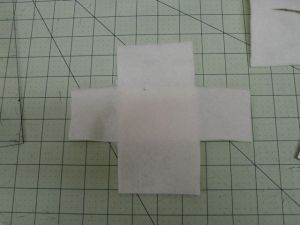
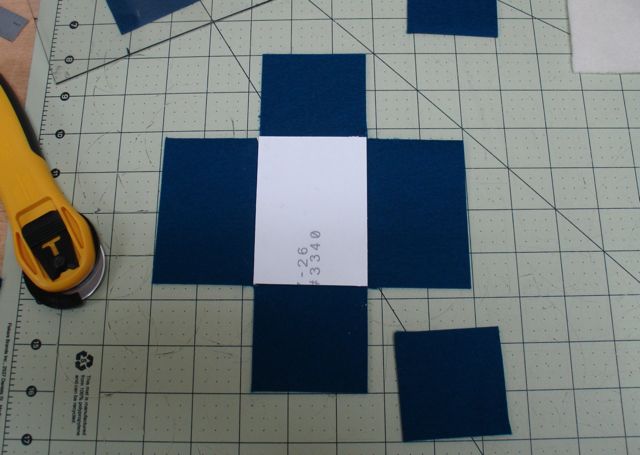
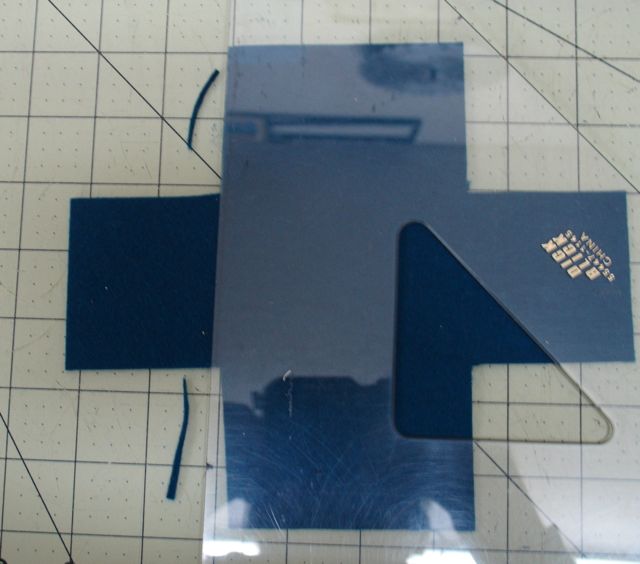
FeltLining-BoxSides-WoodworksbyJohn-1The felt I’m using is 100% wool and is superior to the synthetic variety you’ll find at most “big box” craft and fabric stores.  You can purchase this from FeltonTheFly who has an Etsy shop; here’s a LINK to her store.  When doing something new it’s always wise to start with a trial piece.  In this case some white felt from Hobby Lobby became my pattern piece.  You can see the general shape in this picture.
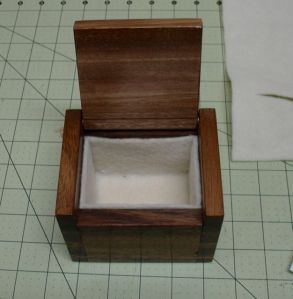
FeltLining-BoxSides-WoodworksbyJohn-2One thing that helps with this process is to use a cutting mat and a rotary cutter.  For most of my other work I use a box cutter and scrap of plywood to cut the material on but borrowed these from my wife.  The mat doesn’t dull the blade and the rotary cutter won’t pull on the materials.  When this is put into the box there was a lot of waffling as you can see.  This is solved with a piece of mat board cut to fit inside the bottom giving you some structure.


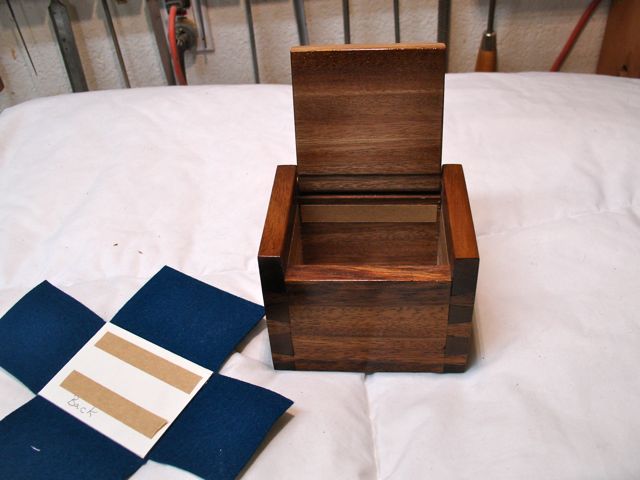
The mat board piece for the bottom should slide in and out of your box easily.  Unless you’re lucky you’ll be making a number of trial fittings so you want that to go in and out of the box without too much hassle.FeltLining-BoxSides-WoodworksbyJohn-3 Although the distance from the bottom of the box to the top edge is almost 2 3/8″, the felt needed to be about 1/8″ less.  The mat board is already attached to the felt with some double stick tape.  I’m using a Scotch brand product designed for the picture framing industry.  You don’t want to use the foam type or the product designed for scrap booking.
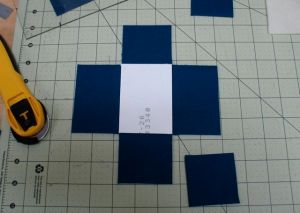
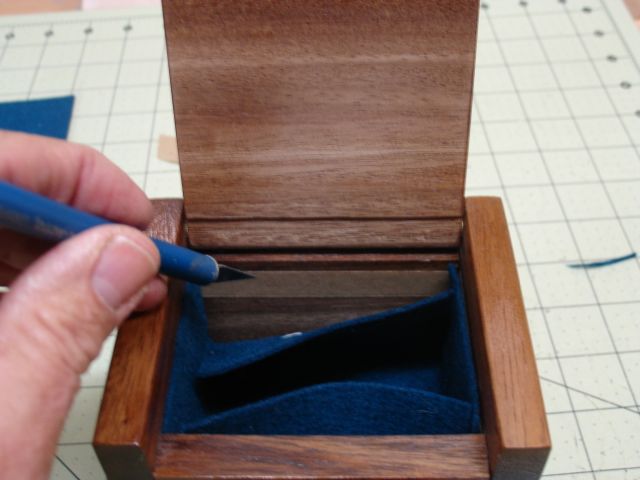
FeltLining-BoxSides-WoodworksbyJohn-6You’ll find that where the felt meets in the corners there  is too much material and it won’t lay flat. To solve this, cut a very slight wedge shaped piece from the felt.  My guess is that the exact amount you’ll need to remove will vary with the thickness of the felt.  It tapers to the top of the piece, you can see how thin of a piece needed to be removed for this project.  Here’s where that rotary cutter is ideal, using an X-axcto knife here just tears the fabric.  Trial and error, only the front and back pieces needed to be tapered for this project.FeltLining-BoxSides-WoodworksbyJohn-7Once the felt fit correctly, two pieces of the double back tape were applied to it.  You can see too, a line of tape applied to the inside of the box that is just slightly below the top edge of the felt.  Only remove the backing from the tape applied to the mat board as you begin to slide the piece in position.
After your felt is securely attached to the bottom of the box it’s time to do each side.  This box is pretty small so I wished my fingers weren’t so large!  Start by peeling the backing off of one side at at time and pressing the felt onto the tape.  There is a little bit of “wiggle room” since the felt and tape both have a bit of give.

FeltLining-BoxSides-WoodworksbyJohn-8If you press the tape firmly against the box sides, removing the backing is not a problem.  Work your way around the box, smoothing out any wrinkles as you go.  The final step to this was covering the underside of the lid.  Tape was placed around the perimeter of it and the backing removed one strip at a time to avoid any wrinkles.

Next thing you know — you’re done!

Posted in Hand Cut Dovetails, Silver Arm Cuff Presentation Box, Tutorial | Tagged , , , , , , , | 5 Comments

Down to the Wire

Arm Cuff Presentation Box -- Open

Arm Cuff Presentation Box — Open Approximate size is 4 1/2″ long by 3 1/2″ wide and 3 5/8″ tall.

Now that the shellac is fully cured I find myself wanting to post the pictures of this box so my client can see the progress that’s been made since the last blog.  Pictures will never replace seeing the real thing and holding it in his hands so this will just be a teaser!  There were five coats of shellac applied to the box on Saturday so tomorrow the finish will be cured sufficiently for rubbing out.  I use Liberon Black Bison wax along with a white Scotch-pad.  I find that the Scotch-pad is a better rubbing out medium than the 4/0, oil free steel wool I used in the past.  Even the best quality of steel wool will tend to shred and leave traces any where it can, that’s never a concern with the synthetic pads.
As you can see in the photos, the grain of the wood is continuous going around the corners of the box.  On close inspection you can even see it on the pins and tails.  As I mentioned in a previous blog, when you’re creating a box from a single board there’s no room for errors — no chance for the proverbial “do over” or “mulligan”!

Other than rubbing out the shellac finish the inside of this presentation box will be lined with a 100% wool felt.  There’s an Etsy store I use to get this called Felt on the Fly that I’ve used before for other projects.  She has an amazing array of colors, my client chose Peacock Blue for this.  The bottom, sides, and underside of the lid will be covered to protect the custom, silver arm cuff this box is designed for.  Hope my client will send me a photograph of how it all came together that I can put in my portfolio.

Posted in Hand Cut Dovetails, Silver Arm Cuff Presentation Box | Tagged , , , , , , | 1 Comment

Arm Cuff Presentation Box

Monkeypod-SilverArmCuff-CustomPresentationBox-WoodworksbyJohn

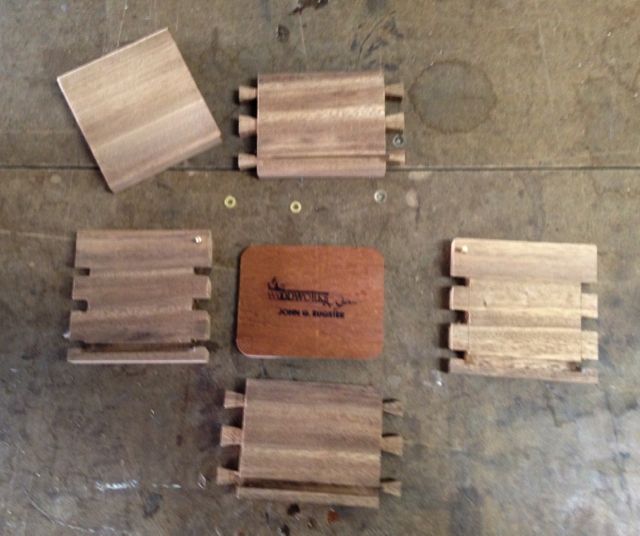
4 sides, a bottom and a lid, plus brass washers and pins — ready to go!

Very happy that the glue up for the presentation box went without a hitch.  Glue ups can tend to be stressful so careful planning is a must; especially for someone like me who’s been accused of even pre-worrying!  Here is a view of the pieces laid out.  You can see the two brass washers that’ll be installed between the lid and the side of the box.  The hinge pin is made of 3/16″ brass rod and is already installed in the two side pieces.

The trick with assembling a project like this is that everything has to come together all at the same time.  The procedure was to apply liquid hide glue to the pins of the back piece and the corresponding tails of the side pieces.  Next the washers were placed on the pins and the lid and bottom inserted in place as the joints were pushed together.  After that subassembly is almost put together the process is repeated with the pins/tails of the front of the box and things are quickly aligned, joints are bottomed out, checked for square, and then clamped to dry overnight.

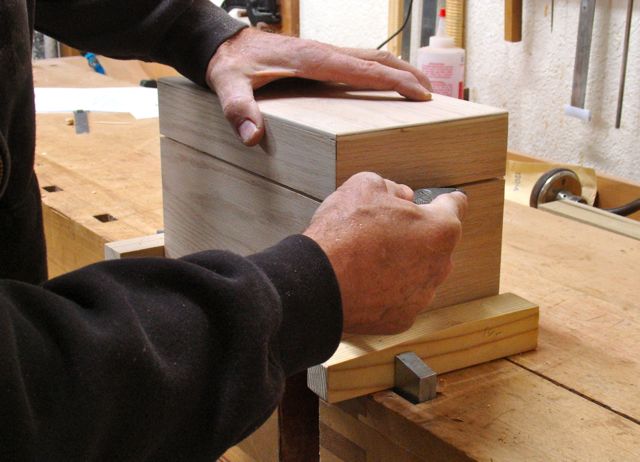
Here are a couple of pictures of the box along with the block plane I’ll be using tomorrow to level out the pins and tails.  Can’t wait to see the luster of the Monkeypod wood once it’s been prepared for the multiple coats of shellac followed by Liberon Black Bison Wax.  Although working with this material was challenging I think my client will be pleased with how the grain pattern of this box will shimmer.  Also received shipping notification that the 100% wool felt is now in Salt Lake City so it should arrive here on Monday.

Posted in Hand Cut Dovetails, Silver Arm Cuff Presentation Box | Tagged , , , | Leave a comment

Walnut & Monkeypod Finger-jointed boxes Done

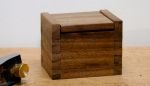
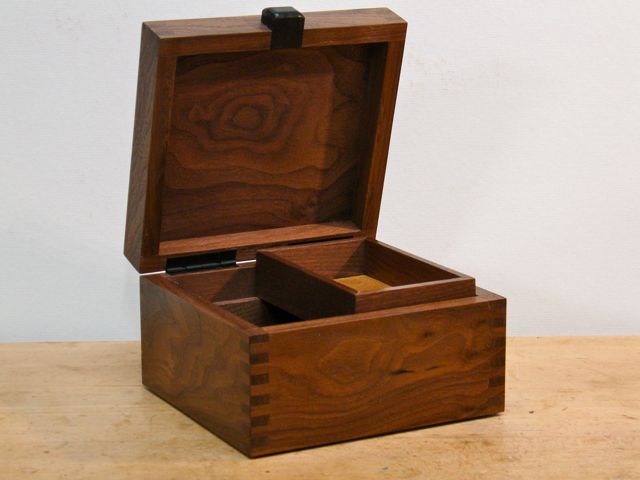
Black Walnut with Ebony lid lift and a sliding tray.

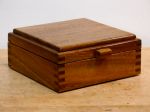
Black Walnut with Ebony lid lift and a sliding tray.

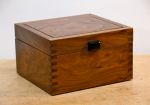
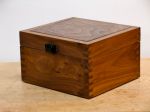
After working on this series of boxes they were completed this morning.  The Walnut one with the sliding tray is a custom order and what will make this a different experience from the usual Etsy sale is that this will be hand delivered!  The client is from a neighboring town so we’ll meet at a central Starbucks to make the delivery.  It’ll be interesting to see his reaction first hand rather than through a followup email which is the best we can expect when doing mail order.  Here are some photographs I took of it to show the grain and beauty of the wood.  The finish is shellac and Liberon wax.

At the same time this order was made, two additional boxes were made of Monkeypod wood.  This way machine set-ups can be used for more than one project to be efficient. This is a tricky wood to work with due to it’s rather coarse, interlocked grain but I think they turned out okay.  I experimented with a different style of floating panel lid and think it turned out well.  It does make the box and lid a bit heavier since it uses 3/4″ thick material rather than the 1/2″ thick used everywhere else.  Same finish as the Walnut box and these have the inside bottoms lined with ultra suede.  One is about 6″ square, the other about 4″ x 6″.  I’ll need to take better photographs of them before I list them on the Etsy store.

Posted in Finger Joint Box, Types of Boxes | Tagged , , , , | Leave a comment

Monkeypod Wood + Dovetails = Challenge

WoodworksbyJohn-CustomFurniture-LasVegas-MonkeypodBox-Dovetails-The thing I’ve always enjoyed about my career choices, whether it was teaching or woodworking, is that there is always a challenge.  I may have taught the same subject hundreds of times but because there was a different student the approach will change.  Looking at woodworking in that light it’s the same — I may have cut hundreds of dovetails but because each piece of wood is as individual as my students were, the approach had to change.  Saying all of that leads up to the current project that is being built of Monkeypod wood.  The picture of the almost dialed in joints is shown at the left.  Experience tells me that the more showy and beautiful the grain is on a piece of wood, the challenge of working it seems to increase proportionately!  Case in point, those two light colored streaks near the bottom of the box have the grain reversing the direction of the surrounding wood.  Add to that the coarse grain of the Monkeypod and that makes achieving a smooth cut somewhat difficult.  The plan is to once more, hone the chisels and work shoulders to achieve the best possible joint.

Tails First:

Yesterday saw the tails being laid out and cut.  I’m a “tails first” dovetailer and knowing that the wood may be challenging required taking time figuring out the best layout.  I settled for two fairly narrow tails at the top and bottom with a slightly wider one centered in the width of the board.  Here is a photo essay to illustrate my dovetail method.

Then the pins:

Here is montage of pictures showing the process I went through to cut the pin boards for this project.  You’ve probably noticed a lot of green masking tape on all of the boards.  This seems to be the most efficient way to mark them so they will be worked and assembled in the right sequence.  I’ve used pencil and chalk in the past but it can smudge and even become hard to remove.  For mortise and tenon joinery I like using machinists letter stamps to permanently  mark the wood on the inside of the joinery where it won’t show once it’s assembled.

The next phase of the project is selecting just the right piece of wood for the lid which will be hinged using hidden brass pins.  This means a lot of trial and error during the fitting process but my plan is to use pieces of plywood that is the same size as the box front and back pieces to avoid having to assemble and re-assemble the dovetailed parts. Don’t want to risk damaging them.

Posted in Hand Cut Dovetails, Silver Arm Cuff Presentation Box, Tutorial, Types of Boxes | Tagged , , , , , | Leave a comment

Silver Arm Cuff Presentation Box

I’ve been very fortunate by having a fairly steady stream of custom requests from the Etsy store.  The Walnut box is almost done, just needs the finishing steps.  I have one request for a type of box that can best be described as a wooden shoe box that needs to be either stained or dyed (my preference) black.  There isn’t a time frame on that unless you call sometime within the next 6 months a time frame!

The more pressing request from the Etsy site is for a small, dovetailed presentation box.  It will be used to safeguard a custom made, silver arm cuff.  I’m known for being somewhat of a dinosaur when it comes to my technology and of course, my love of hand work.  I am amazed though at what we can do via the internet.  This client and I have had about 15 conversations through Etsy.  During that time, he’s sent me photographs and I; in turn, have sent him sketches of my design proposal.  Think of how long this would have taken to do with “snail mail” considering that he lives a couple of states away!  We were able to finalize the design and have the project paid for in a matter of two weeks  — amazing to say the least!

The cuff is going to be 2″ tall and arm shaped; oval like 2″ x 3″.  We explored several designs and the final choice is for a box that will completely contain the cuff.  It’ll be lined with 100% wool felt in a Peacock Blue that will really play off the silver and the almost iridescent quality of the Monkeypod wood we’re using.  Monkey Pod or Monkeypod wood comes from Central America and has some of the appearance and working characteristics of Mahogany or Koa.  I had ordered some from Woodworkers Source a while ago to make boxes from.  Years ago I used this species of wood for an easel and a picture frame and loved the coloration and grain.  I was sent two, very different boards this time and was a little disappointed with one.  The other, however, had the iridescent streaking my client mentioned were something he’d like to see.

ArmCuffBox-WoodworksbyJohn-CustomWood-LasVegas-1

Size of finished box will be 3 1/2″ x 4 1/2″ with a height of 3 1/2″

The first order of the day was selecting the wood and carefully cutting it to the needed sizes.  As always, they are marked in the order that they were cut so the grain pattern flows around the box.  The lid will be similar to the lidded finger joint boxes and pivot on a hidden hinge pin.

Stanley 140 trick with dado head and miter gauge.

Stanley 140 trick with dado head and miter gauge.

If you’re familiar with the Stanley 140 trick I’ve mentioned a time or two when cutting dovetails, it’s a technique I really like to use.  Not having a set of skewed block planes I generally do this by placing the board vertical against the rip fence.  Remember the wooden shoe box custom order?  Well, for that I need to cut a dado and planned the work so the dado head would be in the tablesaw when I needed  to cut the slight rabbet for  the 140 trick.  Although it looks kind of awkward using the stop block and miter gauge did a good job.

Practice dovetail and box parts.Next up was to practice on the wood to see how well it would react to the dovetail saw and chisels as I worked on the joinery.  I mentioned that I was disappointed with the other piece, it tore out and was splintery when machining the finger joints so I was a little apprehensive now that I’d committed to dovetails for this project.  My students are advised to do some warmup exercises prior to cutting joints on their projects and this was an instance where I though it best to follow my own advise.  The Monkeypod wood cooperated nicely!  I’ll want to hone the chisels after figuring out a pleasing layout and do the work when I’m fresh.  The picture gives you an idea of the over-all look of the box and the practice dovetail is about 3/16″ at the narrowest part of the tail.

Time to call it a night and dream about possible layouts for the joinery!

Posted in Hand Cut Dovetails, Silver Arm Cuff Presentation Box, Types of Boxes | Tagged , , , , , , | Leave a comment

Monkeypod Wood and a Lid Lift

WoodworksbyJohn-LasVegas-LidLift-Monkeypod-6Thought I’d give a short tutorial on making and installing a simple lid lift in a box lid.  These are the two additional finger jointed boxes I’m making while finishing up the custom Walnut one.  Trying a new style of floating panel lid with them, any suggestions for a name?  It’s a double round over but that seems a little long — roll top box?  Open for  any suggestions you may have out there.  Thought I’d be different and put a long lift on one and a short one on the other.

WoodworksbyJohn-LasVegas-LidLift-Monkeypod-1Rather than doing a lift of a different wood like on the Walnut box (Ebony lift), these are made from a piece of the same wood as the boxes.  It begins by creating a radius on the board with a block plane and then cutting a rabbet on the side.  A little bit of sanding to refine the shape and then the piece is cut to length.

Here’s a gallery of photos showing what happens after that:

I prefer using the router plane to establish the depth.  You can see the penciled in lines marking the width of the lift so it’s easier to control the router plane than it is to control a marking knife.  I’m finding that the Monkeypod is a little hard to cut cleanly which has me concerned.  I just took on a custom order for a small box made out of it that needs to have some small dovetail joinery.  What’s life without a challenge or two?

Posted in Tutorial | Tagged , , | Leave a comment