Walnut Box Sliding Tray and Miscellaneous

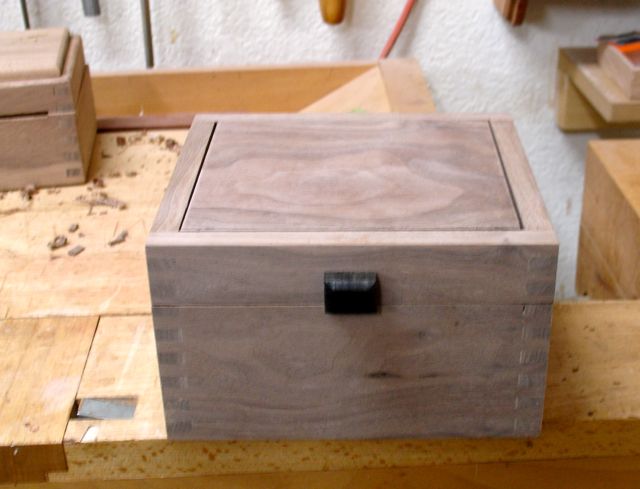
Walnut:EbonyHere is the first view of the box with the Ebony lid lift in place.  There was an entire sequence of pictures taken to illustrate the process that went into not only forming this lift but also showing the progress of the box’s hinge installation and separation of the lid from the rest of the box.  Not sure what happened but I believe something corrupted the memory card; when I plugged it into the computer to download there was a message stating it was unrecognizable format!  Same thing occurred when we tried it in my wife’s computer so it has to be the card.  Luckily I have a spare.

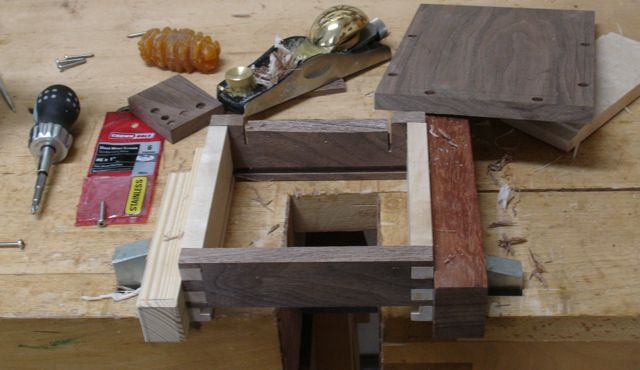
The process of cutting the mortise for the lid lift and cutting it out of my last remaining piece of Ebony is pretty interesting.  It involves the use of dovetail saws, chisels, and the old Stanley #271 router plane.  If you’re interested in seeing the process I’ll give you this LINK to a previous blog about that.  It is “old school” but so much nicer than a noisy, dust creating router!

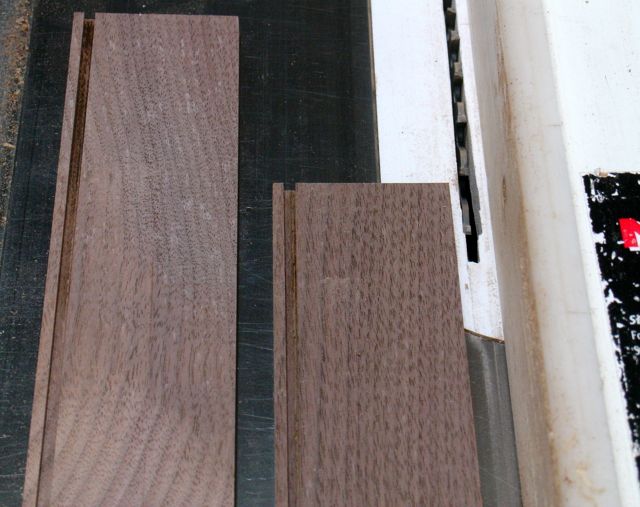
SlidingTray-InsideOut-WoodworksbyJohn-1As you can tell, the box is getting closer to completion.  My client is real appreciative of what he refers to as my “old school” style of craftsmanship that I put into all of my work.  Usually the bottoms of my boxes will have a hardwood plywood that is lined with ultra suede.  He asked for solid wood so no problem.  This box will feature a sliding tray so I wondered if he’d be okay with a thin, plywood bottom for that.  After building up my ego by telling me he really likes my work and blog so far he requested that maybe a solid bottom of a subltly contrasting wood could be used instead.  How can you say no to that!  I had a thin piece of Alder (aka poor man’s Cherry) that I thought would be a good candidate for the bottom piece.  Essentially,  this sliding tray was built from the inside out.  We have an inside requirement of approximately 3″ x 5″ and the request was for a depth of 1″.  Work began by cutting a groove in the bottom of some 1/4″ Walnut that’ll be used for the sides.  Two passes were made with a combination blade to get the needed size.  Next, I measured up 1″ from the top of that groove to establish the width of the tray sides.  They were then mitered to make the tray.

Rabbeting on the tablesaw, kind of small but I'm careful!

Rabbeting on the tablesaw, kind of small but I’m careful!

Dry fit of bottom into the tray.

Dry fit of bottom into the tray.

This was followed by sizing the Alder piece to allow for any expansion/contraction of it.  Chances are that with a piece of wood this small that humidity changes won’t be an issue but why not build it as if it were.  To rabbet the bottom I used the tablesaw and rip fence to carefully remove the material.  As always, the end grain is cut first so that any tear out will be removed when the edges are cut.  Things worked out well as you can see in the dry fit picture.

SlidingTray-InsideOut-WoodworksbyJohn-4

A small, mitered tray or box like this is the ideal place to use packaging tape to apply clamping pressure during assembly.  After the pieces are sanded they are laid out in sequence on the tape with their ends touching one and other.  Glue is applied to the miters and you fold the pieces together while putting the bottom into the groove.  It’s then a matter of checking the corners for square and applying tape tightly to them and waiting for the glue to dry!

All done!

All done!

Posted in Current Commission, Finger Joint Box, Types of Boxes | Tagged , , , , , , | 1 Comment

Assembled but Still a Ways to Go!

WalnutBox-EtsyCommission-AssembledAssembling projects is always a stressful time and I believe most woodworkers tend to agree with me about that.  Think about it; all of your work and effort up to this point can be ruined with one bad assembly error!  Although it’s wise to make several dry fits to rehearse the process, label everything, lay out the pieces in sequence, check your clamps, and all of the other things you do to make the process go smoothly there is always the chance of something going amiss.  Thankfully, that didn’t happen this morning.  I know I tend to stress a bit (okay Diane — a lot) but I suppose that’s my nature.  I use Old Brown Glue which is a liquid hide glue which I’ve mentioned before as being my glue of choice since it has a longer open time and, unlike PVA glues; doesn’t swell the fibers of the wood making assembly difficult.  I’ll leave the clamps on overnight to ensure a good bond.

WalnutBox-EtsyCommission-DatedMy client has expressed an interest in wood and the craftsmanship of having a custom box made so I thought it’s only fitting to have a solid, wooden bottom for his project.  Usually I’ll use plywood for that and line it with ultra suede.  This box has a 1/4″ thick piece of solid Walnut for the bottom.  In one of our conversations he asked about dating and signing it with a fine marker.  I always burn my logo into my work but to this one I added a stamped in date.  That’s what I use for picture frames and the trick I’ve found for keeping the letter stamps aligned is to tape down a piece of 1/4″ graph paper and stamp directly onto it.

WalnutBox-EtsyCommission-Stanley101The top of the lid panel needed to be chamfered ever so slightly.  For this I like to use an antique Stanley #101 plane that came from England.  Adam went there with his Dad and brought it back for me when he was in his early teens.  It’s stamped Stanley Rule & Level and since the lever cap isn’t painted red it was made prior to 1941.  It’s the perfect little tool for this type of work.


WalnutBox-EtsyCommission-CardScraperThe final step before assembly was to take a card scraper to the top to smooth it out and highlight the beauty of this piece of Walnut.  Now that the box is glued up I’ve been checking every hour or so to make sure the panel doesn’t accidentally get glued into the frame.  My client mentioned that he may have a future move to Kentucky and with the humidity there it needs to move to prevent splitting.  The bottom piece has the same concerns.

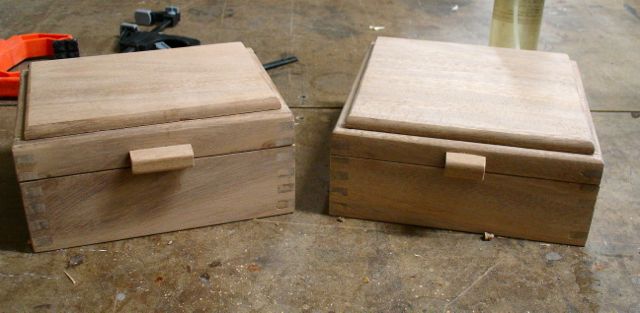
In the meantime I’m continuing to work on the other two finger jointed boxes of Monkeypod wood.  In one of Doug Stowe’s books he shows a floating panel lid made of 3/4″ thick material that extends above the box sides rather than being contained by it.  I’m going to experiment with that design on these boxes.  After cutting the grooves all the way around the panel, the outside edges were radiused.  When I did a dry fit I thought it would look better to have the top of the box radiused as well so did that on the router table too.

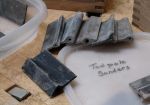
Many woodworkers I’ve talked to are unaware of these tadpole sanding blocks.  I started to use them on picture frames where you have different profiles or coves, V’s, reeds, etc.  Using this type of sanding block on profiles helps you maintain their shape instead of flattening it out.  They’re available from many places, I got this set from Klingspoor  Woodworking Shop.

Posted in Current Commission, Finger Joint Box | Tagged , , , , , , | Leave a comment

Walnut + Finger-Joints + Etsy = Custom Work

Just as I sent the latest project off to Oregon (antique victorian bookstore bell mount)  I received notification from Etsy that there was a request for a custom item.  For those of you that may not be familiar with Etsy, here’s a LINK and an invitation from me to check it out!  It is a huge, on-line website that features the work of individual artists and crafts people like me and my wife.  The work needs to be completed by the artist; in other words, it’s not the mass produced and usually imported stuff that seems to make up the bulk of things we buy.  It’s a fantastic website to find one of a kind gifts and unique items you probably won’t find anywhere else.  You can search for all sorts of items with the many categories they are classified in.  Many of the people on Etsy, like myself, also offer custom work.  I’ve had requests for a variety of items ranging from a custom game box, a flute case, and cremation boxes.  Personally speaking, it keeps me in the shop, feeds my wood addiction, and fulfills my days by allowing me to do what I love to do anyway and make it self supporting.

CustomWalnutBox-FingerJoints-WoodworksbyJohn-1Whereas the last commission was the Victorian Bell Mount and was primarily all hand work with its dovetail joinery, this request is for a finger jointed box of a specific size made of Walnut.  The picture shows it “in progress” with the finger joints cut and the wood selected for the lid.  This client had seen the Rustic Pine Box on the Etsy site and although he liked the over-all appearance was wondering if I had anything like it in a darker wood and a specific size.  Lucky for him (and me!) I had just enough of the Walnut left over from the bell project to fulfill his request.  We had to go slightly smaller than his original request but were able to add a sliding tray to accommodate the items he wants to use the box for.  Another positive is that he’s essentially local so once the item is complete we’ll meet somewhere between our locations and save him the cost of shipping.

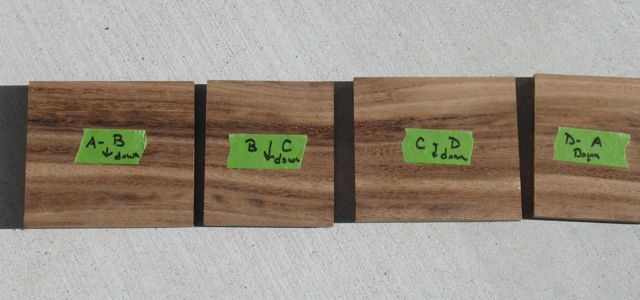
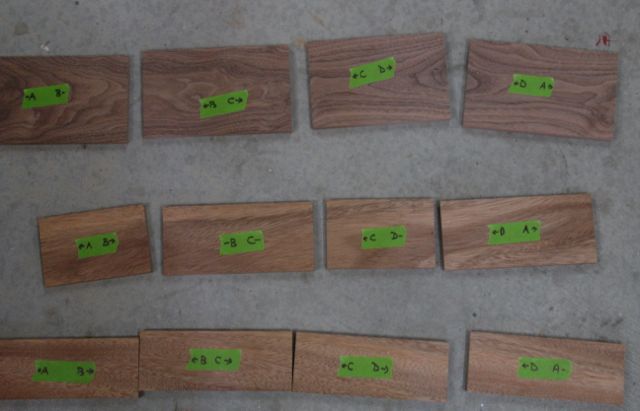
Whenever you make boxes it’s a plus if you have a single board to cut all of the box pieces out.  This will give you the best possible design if you cut your pieces in sequence. When the box is assembled the grain pattern of the wood will be continuous around three of the edges which is pleasing to the eye.  I had some Monkeypod wood that I wanted to use for some boxes as well so in keeping with my multiple boxes to optimize work time concept am making two from that material.  I also want to experiment with a different style of floating panel lid so this is a good opportunity for that.

WoodworksbyJohn-TablesawSled-FingerJoint

Finger joint jig with 1/2″ spacer

The process begins by first cutting the wood to the required width.  These will be 1/4″ finger joints and the general practice is to have an odd number of them for your box.  When you do that you’ll have a full length finger at the top and bottom of your piece.  To cut the pieces I use a sled on the tablesaw with a stop block set for the longest side of the box, in this case 7″.  Since the shorter side of this box is 6 1/2″ it made sense to use a 1/2″ setup block as the spacer, that’s the black block at the left by the stop block in the picture .  One of the other boxes I’ll make measures 6″ x 8″ so for that one I’ll use a 2″ wide scrap for a spacer.  It’s important to keep the pieces in sequence as you cut them — I tend to label them on their outer, show surface with tape and a sharpie so as not to get confused.  Pencil is harder to see and gets smudged plus it can be a hassle to get out of the grain of the wood.  Here you see them ready for the next step, the Walnut box is the boards at the top of the photo.

CustomWalnutBox-FingerJoints-WoodworksbyJohn-3

Pieces laid out in sequence to maintain the grain pattern

Now it’s time to cut the finger joints.  For this I use a Freud Box Joint Cutter Set which cuts perfectly square joints unlike a dado head that tends to leave a slight V at the outer edges of the joint.  Combined with a jig the work progresses fairly quickly.  I lucked out and only needed to make 2 slight adjustments to get the accuracy I wanted.

CustomWalnutBox-FingerJoints-WoodworksbyJohn-4

Trial cut for the finger joints

There is very little to complain about when using this set up other than a sore back from being hunched over the tablesaw!  There’s always a little bit of fine tuning the joinery but much quicker and easier than cutting all of the fingers by hand!  Having done that in the past you can take my word for the efficiency of this setup.  I believe adjustments are needed when the wood may be forced up a little during the cut because it wasn’t held securely or maybe it wasn’t tight against the jig.  In any case, I’ll save those hand cut joints for larger scale joinery.

Next up will be cutting the slots for the top and bottom, forming the raised panel inserts for the lid, and planing all of the surfaces prior to assembly.

Posted in Finger Joint Box, Tutorial, Types of Boxes, Uncategorized | Tagged , , , , , , | 1 Comment

From Sketch-Up to Reality

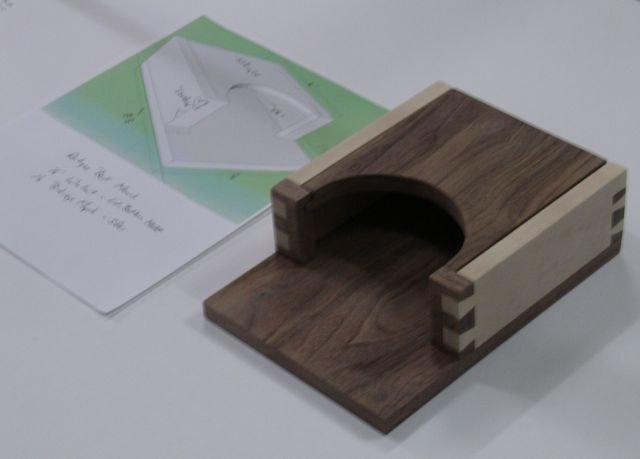
VictorianBookshopBell-WoodworksbyJohn-CustomFurniture-LasVegas-1Here’s what the final project looks like before my client applies the finish to it.  It’s always a fulfilling moment when you complete your work and it actually looks like it was envisioned either in your mind, on paper, or both.  In this case, the Sketch-Up drawing was given to me by my client along with written communication of his concept.  I think the results are just what he had in mind.

WoodworkbyJohnHere’s another view of the completed work from the side.  The bell mechanism will be screwed to the bottom piece after the entire assembly is attached to the house.  There will be some electronics and wiring that the sliding cover will conceal.  The radiused section of the lid faces down.


VictorianBookshopBell-WoodworksbyJohn-CustomFurniture-LasVegas-2

Getting to this stage required some finesse; trimming the assembled box to make sure it was as square and flat as possible before attaching it to the mounting board.  Then the holes for the stainless steel screws were carefully located and counter-bored on the back side of the mounting board.  These are somewhat over-sized to allow for any wood movement.  I always use beeswax to lubricate the screw.  Glue was applied in a few spots and the screws were cinched down tightly in an alternating pattern.  After the glue was fully cured they were backed off a bit to allow for any wood movement.

This was truly an enjoyable project, one I referred to as a “head scratcher” on a few occasions!  That’s the challenge of it all though, creating something totally unique that has you thinking all of the time — I suppose that’s what the saying “outside of the box” really means.  You may recall that to maintain the integrity of the assembled box I pre-cut the opening at the bottom before gluing it together.  Here’s how its removal was handled:

The lid was obviously left intact for the initial fitting into the grooves.  Where it sets into the bottom groove required about a 3/4″ radius which is achieved with a file.  The larger 2 1/8″ radius on the lid was carefully cut on the scroll saw then filed and sanded smooth. I wanted the lid to slide in easily, once the entire unit is mounted on the house it will probably be opened rarely.  The overall goal of the design was for there to be access to the electronics plus have a way to secure it to the house.  With this sliding lid design that goal has been met.

I was able to wrap this package up and send it off to Oregon by noon today — anxious to see how my client feels about the way it’s turned out.

Posted in Antique Victorian Bookshop Bell, Current Commission, Hand Cut Dovetails, Types of Boxes | Tagged | 2 Comments

Victorian Bell Mount Continued

Well, this project will go down as one that really had me thinking things through even more thoroughly than usual.  I tend to be very detail oriented and have been told I even pre-worry about things — guess that explains my bald head!  In my last post I mentioned how sliding lid boxes generally have the lid groove in the pin board but this one has it located in the tail boards.  Figured that one out but today’s wrinkle is having to cut the center out of the bottom board to allow access for the bell mount.

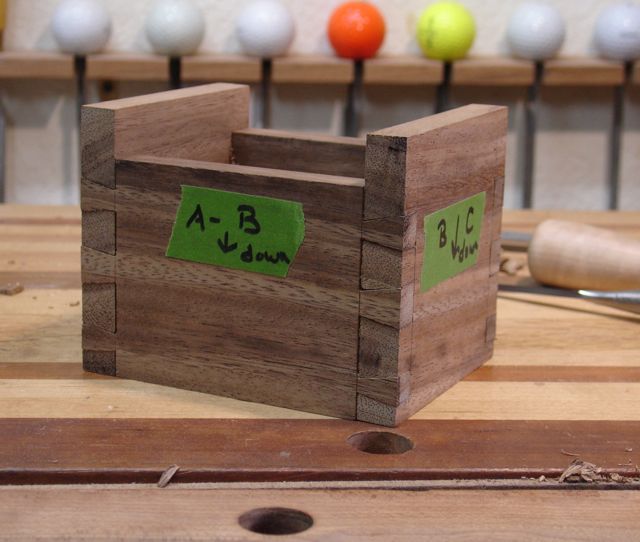
VictorianBookSellers-AntiqueBell-1Let’s talk about today’s progress.  I’d like to keep working on the project but am forcing myself to let the glue dry the 24 hours the directions call for.  You’ll understand my wanting to have the optimum strength as you read through the post.  The first step was to cut the groove for the sliding lid.  I love using Lee Valley’s Box Slotting Bit to cut the groove for box bottoms and lids, it simplifies the process.  It’s a matter of clamping the box together and running the bit on the inside of the box.  I generally do it in two passes.  Notice all of the markings on the tape to identify the proper sides.  I wanted to be certain of the orientation of each of the parts.

VictorianBookSellers-AntiqueBell-2The lid will slide in from the top of the box so after cutting the slot, I used the slot location to trim the Walnut piece with a saw.  This is followed by carefully planing to the required width without planing on the finger joint.  Notice I even wrote “cut off” with a sharpie to keep myself organized.


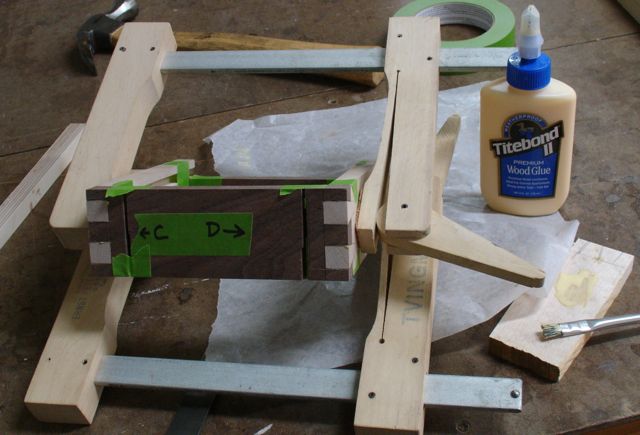
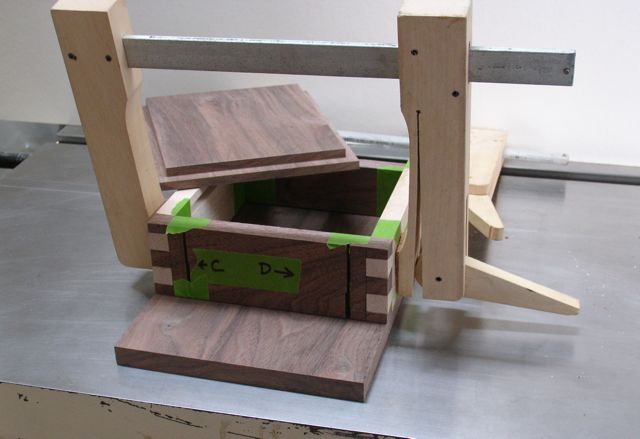
VictorianBookSellers-AntiqueBell-3Now it was time to assemble the box.  Generally speaking, liquid hide glue is my glue of choice for dovetails and finger joints.  It has a longer open time and does not cause the wood to swell up making assembly difficult.  However; this box is going outside so an exterior rated glue is called for.  To make the glue easier to work with I heated it to reduce the viscosity just as you do with the liquid hide and it worked!  The glue spread on easily and the joint went together without a fight.  Look close, see that cut line about 1″ in from each edge on the Walnut piece?  That was yet another concern.  The piece labeled C-D will be the bottom of the box and the area between those partially cut lines will be removed after everything is assembled.  I figured I need the strength of that piece to clamp everything securely so partially cut through to guide a dovetail saw after all is in place.

VictorianBookSellers-AntiqueBell-4I’ll need to fine tune the slot and the lid but I was able to cut the lid to rough size.  As much as I’d like to do that today it’s wiser to wait for the glue to cure completely.  The sliding lid will have a half circle with a radius of 2 1/8″ cut from the bottom of it to show off the beautiful casting of the bell.  It’s placed on the piece of Walnut that will be the mounting board.

I’ve been thinking about the best way to mount the box to the board.  As you can see, there is very little area at the bottom after the center is cut out.  The dovetails are tight so I’m thinking it’ll be safest to not put any screws into the short piece of Walnut that will remain.  Another consideration is wood movement, not a problem here in the desert with single digit humidity but this is going to Oregon which is known for its rainfall.  I’ve decided to go with stainless steel, sheet metal screws in oversized holes.  Why sheet metal rather than brass wood screws?  There’s no taper with them so I’ll eliminate the possible risk of the 1/2″ thick side splitting as the screw is turned in.  I’ve had that happen even when using a tapered drill bit.  The oversized hole will allow for some wood movement and with a sparse amount of glue should eliminate the possibility of the mounting board splitting.  Of course, it is wood and will have a mind of its own but hopefully this design will give my client years of enjoyment.

Posted in Antique Victorian Bookshop Bell, Hand Cut Dovetails, Sliding Lid Box | Tagged , , | Leave a comment

Antique Victorian Bell Commission

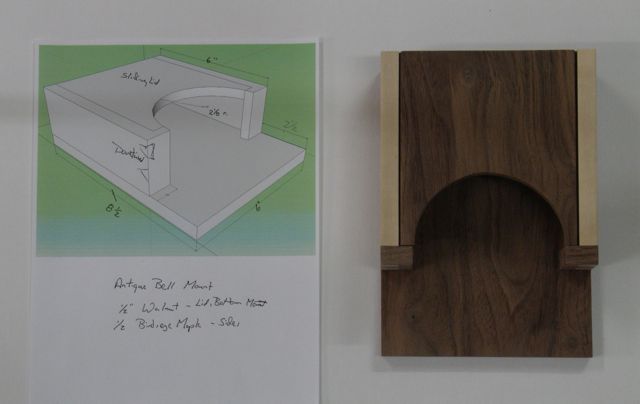
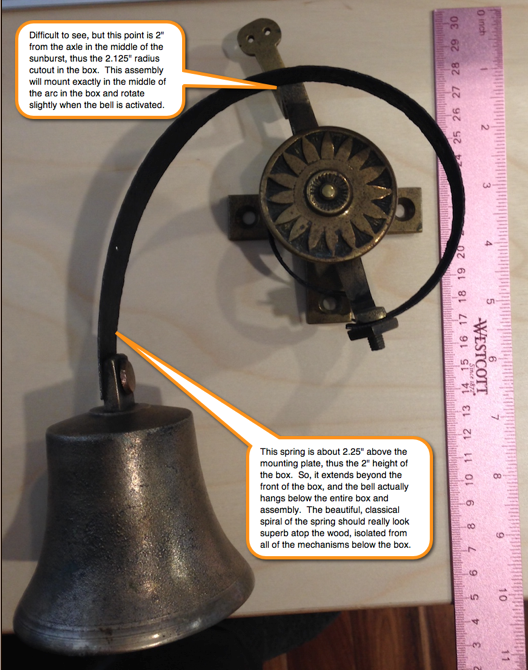
Screen Shot 2013-10-26 at 7.13.09 AMI love getting projects that are interesting and challenge my woodworking skills.  This is a picture of an antique, Victorian book store bell that will be going on a restored, 110 year old farmhouse in Oregon.  A man found me via the Etsy store and after a dozen or so conversations back and forth he went ahead and ordered the box for this bell from me.  I’ve always been detail oriented so that’s why it’ll take a number of communications back and forth before the  piece is ordered.  This client provided   sketch up drawings he made plus the picture you see on the left.  The box will be dovetailed and made of some figured Maple and also Walnut.

The way he’s designed it is that the beautiful cast bronze/brass mounting will be attached in the Walnut box.  It will be partially concealed by a lid that will have a radius cut out of it to hide the electronics he’ll install but still show off the antique casting.  The bell is mounted on a 2″+ tab so the spring that connects the two will be proud of the box.  The way I understand it, when someone rings the bell it will trigger the electronics so you can hear a door bell chime in the house.  I’ve been told I’m a dinosaur when it comes to technology because I really enjoy the traditional, hand  wood working techniques but I must admit it was pretty cool to be able to put his address into a Google map and see the actual house this bell is going on!

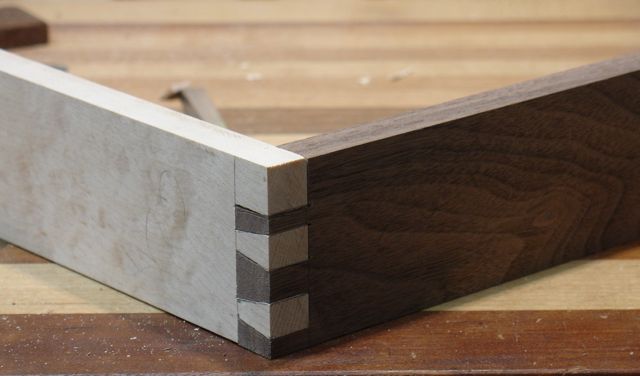
He was inspired by my Tails Around the Corner box on the Etsy store.  He liked the combination of Walnut and Quarter Sawn Sycamore.  As I mentioned this box will have a sliding lid and that had me scratching my head a bit!  Usually a dovetailed box with sliding lid will have the groove for the lid cut into the pin board.  For this project I knew his focus was being able to see the dovetails from the side so that meant the groove needs to be in the tail board instead.  After some sketching and experimentation I came up with the solution.  Instead of having a half pin this will have a “half-stub” to house the groove for the lid.  WoodworksbyJohn-CustomWoodworker-BookstoreBell-2Here’s a tutorial showing my method of cutting dovetails by hand.  When ever possible I cut both tail boards at the same time.  I clamp them together firmly after scribing the thickness of the work on it and lay out the tails.  You can see what I mean by a “half-stub” at the left of the boards.

WoodworksbyJohn-CustomWoodworker-BookstoreBell-3

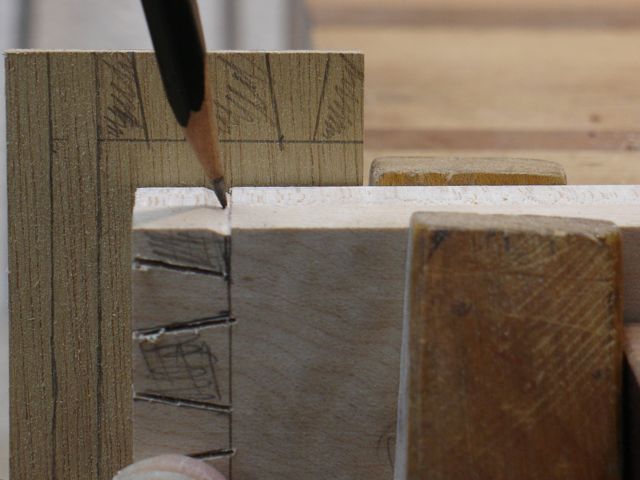
After sawing the cuts the piece at the right side was removed.  It’s a good practice to first cut a little wedge with a chisel before using your crosscut saw.  You’ll find it’s easier to not only start the saw but also to follow the line.  The pencil is pointing to that wedge, behind it is my trial lay out.  Always mark the piece of wood that is to be removed — I’ll admit to a time or two I thought I had that figured out and removed the wrong part!

WoodworksbyJohn-CustomWoodworker-BookstoreBell-4Next up is to remove the remainder of the waste, I follow the same procedure by making that wedge cut at the scribed line.  After doing that to one side, the board is flipped over and the rest of the wood is removed.

WoodworksbyJohn-CustomWoodworker-BookstoreBell-5The tails were transferred to the pin board and cut to match.  I give myself a safety net  by leaving the board way longer than it needs to be when cutting the first ends.  This way I can simply cut it off should I make an error.  God was guiding my hands and the joints came out the way they should.  Once one corner is done then the piece was cut to the required length (6″) and the other side was cut — no more safety net now!  This piece of Walnut will be the top of the box.  It’ll be trimmed to the bottom of that “half-stub” I mentioned earlier.  The lid slides into the groove that will be cut into the Maple sides.  Both of these pieces are cut and fit, next up is the joinery on the bottom of the box.  This will consist of a pair of tails with traditional half tails rather than the half-stubs!

Posted in Antique Victorian Bookshop Bell, Current Commission, Hand Cut Dovetails, Tutorial | Tagged , , , , , | Leave a comment

Scrub Plane in Fine Woodworking Magazine

ScrubPlane

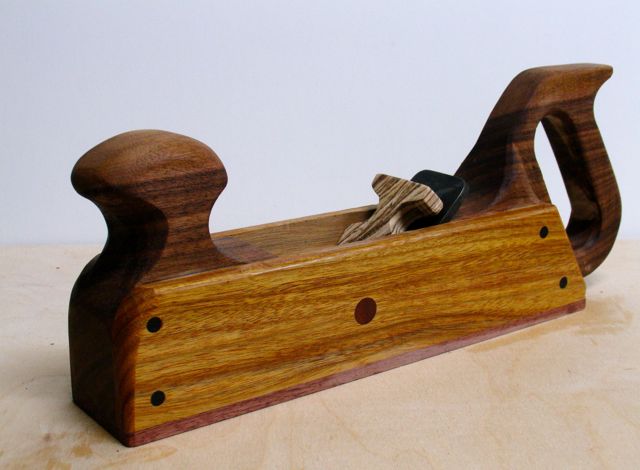
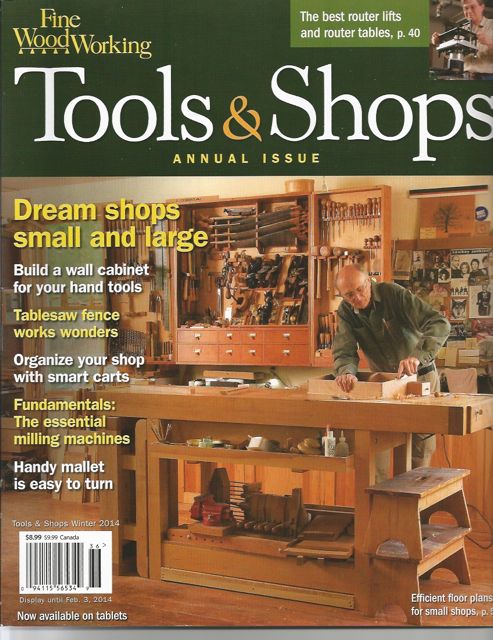
Tools & Shop 2014Recently I was honored to have the scrub plane you see in this picture accepted into the Reader’s Gallery section of Fine Woodworking.  The issue is their annual Tools & Shop edition and it should be on the newsstand by the end of this month.  It’s been over a year ago but there was an email invitation from Fine Woodworking where they asked readers to submit tools that were shop made.  As it turned out, I had recently built this plane which uses a Ron Hock radiused blade and is roughly patterned after a James Krenov style plane.  I was happy with my tool so decided to submit it to them.

It has been modified from the Krenov style with the handle (tote) at the rear which is patterned more like a backsaw handle plus the knob on front.  This knob is somewhat off center but was formed to feel right in my hand while using the tool.  My reasoning for the design was that for scrubbing work you need to really get a good grip on the tool; something the typical Krenov style plane didn’t provide.  As it turns out, I taught a class on making a block plane based on the Krenov design.  The students used blades from Ron Hock with their own wood and others bought the complete kit he offers on his website.  The class was taught at Wooditis, a woodworking school here in Las Vegas.  One of the students replicated my design to make his own scrub plane.

It gets a bit long but for those of you that may be interested in the construction of this plane I documented it on my old Blogger site.  Included is the first project and a “how to” on using the plane.  Here’s a LINK to that series.

Posted in Uncategorized | Tagged , , , , , , | 4 Comments

Mortises Two Ways

Well, I suppose this title shows you I’ve been watching too many episodes of Chopped where they prepare the mystery basket ingredients two ways!  While finishing up the last series of boxes I needed to cut mortises for the lid lifts and the hinges so I’ll use this as a tutorial to share my method.  What is a mortise?  well here’s a definition found on line:

 Babylon English Dictionary:  recess or groove in a piece of wood or another material that fits together with a corresponding projecting piece of material; connection, joint

Usually when you think of a mortise the corresponding part (tenon) immediately comes to mind.  However, butt hinges need to mortised in and going by the definition above; anytime you cut a slot, recess, gain, etc. to fit wood together you have a mortise.  Here are two pictures of the Black Limba box just completed:

These were taken with my iPhone and it’s my first ever cell phone so still working on the quality but it does show the completed projects which will go on my Etsy store as soon as I get the photography work done.

Let’s get into the mortises, the largest and most time consuming ones were those required for the lid lift.  I used a piece of Ebony that I have and let it determine the size of the lift.  Decided this should be cut out using hand tools, really; anything this small would be dangerous to attempt on power tools.  The only exception to this was after cutting the step on them while the stick was still around 16″ long, I used the chop saw to cut them to length.  It leaves a finer finish than a tenon saw.

After using the marking gauge to outline the area that needed to be removed, chalk was rubbed over it.  After wiping it from the surface a bit of it remained in the scribed lines that allowed me to see what I was cutting.  Once cut, they were squared with a chisel.  Now it was time to locate them on the underside of the lid and remove the material.  This is the mortise, hand cut way in a pictorial tutorial.

Process begins by locating lift at the center and scribing it’s location.  I tend to scribe one side and then move the lift ever so slightly to cover that first scribed line. Now when I scribe the opposite side it’s slightly undersized which leaves you some material to carefully pare away for a tight fit.

WoodworksbyJohn-CustomWoodworker-LasVegas-Mortises-1Next I prefer to use a small router plane to scribe the depth.  It’s the best way I’ve found to keep from scribing a line that is longer than the mortise.  If you angle the plane you can see the lines you scribed to outline the lift.

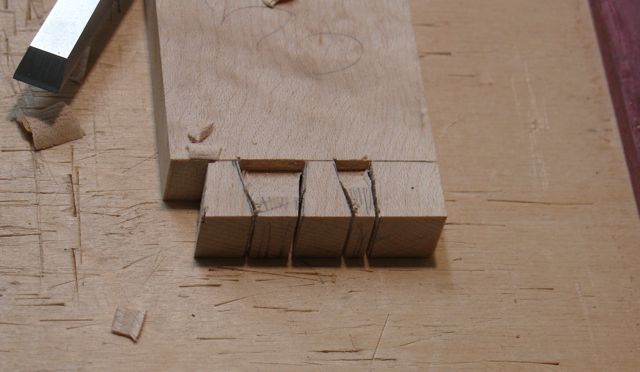
WoodworksbyJohn-CustomWoodworker-LasVegas-Mortises-2Before using the dovetail saw to outline the side I use a chisel to remove a wedge of material the same way I would do for chiseling dovetails.  You’ll see that by creating a square shoulder it’ll be easier to start your saw.  In such a shallow cut I find it’s better to rely on muscle memory to saw square than to scribe a line that will probably go beyond the depth line.

Notice the wedge removed with chisel prior to sawing.

Notice the wedge removed with chisel prior to sawing.

Once those cuts are made, make a series of cuts just shy of the the scribed depth line with your saw, this makes chiseling out the waste easier.

WoodworksbyJohn-CustomWoodworker-LasVegas-Mortises-4Once that material is chiseled out all that remains is to smooth out the bottom of your mortise with the small router plane, this is a Stanley 271.

WoodworksbyJohn-CustomWoodworker-LasVegas-Mortises-5Final fitting, glue, clamp, and you’re done!

WoodworksbyJohn-CustomWoodworker-LasVegas-WorkBenchThat’s the hand cut way, for the hinges I use a small trim router with a ball bearing guided bit and a jig.  By the way, here’s what my work area looks like when I do these types of things.  Being in my sixth decade the back and eyes aren’t what they  used to be!  This is the carving bench that’ll save your back because you don’t have to bend over all day.  I use this for carving, cutting dovetails, and any other work where I need to position the work higher.  The light is an LED one that slips over the dowels that normally hold my coping saw.


WoodworksbyJohn-CustomWoodworker-LasVegas-Mortises-6


For these boxes I used  Rocklers #48106 which although a far cry from the quality of Brusso hinges is about 1/4 the cost so for work like this more than acceptable. It stays open at 105 degrees or so making it ideal for this application. At this level of quality (China’s finest)  they can have a bit of variation in length so the jig is slightly smaller than the hinge.  This gives me room to fine tune its location if needed.  As long as the outside edge of the hinge is consistent on the box and lid, fitting them together goes well.  I scribe a line from the outer edge of the box/lid and set the jig there to keep that measurement the same.

WoodworksbyJohn-CustomWoodworker-LasVegas-Mortises-7After routing, all that’s required is squaring the radius created by the bit, pre-drill the mounting holes, and attaching the lid and box together.  After using these hinges for some time now I haven’t had any complaints from my customers regarding the quality or performance.  The only negative thing I can think of is that they’re only available in 2 and 8 inch lengths.


Posted in Lidded Finger Joint Box, Lidded Finger Joint Box, Tutorial, Types of Boxes | Tagged , , , , , , | 3 Comments

Macacauba Box Complete

Ever find that whenever you think you’ve completed a project you stop and say “‘except for ……..!”  That’s what just crossed my mind as I put in the title to this post.  I need to line the bottom of the box before I can ship it out.  I just configured a shipping box for it and just came back from Home Depot since I’m out of the styrofoam sheets I use for packing material.  Anyway, other than the bottom being lined, here’s the completed box:

Macacauba Box- WoodworksbyJohn-LasVegas

The final steps to this were to insert the brass screws and then file them down after snipping off the heads.  As you recall, all of the holes were pre-drilled before the box was assembled using a jig on the drill press that located them exactly.  My personal thoughts are that this small, brass detail adds a lot to the over-all appearance of the box.

WoodworksbyJohn-Macacauba-SpecialOrder-3Here you see a sequence of how it goes.  I must admit that I’m super cautious when screwing in the brass screws.  Brass is a pretty soft material to begin with and then add to that the cheapest brass the Chinese can find and you have a snapped screw in the making! I always pre-drill and bees wax for any screw but since the box is unfinished didn’t use the wax on this.  It wouldn’t be a major problem if the screw were to snap except on those rare occasions it’s done that it snapped below the surface so there was a slight divot. The two on the right are obviously uncut, the next one down has been cut with the nippers and the last one has been filed flush.  Before sanding I blow the brass skewings off so they won’t get embedded into the wood.

The final step after sanding was to apply the shellac.  I mix my own from flakes to keep it fresh then use an airbrush to apply multiple coats.  For this series of boxes I used an ultra blonde shellac to preserve the beautiful coloration of the wood.  After an initial coat the finish is lightly sanded with 400 grit paper, blown off, and then more coats are applied.  I like to wait at least 3 days before using Liberon wax and a white scotch pad to rub out the finish.  Here’s a photo of the four boxes built in this series, with the lids propped open kind of looks like a used car sales lot!

The Macacauba box is headed to my customer in Ohio and the others will go on the Etsy store.  The Black Limba boxes will be hinged with some stop hinges I have that are also black.  The coloration of this wood has a greenish tint to it which I find appealing — anxious to see what the public reaction will be to them.

Posted in Lidded Finger Joint Box, Lidded Finger Joint Box, Types of Boxes, Uncategorized | Tagged , , , , , , , | Leave a comment

Kaizen Foam

KaezenFoam-Iphone-2Have you ever wanted to fit something securely into a box or drawer but didn’t have the time, skill, or inclination to go the traditional French Fit style?  Well then, you need to know about Kaizen Foam.  Before I switched to WordPress from Blogger I published a post regarding this material.  In it I used the foam to make inserts in my tool chest for my dovetail saws and planes.  Crazy stuff, check out this LINK to that blog.
We recently joined up with the 21st. century and purchased cell phones.  One of the many things that lead up to this decision was the recent art festival and needing a way to take payments at an event like that.  I’m sold on the iPhone 5C that we both got and will find more uses for it the longer I have it.  One of the really neat features is being able to get turn by turn directions.  We have a Garmin but it’s so old that it was beyond updating so these will replace that without any problem except where to put the darn thing when you’re driving.

KaezenFoam-Iphone-1Nevada has a “no-phone” law so holding wasn’t an option even if I could put up with the distraction.  After doing a web search for various ways to hold your phone in the car I decided to go to Best Buy and see things first hand.  Not wanting to attach a suction cup to the windshield and having it interfere with my vision plus bake in the sun that wasn’t an option.  I chose a suction cup device and after settling on a fairly good location for it, stuck it on in the parking lot.  Well, three turns out of the lot and two tumbles off of the dash it was time for a refund and some head scratching.  As you can see in the picture, the console on the Tacoma has a rectangular opening next to the shift.  Good place for change but the phone moves too much in there.  Didn’t care too much for the sound of it banging against the sides.  As I was driving home it dawned on me that I have some of the foam left over and maybe I could do the Dutch guy solution (thrifty not cheap!) and make it work.  This photo shows how it looks from the passenger side.

The solution was surprisingly simple.  After cutting the foam to fit snugly into the rectangular opening of the console and reducing its thickness it was a matter of tracing the phone and cutting it out.  There aren’t any in progress photo’s but I put a layer of tape on the foam so I could trace the outline of the phone.  Next up the depth was cut on the side that would be closest to the driver followed by making a slanted cut to tilt the phone into my line of vision.  The foam cuts easily and I added a slightly deeper cut at the bottom of the angle to help secure the phone.  I gave it the “swerving around the parking lot” test and it stayed in place!  Inexpensive solution to a 21st. Century dilemma!

Kaizen Foam with iPhone

Kaizen Foam with iPhone

Posted in Uncategorized | Tagged , , | Leave a comment